
Best SEO Keyword Research Tools: A True-Cost Buyer's Guide
Forget sticker prices. Calculate Total Cost of Keyword Research — subscription plus your time — and the ranking of the best tools flips hard.
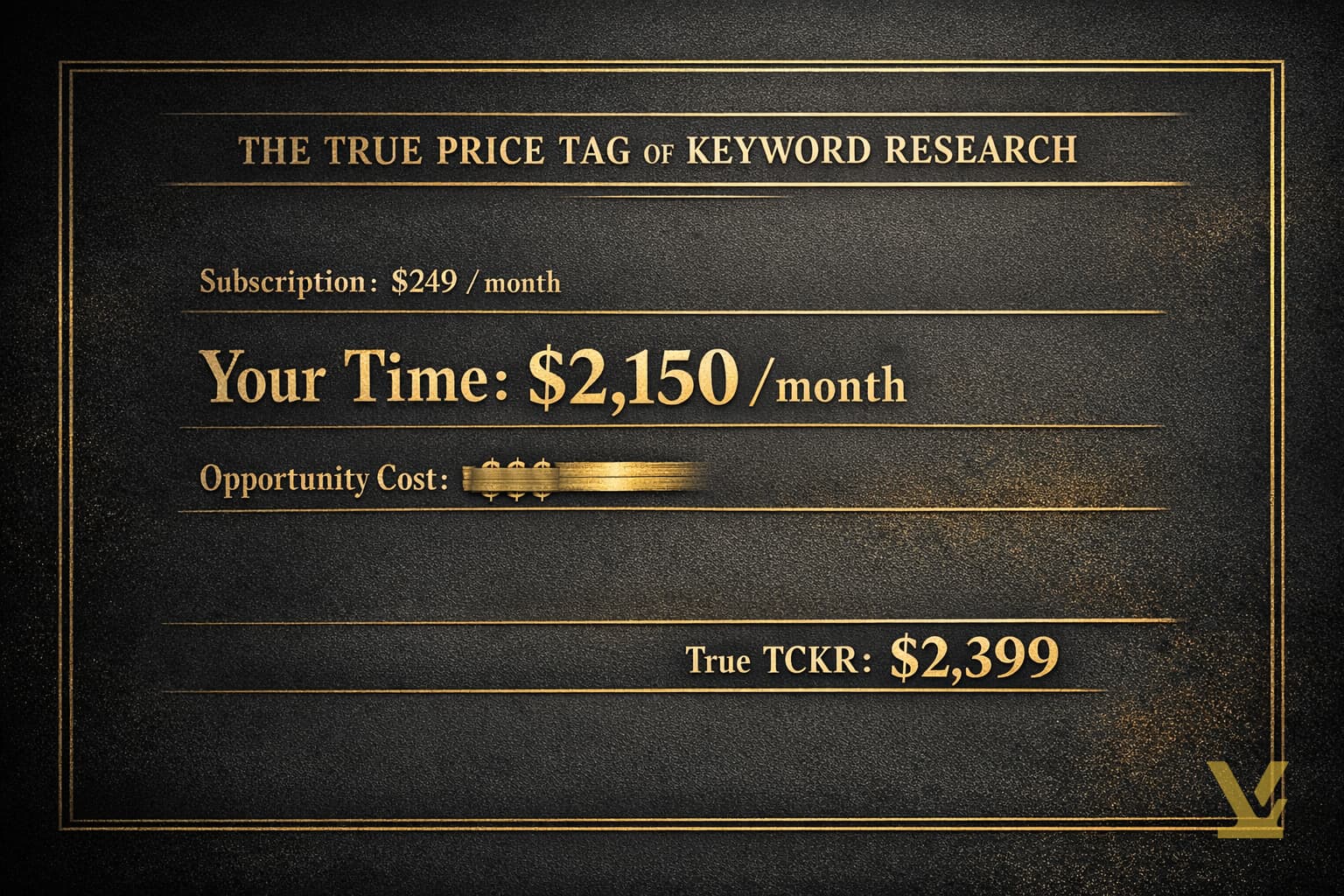
The best SEO keyword research tools are almost never the cheapest. A free tool costs zero dollars per month, but a senior marketer’s hour costs $50–$200. When a free workflow burns ten hours a week, the real invoice lands between $2,000 and $8,000 per month. The dollar line on the receipt is the smallest line.
This guide reframes keyword research around that reality. Call it Total Cost of Keyword Research (TCKR) — subscription dollars plus effort hours plus revenue lost while your content plan sits unbuilt. Once you price your hours honestly, the ranking of best tools flips. Expensive tools become cheap. Free tools become expensive. And a category most buyers have never evaluated — content-opportunity services that ship ranked briefs instead of keyword spreadsheets — becomes worth evaluating.
TCKR: the real price tag on keyword research
TCKR is three lines on one invoice: subscription cost (dollars per month), effort cost (hours per week × your hourly rate × 4.33 weeks), and opportunity cost (revenue lost while content isn't live). Most keyword-tool reviews stop at line one, which is why they're useless for buying decisions.
Worked baseline: Ahrefs' Lite plan is $129/month, Standard $249/month (Ahrefs Pricing). A solo marketer spending ten hours a week pulling volume, clustering, and writing briefs invests ~43 hrs/month. At $50/hour — conservative for SEO-for-profit — that's $2,150/month in effort. True TCKR: $2,300–$2,400/month.
Swap Ahrefs for Google Keyword Planner and thirty browser tabs: subscription $0, easily 15–20 hrs/wk doing manually what paid tools automate. TCKR: $3,000–$4,300/month. Now hire a mid-tier SEO agency at ~$2,000/month (Ahrefs' SEO pricing data); effort drops to two hours a week. TCKR: $2,433/month — nearly identical to the Ahrefs DIY path, but the agency ships more articles. The tool with the lowest sticker price is rarely the cheapest. That's the whole argument.
Quick answer: best tool category by profile and time budget
Scan this before reading the rest. It maps operator profiles to a tool category and a realistic TCKR range, priced at a $50/hour effort rate.
- Hobby blogger (~2 posts/month, pre-revenue, 2–3 hrs/wk): free tools. TCKR $430–$650/mo.
- Solo operator (4–8 posts/month, revenue-producing, 5–8 hrs/wk): mid-tier suite (KWFinder, Mangools). TCKR $1,200–$1,800/mo.
- In-house marketer (single brand, 8–15 posts/month, 8–12 hrs/wk): all-in-one suite (Ahrefs, Semrush). TCKR $2,000–$2,700/mo.
- Content-plan buyer (wants briefs not spreadsheets, <2 hrs/wk): a content-opportunity service. TCKR $500–$900/mo.
- Agency or multi-brand operator (15+ posts/month): enterprise suite plus internal process. TCKR $3,500–$6,000/mo.
- Outsourced strategy (hands-off, 1–2 hrs/wk): SEO agency retainer. TCKR $2,000–$4,000/mo.
Most buyers haven’t priced the content-opportunity service category. These don't compete with Ahrefs on keyword-database size — they compete on what you do with the data. Paste a niche or URL, get grouped ranked opportunities with briefs attached, human- or AI-written. Whether that's cheaper than an all-in-one suite depends on how much of your tooling spend would otherwise reappear as time.
How to choose the right keyword research tool (decision framework)

Most buying guides start with features. That's backward — features are downstream of time. Start with your time budget — the hours per week you can realistically spend on research — then work forward to the tool category that fits.
Define your content goals and keyword criteria
Write your time budget in one sentence: I can spend X hours per week on keyword research and brief writing. Be honest. If you're also running a business, X is probably 2 to 5 hours, not 15.
- 2 articles/month, new niche site: 2–3 hrs/wk. Free tools suffice; anything more is wasted capacity.
- 4–8 articles/month, revenue site: 5–10 hrs/wk. Mid-tier pays for itself — KWFinder at $29–$49/month saves 3+ hours weekly versus free workflows.
- 10+ articles/month or agency: 10+ hrs/wk on research is a losing trade. Go enterprise (Ahrefs, Semrush Pro) with a systematized process, or buy the output — agency briefs or a content-opportunity service.
Feature checklist: data and UX to evaluate
Once the time budget is set, these features actually matter — in this priority order, not the order vendors list them:
- Brief output — does the tool ship writing briefs or just keyword lists? In our trial, attached briefs cut 3–5 hour brief prep to ~30 minutes.
- Clustering and intent labeling — groups related queries automatically. Saves 2–4 hrs/wk per niche.
- SERP feature and difficulty data — realistic opportunity scoring, not raw volume.
- Export or API integrations — pipes research into your CMS without a copy-paste round.
- Search volume accuracy — matters less than buyers assume. Within-category accuracy wins rankings, not single-digit precision.
Pick the tool that scores highest on the top three items you need, not the one with the longest feature matrix. Feature matrices are marketing output, not evaluation criteria.
Free vs paid: hours per week vs dollars per month
The free-vs-paid debate treats subscription cost as the only variable. It isn't. The real trade is hours per week vs dollars per month, and the math is brutal for free tools at any serious publishing volume.
- Free workflow (Google Keyword Planner + manual SERP + Reddit): $0 subscription, 12–15 hrs/wk, effort $2,600–$3,250. TCKR $2,600–$3,250/mo.
- Paid mid-tier (Mangools KWFinder at $49/month): $49 subscription, 5–6 hrs/wk, effort $1,080–$1,300. TCKR $1,129–$1,349/mo.
- Paid all-in-one (Ahrefs Standard at $249/month): $249 subscription, 7–9 hrs/wk (depth = rabbit holes), effort $1,520–$1,950. TCKR $1,769–$2,199/mo.
Free is the most expensive option above two articles a month. Mid-tier wins DIY because it automates clustering without giving you enough toys to get distracted. The upgrade rule: you don't buy a paid tool when you have more money — you buy it when each hour of your time is worth more than the subscription.
Best SEO keyword research tools: what each category delivers
Six buying categories. Match yourself to one — you only need to understand the category that fits your time budget.
- Free tools — Google Keyword Planner, AnswerThePublic free, Reddit, Autocomplete. Raw ideas, high effort. Best for pre-revenue validation.
- Lightweight paid tools — Mangools/KWFinder ($29–$49/mo), Ubersuggest ($12–$40/mo). Cleaner lists with clustering and difficulty. Best for solo operators shipping 2–8 articles/month.
- All-in-one SEO suites — Ahrefs ($129–$449+), Semrush ($139–$499+; Semrush Pricing). Deep keyword data plus backlinks and audits. Best for in-house marketers and agencies needing non-keyword features.
- Enterprise platforms — BrightEdge, Conductor, Seoclarity. AI-driven opportunity identification at scale. Best for teams with dedicated SEO roles.
- SEO agencies — $1,000–$5,000/mo retainer (Ahrefs' SEO pricing benchmarks). Managed strategy and reporting. Best for operators who want to stop thinking about SEO.
- Content-opportunity services — emerging category at $300–$900/mo. Ranked content opportunities with briefs attached, human- or AI-written. The brief-and-research slice of an agency engagement, not a full agency replacement.
Recommended picks by user profile
- Hobby blogger: Google Keyword Planner + Autocomplete. Upgrade at $500+/mo content revenue or 4+ hrs/wk in research.
- Solo operator (4–8 articles/month): Mangools or KWFinder.
- Solo operator who wants to stop planning and start writing: a content-opportunity service. Trade tool evaluation for managed briefs.
- In-house marketer: Ahrefs Standard or Semrush Guru. Add a content-opportunity service for briefs if shipping 10+ articles/month.
- Agency: Ahrefs Advanced + internal process. Consider a content-opportunity service for junior writers' briefs.
- Hands-off operator: SEO agency if budget allows; otherwise a content-opportunity service for managed briefs and lower planning effort, accepting reduced scope.
How to test a tool: a 4-step trial workflow

Free trials are won or lost on how you use them. Most buyers poke at a dashboard for twenty minutes and form an opinion. That opinion is worthless. Run this four-step trial that measures time, not features.
Step 1 — Define a standard test brief (30 min). Pick one niche and one article you actually need. Write target audience, outcome, deadline, and the questions readers must get answered. Every tool delivers against the same brief.
Step 2 — Produce a content plan inside the tool (timed). Stopwatch on. Build a 5-article plan. Record hours to research seeds, cluster, produce briefs (or lists), and export. Honest answers: 4–8 hrs for a paid tool, 12+ for free, under 1 hr for a content-opportunity service.
Step 3 — Score the outputs (45 min). Rate each plan on brief completeness, opportunity quality, and publish-confidence (1–5 each). Do it with a second person — solo scoring is charitable to the tool whose UI you liked.
Step 4 — Compute cost-per-quality-point (30 min). Multiply Step 2 hours × 4.33 × your hourly rate = monthly effort. Add subscription. Divide by scored quality. Lowest cost-per-quality-point wins. Feature lists and podcast endorsements do not.
Pricing and ROI for 2026: the agency math

Worked comparison for a team publishing eight articles a month, valuing time at $50/hour. Numbers are monthly. Keep this open while you evaluate options.
- Google Keyword Planner (free): $0 + 15 hrs/wk × $50 × 4.33 = $3,250 TCKR. Articles realistically shipped: 4–6 (time runs out).
- KWFinder mid-tier: $49 + 7 hrs/wk = $1,565 TCKR. 8 articles.
- Ahrefs Standard: $249 + 9 hrs/wk = $2,199 TCKR. 8 articles.
- Mid-tier SEO agency: $2,000 + 2 hrs/wk = $2,433 TCKR. 8–12 articles.
- Content-opportunity service (managed-brief volume): ~$500 + 1.5 hrs/wk = ~$825 TCKR. 8–12 articles, brief quality varies by vendor.
Free is the most expensive option here — $3,250/month in time, fewer articles shipped. Mid-tier DIY and an agency retainer land in the same $1,500–$2,500 band; the agency absorbs the time. At $75+/hour the agency wins; at $25/hour DIY wins.
Pricing for content-opportunity services follows a different curve. At $300–$900/mo for matched brief volume, TCKR lands around $825 — inside DIY Ahrefs range and below typical agency retainers at matched scope, with brief quality and vendor scope as swing variables. For 2026 contracts, watch annual volume caps, seat-based pricing, and AI-credit metering.
Frequently Asked Questions
Which tool is best for beginners who want quick wins?
Start with Google Keyword Planner and Autocomplete while validating the niche — free and enough to confirm queries exist. Once you commit to publishing regularly, upgrade to KWFinder or Mangools at $29–$49/month. Skip premium suites until you're publishing 4+ articles a month and actually need the depth.
Are free keyword tools reliable, or should I pay?
Google Keyword Planner, AnswerThePublic free, and Reddit surface real queries reliably — data isn't the problem, time is. A $49/month paid tool that saves 3 hrs/wk returns ~$650 in reclaimed time at $50/hour (freelance SEO rate data) — roughly 12× the subscription.
How do I compare keyword data between tools during a trial?
Pick twenty seed keywords. Pull volume and difficulty on the same day. Ignore absolute numbers — they vary 30–50% across tools (Ahrefs' own research acknowledges this). Compare the ranking of the twenty keywords instead. The tool that ranks opportunities closest to your instinct is the one to keep. For the full picture, read our VarynForge vs Ahrefs comparison.
What features matter most for building a large content plan?
In priority order: brief generation, clustering, intent labeling, SERP feature data, difficulty scoring. Raw volume is overrated — within-cluster accuracy wins rankings. If your tool doesn't ship briefs natively, budget 2–4 extra hrs/wk to do that work manually. That's why content-opportunity services command premium pricing despite smaller keyword databases.
How long should I trial a tool before subscribing?
Seven days used intensively on a real project beats a 30-day trial used casually. Run the four-step workflow above. Most decisions are clear by day three. If you're still uncertain after a week, the tool isn't a fit — paralysis is a signal.
How do I estimate a tool's ROI for 2026?
Compute TCKR monthly, divide by articles shipped and quality score, then track published-article revenue over 90 days. A tool that drops TCKR $500/month while keeping article quality returns ~$6,000/year before compounding traffic gains. Tools that don't move TCKR in 90 days get dropped.
Further Reading
- Best keyword research tool for SEO
- Free SEO tools that actually work
- Build a content plan with one tool
- r/Blogging discussion
- The complete VarynForge free tier guide
Sources
- Ahrefs Pricing
- Semrush Pricing
- Mangools KWFinder
- Ahrefs blog: SEO services pricing benchmarks
- Ahrefs glossary: Keyword Difficulty
How VarynForge fits in
VarynForge is the content-opportunity service category referenced above. At $300–$900/mo with managed briefs, it sits between lightweight paid tools and a full agency retainer (~$825 TCKR midpoint). Fit for execution-bottlenecked teams; not a substitute for agency-grade strategy or technical SEO. See current VarynForge pricing. For the enterprise-suite angle, see our VarynForge vs SEMrush comparison.
Conclusion
What is the best keyword research tool has no answer without a time budget attached. Price your hours honestly, calculate TCKR, and the ranking inverts from the typical listicle. Free becomes most expensive. Agencies become competitive.
If your bottleneck is tool evaluation rather than execution, content-opportunity services are worth pricing alongside the agency option. The trade-off is narrower scope — ranked briefs but not the strategy ownership or technical SEO of a full retainer. Run TCKR for your own volume.
Frequently asked questions
Which tool is best for beginners who want quick wins?
Start with Google Keyword Planner and Autocomplete while validating the niche — free and enough to confirm queries exist. Once you commit to publishing regularly, upgrade to KWFinder or Mangools at $29 to $49 per month. Skip premium suites until you are publishing four or more articles a month and actually need the depth. The trap most beginners fall into is paying for an enterprise suite they cannot fill the daily query cap on, while the actual bottleneck is brief writing and shipping articles, not data access.
Are free keyword tools reliable, or should I pay?
Google Keyword Planner, AnswerThePublic free, and Reddit surface real queries reliably. Data is not the problem — time is. A $49 per month paid tool that saves three hours a week returns roughly $650 in reclaimed time at a $50 per hour freelance SEO rate, which is about twelve times the subscription. Free is the cheapest sticker price and the most expensive option above two articles a month. Mid-tier wins do-it-yourself work because it automates clustering without giving you enough toys to get distracted with.
How do I compare keyword data between tools during a trial?
Pick twenty seed keywords. Pull volume and difficulty from each tool on the same day. Ignore absolute numbers — they vary 30 to 50 percent across tools, which Ahrefs has acknowledged in its own research. Compare the ranking of the twenty keywords instead. The tool that orders opportunities closest to your instinct is the one to keep. Within-category accuracy wins rankings, not single-digit precision on volume estimates, so the relative ordering matters far more than the absolute numbers.
What features matter most for building a large content plan?
In priority order: brief generation, clustering, intent labeling, SERP feature data, then difficulty scoring. Raw volume is overrated — within-cluster accuracy wins rankings. If your tool does not ship briefs natively, budget two to four extra hours a week to do that work manually. That is why content-opportunity services command premium pricing despite smaller keyword databases: in our trial, attached briefs cut three to five hours of brief prep down to about thirty minutes per article.
How long should I trial a tool before subscribing?
Seven days used intensively on a real project beats a 30-day trial used casually. Run a four-step workflow: define a standard test brief, produce a five-article content plan inside the tool while timing it with a stopwatch, score the outputs on completeness and publish-confidence, then compute cost per quality point by multiplying hours by your hourly rate plus the subscription cost. Most decisions are clear by day three. If you are still uncertain after a week, the tool is not a fit — paralysis is a signal.
How do I estimate a tool's ROI for 2026?
Compute Total Cost of Keyword Research (TCKR) monthly: subscription dollars plus effort hours times your hourly rate times 4.33 weeks. Divide by articles shipped and quality score. Then track published-article revenue over 90 days. A tool that drops TCKR by $500 per month while keeping article quality returns about $6,000 a year before compounding traffic gains. Tools that do not move TCKR in 90 days get dropped. The sticker price line is the smallest line on the real invoice; the time line dominates above two articles per month.