
How to Have Organic Traffic: Compounding vs Bleeding Content
Most 'how to get organic traffic' guides teach hacks that decay. A compounding content system keeps working — here is how to build one that gets ahead.
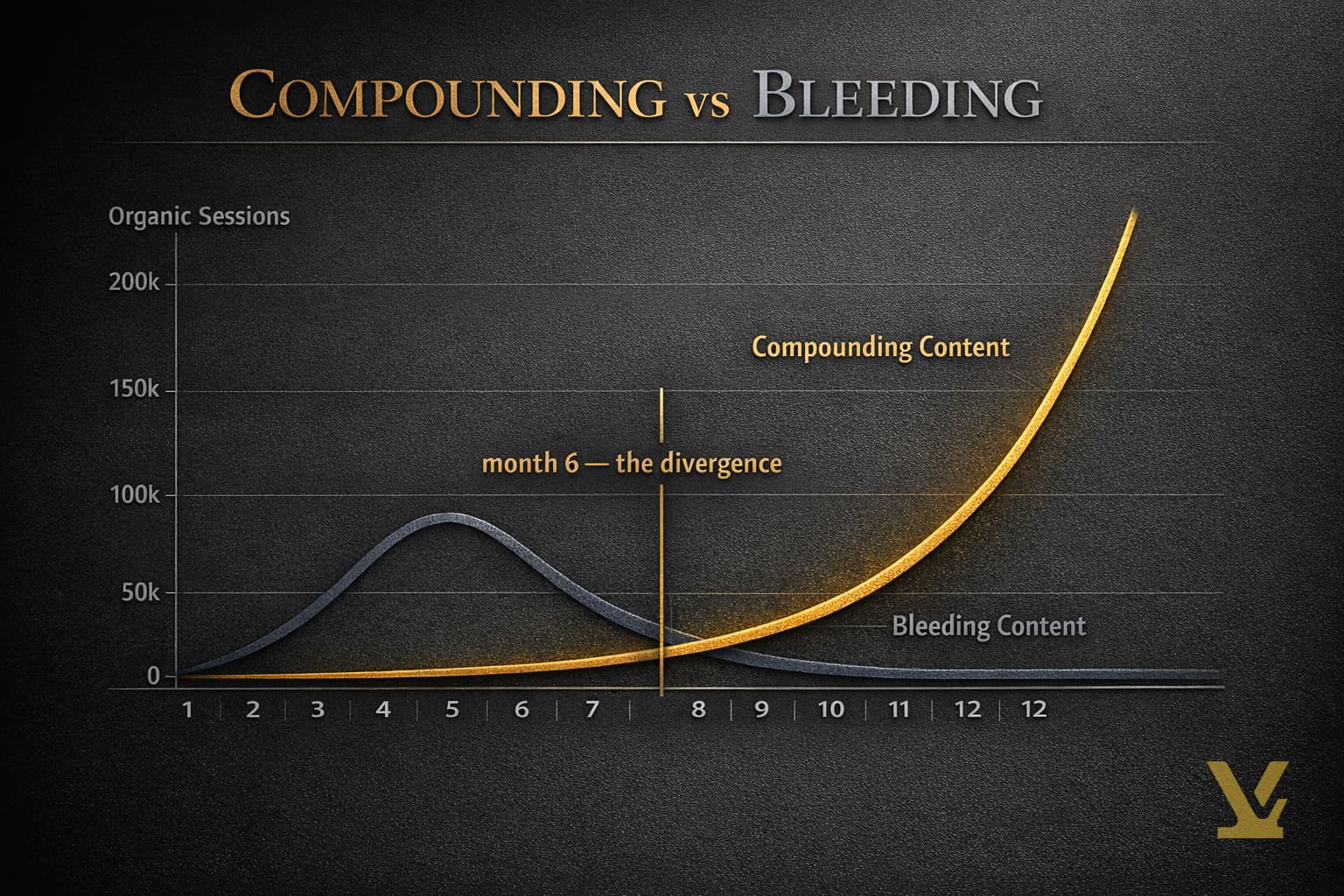
The honest answer to how to have organic traffic is this: stop collecting tactics and start building a system that compounds. Every listicle you've read — Yotpo's 7 strategies, Forbes's 15 low-cost tactics — is a bag of parts. Parts don't ship traffic. A system does.
Here's the frame this article hangs on: every page you publish is either compounding or bleeding. Compounding pages get more traffic every month — they rank for more queries, attract internal links, get refreshed, and turn into assets. Bleeding pages spike once and decay. A repeatable organic-traffic system is engineered to mint compounders and quietly retire bleeders.
Sites that hold organic traffic over years share three inputs: consistency, honesty, and originality. Those are the only inputs that survive Google updates, AI search, and the next tactic-of-the-quarter. The hacks do not. Here's the playbook, the KPIs, and the loop.
What "how to have organic traffic" really asks
Organic traffic is visitors who arrive from unpaid search — Google, Bing, increasingly AI engines like ChatGPT and Perplexity. It compounds because every ranking page earns more links, pulls in more queries, and strengthens topical authority, which in turn lifts the whole domain (Google's helpful-content guidance). Paid traffic, by contrast, stops the moment the budget stops.
The question most readers really mean is: how do I get predictable organic traffic without spending my life on it? That answer is always a system, never a tactic. Ahrefs' 2020 study of 2 million random pages found over 90% get zero organic traffic from Google. The split between the 9% that get traffic and the 91% that don't is not talent or tactics — it's whether the page was produced inside a system or not.
Define a repeatable system: inputs, outputs, and the compounding loop
A repeatable system has three traits: explicit inputs (what goes in), documented processes (what happens to them), and measurable outputs (what comes out). For organic traffic, the shortest honest definition is a closed loop of three inputs that each feed the next. Remove any one and the loop breaks.
- Keyword supply — a pipeline of intent-classified queries your audience actually searches, refreshed on a cadence (monthly or quarterly), not generated once and abandoned.
- Production cadence — a rhythm for turning queries into briefs, drafts, and published pages that a small team can hold for 12+ months without burning out.
- Technical compound — the on-page, internal-linking, and refresh discipline that lets every published page pull traffic for years instead of weeks.
Setting measurable goals and KPIs
Pick three KPIs and ignore the rest until they tell you to look:
- Organic sessions, segmented by page age — total traffic is a vanity number. Traffic from pages >6 months old is the compounding signal.
- Compounding-page percentage — share of your top-50 traffic-earning pages that are still growing month-over-month. Healthy sites sit above 50%.
- Publish + refresh cadence — raw output alone rots. Pair X new pages per month with Y refreshed pages per month, and hold both.
Everything else (CTR, bounce, time-on-page) is downstream. If compounding-page % drifts below 40%, your system is drifting toward bleeding. Fix the inputs before chasing the output.
Keyword research and content planning: the repeatable process

Keyword research is only valuable if it feeds the loop on a schedule. A one-off spreadsheet is a bleeding asset. The repeatable pattern is four steps, every month or quarter:
- Discover — pull seed queries from your current rankings, competitor keyword gaps, and community sources like Reddit and forum threads your audience actually reads.
- Prioritize — score each query on intent-fit, realistic difficulty, and traffic value. Drop anything below a threshold. Ruthlessly.
- Map — assign each surviving query to one target page (new or existing). One page, one primary query. Stop splitting authority across five thin pages.
- Calendar — drop the mapped queries into a dated editorial calendar with brief owner, draft owner, and publish date. If it is not on the calendar it does not exist.
This is upstream of the writing itself. A keyword list alone leaves most of the planning work on your plate. Whether you handle Discover, Prioritize, and Map manually in spreadsheets or with planning software, the discipline is the same: classify intent, score difficulty, map each query to a page type before drafting.
How to use keyword intent to prioritize topics
Classify every query into one of four intents: informational (learn), navigational (find a specific brand/page), commercial (compare options), transactional (buy). Map intent to page type: informational → blog posts; commercial → comparison and "best X" pages; transactional → product and pricing pages. A blog ranking for a transactional query converts worse than a pricing page ranking for the same query. Stop fighting the intent.
Content creation workflow & optimization checklist

Every page that goes live should pass through the same short pipeline: brief → draft → on-page check → internal links → publish → schedule refresh. No step is optional — the skipped one is where bleeding starts.
- Brief — target query, intent, outline with H2/H3 headings, word range, unique angle, 3–5 primary sources to cite, the internal links to weave in. Briefs this tight turn a 6-hour draft into a 2-hour one.
- Draft — answer the primary query directly in the first 200 words. Take a position. Use specific, cited claims. Every statistic traces to a primary source.
- On-page — primary keyword in title, first 100 words, at least one H2. Meta description 150–160 chars with an outcome verb. Slug ≤60 chars.
- Internal links — 3+ links to related pages. Anchor text that matches the target page's primary query, not 'click here'.
- Schedule refresh — every page gets a 90-day calendar reminder. When it fires, check rankings, freshness of stats, new competitor angles. Update or mark for consolidation.
On-page and technical work that helps you have organic traffic
Technical SEO is not a one-time audit. It is a continuous removal of friction between your content and the crawler. Prioritize by uplift-per-hour, not by what's visible in the audit tool:
- Core Web Vitals + mobile UX — Google confirms these as ranking signals (Core Web Vitals docs). Fix LCP first; it moves ranking faster than any other technical fix.
- Internal linking depth — no important page should be more than 3 clicks from the homepage. Pages 5+ clicks deep rarely rank.
- Structured data (Article, FAQ, HowTo, Product schemas) — directly enables rich results and the new AI-overview citations. Cheap to add, high leverage.
- Crawl-budget hygiene — canonicalize duplicates, noindex low-value archive pages, kill zombie URLs. Compounding pages need crawl budget to get re-crawled and re-ranked.
Promotion, link earning, and distribution playbook
Promotion is how a compounding page gets its first push; link earning is how it stays compounding. Match the tactic to the content type:
- Linkable assets (data studies, frameworks, tools) → earn links passively. Do 2–4 per year and actively pitch to reporters and niche newsletters.
- Educational long-form → amplify through newsletter, community replies (Reddit, Slack, Discord), repurposed threads on X and LinkedIn. Do not buy links.
- Comparison and "best of" pages → earn brand mentions by being included in third-party roundups; reach out once ranking is in the top 20, not before.
- Product and pricing pages → not for external promotion. Internal links and conversion optimization only.
Skip paid links, paid guest posts with dofollow links, and PBNs. Every Google core update in the last three years has penalized them. The consistent winners are the pages that earn links because other people want to cite them.
Measurement, iteration, and scaling the system

You measure a system, not a post. Run two cadences in parallel:
- Weekly (15 min) — sessions by source, top-50 keyword positions, flag any page that dropped >5 positions. Nothing else.
- Monthly (60 min) — compounding-page % vs last month, refresh backlog, publish cadence held or missed, one pre-registered experiment result.
Pre-register experiments. Write down the hypothesis, the test page, the metric, and the cutoff date before running it. This kills the post-hoc rationalization that turns every published page into 'a success'. Scale comes from templates, SOPs, and consistency — not from doubling output.
Two small examples. A blog running this system: 4 compounding posts per month for 12 months = 48 pages, of which typically ~15 drive 80% of traffic by month 18. A product landing page running this system: one page, 6 refreshes per year, internal links from every relevant blog post, ranking for 40+ commercial queries by year two. Both outcomes from the same loop.
Frequently Asked Questions
What is a repeatable system for organic traffic vs a list of tactics?
A list of tactics is 'try these 15 things'. A repeatable system is 'do these 3 things on this cadence, measure these 3 outputs, refresh this way'. Tactics hope something sticks. A system guarantees compounding across months, because every step feeds the next and nothing is optional.
How long does it take to see results?
Honest answer: 3–6 months to see a trend on a new site, 6–12 months for the compounding curve to inflect. Sites with existing domain authority see movement in weeks. A year is the realistic horizon; anyone promising faster is selling a hack that will decay.
Can I get organic traffic for free?
Nothing is free — you pay in dollars or in hours. Google Keyword Planner, AnswerThePublic free tier, and manual SERP analysis cost $0 but consume 10–15 hrs/week. A $50/month paid tool that saves 5 hrs/week returns $1,000 of reclaimed time at a $50/hr rate. Price your hours honestly before calling anything free.
What is the single most important action to prioritize first?
Fix your compounding-page %. Pick the top 10 pages that earn any traffic at all, refresh them with current stats, add internal links to each from your other relevant posts, and schedule a 90-day refresh reminder. This single pass typically lifts total organic sessions 15–30% within a quarter — more than any new publishing push of the same effort.
How often should I publish new content?
Hold a cadence you can sustain for 12 months without burnout. For most small teams that is 2–4 posts per month. Consistency beats bursts; publishing 8 posts in January and zero in February is worse than publishing 2 every month. Google rewards sustained topical coverage, not one-off sprints.
Which KPIs actually matter?
Three: organic sessions from pages older than 6 months (compounding signal), compounding-page % across your top 50 pages, and publish + refresh cadence. Everything else — CTR, bounce, pages per session — is either downstream or noise. Track three things and act on them.
Should I optimize existing pages or create new ones?
If compounding-page % is below 50%, refresh existing pages until it climbs back. Above 50%, publishing new pages is the higher-leverage move. Rule of thumb: 1 hour of refresh on a page already ranking on page 2 beats 5 hours of new content competing cold.
Further Reading
- How to generate organic traffic
- Grow organic traffic without ad spend
- Types of keywords: intent and long-tail
- r/SEO: Raising organic traffic for a new site
- What are long-tail keywords and why they matter
- How to get more traffic to my website
Sources
- Google Search Central: Creating Helpful, Reliable, People-First Content
- Ahrefs: Over 90% of Pages Get No Traffic From Google
- Google Search Central: Core Web Vitals
- Google Search Central: Structured Data Introduction
- Ahrefs: Internal Links for SEO
How VarynForge fits in
VarynForge handles the upstream half of this loop: niche in, ranked content opportunities with writing briefs out, human- or AI-written. It compresses Discover → Prioritize → Map for teams whose bottleneck is planning, not production cadence or technical SEO. See VarynForge pricing.
Conclusion
The honest answer to how to have organic traffic is slower and less satisfying than any '15 tactics' post will admit: build a system that compounds, run it for a year, and prune the pages that bleed. Every shortcut decays in the next core update. Every compounder still earns traffic three years later.
The rest of the loop — production cadence, technical compound, the refresh schedule — is on you. Consistency is the only unfakeable input. Be honest, be original, keep shipping. The traffic follows.
Frequently asked questions
What is a repeatable system for organic traffic vs a list of tactics?
A list of tactics is try these 15 things. A repeatable system is do these three things on this cadence, measure these three outputs, refresh this way. Tactics hope something sticks. A system guarantees compounding across months because every step feeds the next and nothing is optional. The three inputs are keyword supply on a refresh cadence, production cadence a small team can hold for twelve months, and technical compound through internal linking and refresh discipline. Remove any one and the loop breaks.
How long does it take to see results?
Honest answer: three to six months to see a trend on a new site, six to twelve months for the compounding curve to inflect. Sites with existing domain authority see movement in weeks. A year is the realistic horizon, and anyone promising faster is selling a hack that will decay. Ahrefs studied two million random pages and found over 90 percent get zero organic traffic from Google — the split between the 9 percent that earn traffic and the 91 percent that do not is whether the page was produced inside a system, not talent or tactics.
Can I get organic traffic for free?
Nothing is free — you pay in dollars or in hours. Google Keyword Planner, AnswerThePublic free tier, and manual SERP analysis cost $0 but consume 10 to 15 hours per week. A $50 per month paid tool that saves five hours a week returns about $1,000 of reclaimed time at a $50 per hour rate. Price your hours honestly before calling anything free. Most operators discover the truly free option is the most expensive once they account for the time cost of doing manually what paid tools automate.
What is the single most important action to prioritize first?
Fix your compounding-page percentage. Pick the top ten pages that earn any traffic at all, refresh them with current stats, add internal links to each from your other relevant posts, and schedule a 90-day refresh reminder. This single pass typically lifts total organic sessions 15 to 30 percent within a quarter — more than any new publishing push of the same effort. Refreshes preserve the link equity those pages have already accumulated, which a brand-new article does not have on day one.
How often should I publish new content?
Hold a cadence you can sustain for 12 months without burnout. For most small teams that is two to four posts per month. Consistency beats bursts: publishing eight posts in January and zero in February is worse than publishing two every month. Google rewards sustained topical coverage, not one-off sprints. The system here is built around the cadence you can hold for a year, not the cadence you could hit for one good week. Match your publishing rate to whichever number stays true through a busy quarter.
Which KPIs actually matter?
Three: organic sessions from pages older than six months as the compounding signal, compounding-page percentage across your top 50 pages where healthy sites sit above 50 percent, and publish plus refresh cadence held month over month. Everything else — click-through rate, bounce, pages per session — is either downstream or noise. Track three things and act on them. If compounding-page percentage drifts below 40 percent, your system is drifting toward bleeding and you should fix the inputs before chasing the output.
Should I optimize existing pages or create new ones?
If compounding-page percentage is below 50 percent, refresh existing pages until it climbs back. Above 50 percent, publishing new pages is the higher-leverage move. Rule of thumb: one hour of refresh on a page already ranking on page two beats five hours of new content competing cold. New pages have to earn link equity from scratch; refreshes inherit signal already in Google's index. Ration your hours to the higher-return move based on what your current top-50 distribution actually looks like.