
Competitor Page Analysis SEO: How to Tear Down a Top Page
A paste-ready LLM prompt that turns any competitor URL into a structured teardown with strengths, the angle, and a brief in under five minutes.
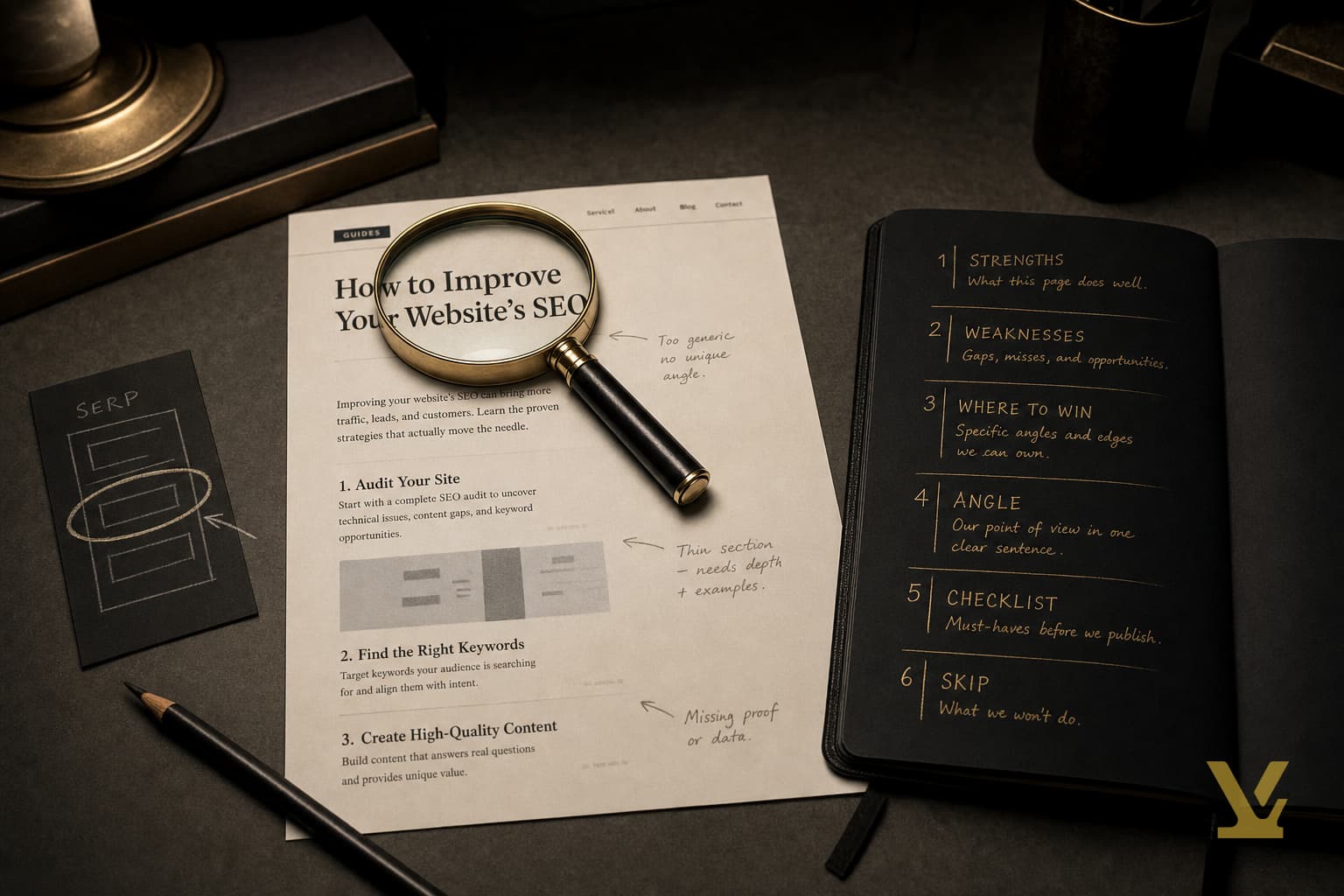
Solid competitor page analysis SEO work pays better than another keyword research pass. A competitor page at position one is a finished experiment: the titles, headings, entities, internal links, and images have been graded by Google in public. Reverse-engineer it well and you walk out with the angle, the gap, and the brief for an article that beats it.
This guide hands you a paste-ready LLM prompt that turns any competitor URL into a structured teardown in under five minutes. No SEMrush. No Surfer. You give the model the URL, your niche, and the keyword; it returns strengths, weaknesses, where you can win, an article angle, and a quick-win checklist.
Why competitor page analysis SEO beats one more keyword pass
Keyword research tells you what to write about. Teardowns tell you how the page that already wins is built. Small sites mistake the first for the second and ship one more "ultimate guide" that ranks at position 27.
A position-one page has cleared Google's bar for that query — relevance, depth, entities, link equity. Treating it as a public spec sheet is faster than guessing. The four-layer Ranking Signal Stack that drives Google search ranking today rewards pages that resolve the searcher's job better than the current winner. You have to read the current winner before you can beat it.
The cheap version of this loop — read three top-rankers, swap a paragraph, ship — is what AI content farms do, and it is why most of those farms slid out of the index in the last two refreshes. Real teardowns extract the structure and replace the thesis.
Pick the right competitor before you tear anything down
The mistake here is picking a competitor by gut — usually the brand your CEO mentioned once — instead of by who actually wins the SERPs you care about. Two free workflows, ten minutes each:
- Search your three core money keywords. Use an incognito window. Note the top-three organic domain for each. Domains that show up in two or more lists are your real SEO competitors, not the brand competitors you talk about internally.
- Use Google's "related:" operator. Paste related:competitor.com into Google. Google groups sites by topic and link graph; three or four will surprise you and at least one becomes your next teardown target.
A SERP-clustering tool can do this work for you — group the SERPs of your seed keywords and rank the domains that recur across the cluster. Same artifact, sortable and clickable. Until you have one, the two manual workflows above land you in the same place in twenty minutes.
Pick one URL per teardown. Two URLs in one prompt dilutes the output: the model averages across them and you lose the specifics.
Running the "Tear down a competitor" prompt

The prompt has one job: turn one URL into a structured teardown a writer can act on. Inputs are minimal — niche in one sentence, target keyword, and the URL. Output is fixed-shape so two teardowns are comparable.
Here is the prompt verbatim. Copy it.
"You are an SEO competitive analyst. My niche: [one-sentence niche]. Target keyword: [keyword]. Competitor URL: [paste URL]. Read the page (or the cached version) and return six sections. Section 1 — Strengths: list the three things this page does better than a typical position-one ranker for this keyword, with one-line evidence each. Section 2 — Weaknesses: list the three weakest spots (thin sections, missing entities, dated stats, weak internal links, format mismatches), with one-line evidence each. Section 3 — Where I can win: name two specific angles a smaller site could realistically beat this page on, given my niche. Section 4 — Article angle: one-sentence positioning line for my replacement article that is different from the competitor's H1. Section 5 — Quick-win checklist: five concrete on-page things my version must do, ordered by impact. Section 6 — Skip list: two things this page does that I should NOT copy because they would not fit my niche. Do not invent traffic numbers. Do not recommend SEO tools."
The constraints matter. "Do not invent traffic numbers" stops the model from hallucinating estimated visits — a documented LLM failure mode. "Do not recommend SEO tools" keeps the output on the page in front of you instead of pivoting to a vendor list.
Free Claude, ChatGPT, and Gemini all handle the prompt. Browsing models produce stronger Section 1 and 2 results; non-browsing models pull from cache or ask you to paste the page text. Either is fine — structure is what matters.
What the teardown output includes (and how to read it)

Read the six sections in order. Skip ahead and you risk writing a thesis the SERP will not support.
- Strengths. The three load-bearing things you must match. If the competitor has a custom diagram, your version needs an equivalent visual, not the same one.
- Weaknesses. The opening. Look for missing entities — named tools, studies, people — that a sophisticated reader expects. Look for stats older than 18 months and thin sections under 100 words.
- Where you can win. Two angles, not five. A model that gives you ten "wins" is hedging; force it to two with "give me only the two strongest angles."
- Article angle. One sentence. This is the H1 in disguise. If you cannot defend it in one sentence, your article does not have a thesis yet.
- Quick-win checklist. Five on-page items. Use it as brief input. Add structural items the prompt cannot see — your internal link plan, your seed-to-target keyword pipeline, your CTA — on top.
- Skip list. The discipline section. The most common entry is a long product comparison the competitor uses to convert their audience that would not match yours.
Tear down three URLs for one keyword and the strengths and weaknesses overlap. That overlap is the spec for the article.
Running the prompt against a real competitor URL
The screenshot below shows this prompt running inside ChatGPT against a representative top-three ranker in the SaaS analytics space. Niche line: "B2B SaaS analytics for product managers." Target keyword: "product analytics dashboards."
Section 1 calls out the page's strongest move — a custom diagram of the analytics stack — as a strength to neutralize, not copy. Section 2 flags two thin sections and one entity gap (the page does not mention the open-source incumbent, which a sophisticated reader expects). Section 3 proposes two angles aimed at narrower personas. Section 4 lands the angle in one sentence.
The model never estimated the competitor's traffic — the prompt forbade it. The Skip list caught a feature comparison block that would not fit a smaller site's funnel. The angle in Section 4 is genuinely different from the competitor's H1 — not a synonym swap, a different framing of who the page is for. That last point is the load-bearing test for whether the teardown produced a brief or just a rewrite.
If the output reads like a paraphrase, the niche line is doing too little work. Rewrite it with one specific reader pain — "PMs who replaced their first SQL dashboard last quarter" — and rerun.
Turn the teardown into a brief: what to prioritize
The teardown is brief input, not a brief. The order of operations:
- Lock the angle first. Section 4 becomes the working H1. Every later section is graded against it.
- Build the H2 outline from the weaknesses + your angle. Each weakness from Section 2 is a candidate H2 — that is where you outperform.
- Match intent before drafting. Run a fast check with our guide to determining search intent for keywords. The teardown gives the spec; intent confirms the format.
- Pull entities from Section 2 and 5 into a "must mention" list. Most teardown briefs leak here — the writer ignores the entity list and the article reads thinner than the competitor.
- Add the internal link plan separately. Pick three to five existing posts to point at, anchored on low-competition keyword targets. The teardown cannot see your domain.
- Run a content gap audit on the cluster. One teardown is the first article. A free content gap audit across the cluster is the strategy.
Do this in 5 minutes: competitor page analysis SEO on one URL

Right now, before you close this tab.
- Pick one keyword from your editorial backlog. The one you were about to brief next.
- Find the position-one URL. Search the keyword in incognito. Copy the top organic URL. Skip ads and AI Overviews.
- Open ChatGPT, Claude, or Gemini. Paste the prompt above. Fill in your niche, the keyword, and the URL.
- Read the six sections. Note the angle in Section 4 and the checklist in Section 5.
- Update the brief. Replace the working H1 with Section 4. Add entities from Sections 2 and 5.
Under five minutes. You just turned a static SERP into a working brief that points at the article that can beat the current ranker.
Weaknesses and drawbacks of the free LLM teardown
The prompt is good. It is not magic. Two honest limits worth naming before you scale this beyond a handful of teardowns.
Where the free LLM approach falls short
- Browsing is approximate. The model is not really opening the URL — it is leaning on training data and, in browsing mode, a fetched snapshot. Competitors that are not well-represented in that snapshot get a generic, hand-wavy teardown.
- One URL at a time. Mapping a full competitive landscape this way is a manual round-trip. Fifteen URLs is a focused afternoon, not five minutes.
- No SERP context. The prompt can describe what a page appears to be about. It cannot tell you which queries the competitor actually wins, where they rank, or how much of your niche they cover.
- No authority signal. Domain rating, backlink profile, and traffic estimates are unknowable from a URL alone. You cannot tell whether the page is winning on merit or on muscle.
- Recent updates are invisible. Price changes, new pages, refreshed copy, or a pivot that happened after the model's training cutoff will not show up in the teardown.
The honest line: the free prompt is a strong way to dissect one competitor when you already know who matters. The moment you need breadth, freshness, or ranking context, you have outgrown the LLM-only workflow.
How VarynForge fits in
Running one teardown is easy. Running fifteen across a full cluster, keeping the outputs side by side, and turning them into briefs is the harder problem. VarynForge ships the "Tear down a competitor" prompt in a saved library alongside six others, pulls competitor URLs straight from the Companies tab, and pipes every teardown into the free brief generator (ten briefs per 24 hours, no credit card). Create a free VarynForge project to run teardowns against your real competitor list and turn the outputs into briefs without paid tools.
Frequently Asked Questions
Is competitor page analysis SEO different from a content gap audit?
Yes. A teardown is a single-URL deep read — strengths, weaknesses, angle, brief. A content gap audit is a cluster-level survey across three to ten URLs mapping which sub-topics every winning page covers and which nobody covers. Teardowns scope one article; gap audits scope a cluster. The two compose: the gap audit picks the URL, the teardown specs the article.
Can ChatGPT really read a competitor URL accurately?
For browsing-enabled frontier models, mostly yes — Section 1 and 2 outputs match what a careful human reader would surface. For non-browsing models, paste the page text into the prompt. Structure is what makes the teardown useful, not the act of fetching. What the model is bad at is estimating traffic or link counts; the prompt forbids those for that reason.
How many competitor URLs should I tear down per keyword?
Three. The strengths and weaknesses overlap across three teardowns reveals the spec for the article. One teardown is anecdote; three is signal. Beyond three the marginal information drops fast — you are in cluster-strategy territory and a content gap audit is the better tool.
Does this work if my competitor has 100x my domain authority?
The teardown still works; the angle changes. Against a high-authority competitor you cannot win on the head term — you compete on the long tail of the same intent and link your way back to the head over time. A free keyword research workflow paired with the teardown surfaces those long-tail variants.
How often should I rerun a teardown on the same competitor?
Every six months for a stable SERP, sooner after a major Google update or after the competitor publishes a refresh. If the competitor's H1 or top-three H2s changed, your teardown is stale and the brief downstream of it is too. Two minutes to rerun.
Further Reading
- Free Content Gap Audit: A 30-Minute Workflow With Just an LLM
- How to Determine Search Intent for Keywords (5-Minute Method)
- The Free Keyword Research Tool Alternative That Actually Ships Briefs
- Google Search Central — Creating helpful, reliable, people-first content
- Competitor Analysis: The Definitive Guide — Backlinko
Sources
- Google Search Central — Helpful content guidance
- Google Search Central — Structured data documentation
- Google Search Console — About page
- VarynForge — Google SEO: How to Optimize for Google Search and Improve Rankings
- VarynForge — Keyword Research for SEO: From Seed Terms to High-Intent Targets
Conclusion
Competitor page analysis SEO is the cheapest leverage left in the stack. The position-one page is a finished experiment; reading it carefully beats running another keyword research pass. Five minutes with a structured prompt gives you the strengths to match, the weaknesses to exploit, the angle that counter-positions, and the brief that ships. Skip the work and you ship a thinner version of a page already at the top.
Pick one URL today. Run the prompt. Update one brief. Then run the same teardown against the next two URLs in the SERP and let the overlap in strengths and weaknesses spec the article that beats all three.
Frequently asked questions
What is competitor page analysis in SEO?
Competitor page analysis in SEO is the practice of reverse-engineering a top-ranking page on a target keyword to learn why Google rewards it and where you can outperform it. The article uses a paste-ready Tear down a competitor LLM prompt that takes one URL, a one-sentence niche line, and the target keyword as input and returns a six-section teardown. The teardown includes strengths, weaknesses, where you can win, the angle for your draft, a quick-win checklist, and a skip list of what not to copy. The whole loop runs in under five minutes.
How do I tear down a competitor page in five minutes?
Open the position-one ranker for your target keyword, copy its URL, and feed it to the article's Tear down a competitor prompt with your niche line and the target keyword. The prompt returns the six-section teardown in one round-trip on a free-tier LLM. The article emphasizes that the prompt explicitly forbids hallucinated traffic estimates and tool recommendations, which is where most LLM-driven competitor analyses go wrong. The output is a writer-ready brief that names the angle to take and the parts of the competitor's argument to leave alone, ready to drop into an editorial calendar.
What does the teardown prompt return?
Six sections. Strengths name what the competitor does well that you should not try to undercut. Weaknesses name argument or coverage gaps you can credibly close. Where you can win is the strategic angle, the place where your background or product gives you a defensible position. Article angle is the differentiated thesis to brief the writer with. Quick-win checklist is the structural moves like better H2 coverage, sharper definitions, or richer examples. Skip list names traps to avoid, including things the competitor does that work for them but would not work for you. Each section is short and load-bearing.
Can the LLM hallucinate traffic numbers in the teardown?
Yes, and the article guards against it explicitly. The Tear down a competitor prompt includes a constraint that forbids the model from inventing search volumes, traffic estimates, backlink counts, and tool recommendations. Without that constraint, free LLMs cheerfully produce confident traffic numbers that have no basis in real data. The article frames this as the most common reason competitor analysis prompts fail in practice. The fix is in the prompt, not in the model. Once the constraint is in place, the teardown stays grounded in the parts the LLM can actually read: the page itself.
Does the teardown require paid SEO tools?
No. The teardown reads only the competitor URL and the SERP. It does not pull traffic, backlinks, or volume data, and the prompt forbids the model from guessing them. Paid tools add convenience for batch teardowns at scale, but a single competitor analysis runs cleanly on free-tier ChatGPT or Claude. The article positions this as a strategic exercise, not a data-mining exercise. The valuable output is the angle and skip list, which come from reasoning about the page itself, not from dashboards.