
Content Brief Generator Free: Writer-Ready in 60 Seconds
A paste-ready prompt that turns topic, niche, keyword, and outline into an eight-artifact writer-ready brief in sixty seconds. No paid tools.
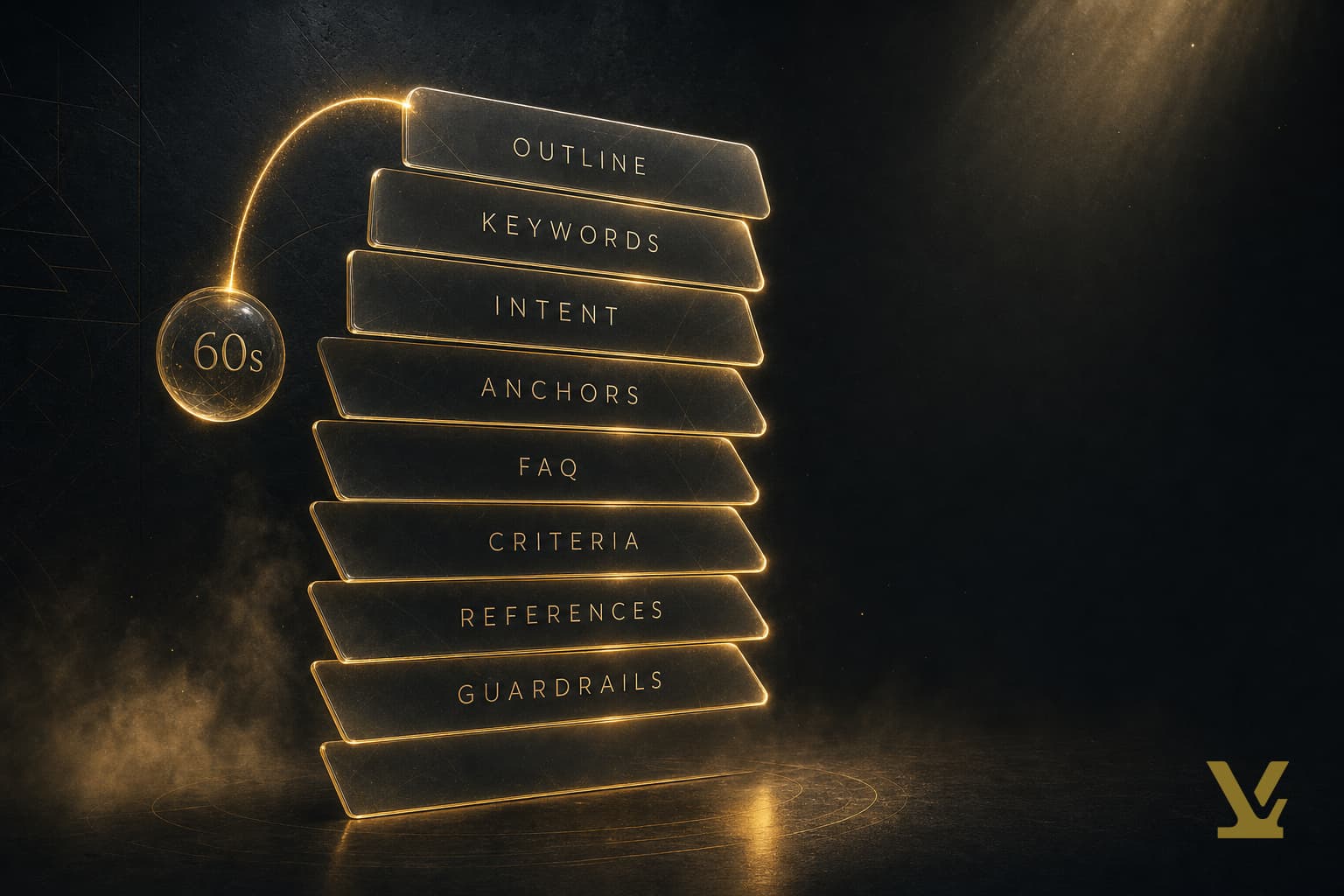
A content brief generator free of paid tools sounds like a stretch — most "free brief" results end with a Google Doc template the writer fills in alone. This guide does the opposite: a paste-ready ChatGPT, Claude, or Gemini prompt that turns one topic, one niche line, one primary keyword, and one outline into the eight-artifact brief a writer can actually draft against. Sixty seconds. No credit card.
The catch most "free brief" guides miss: without structure the LLM hands back a vague summary nobody can write from. Like free keyword research with ChatGPT, the fix is the same — push the labelling work into the prompt.
What a writer-ready content brief actually contains (and why most don't)
A bad brief is a one-paragraph topic and a target word count. The writer reads it, makes ten decisions the editor never wrote down, and the draft comes back generic or off-target. A good brief makes those ten decisions in the brief itself. Eight artifacts, each a different job:
- Outline. H2/H3 skeleton with the order locked in. The writer should not be picking section order at draft time.
- Primary and secondary keywords. One primary, three to five secondaries. The writer knows what the page has to rank for.
- Search intent classification. Informational, commercial, transactional, or navigational. Sets the format and the conversion path.
- Internal-link anchors. Three to five anchors with the section each belongs in. Cuts the writer's research time and protects topic-cluster shape.
- FAQ block. Five questions in the language a real reader types into Google. Doubles as FAQPage structured-data raw material.
- Acceptance criteria. One sentence per H2: "this section is done when X." The editor's checklist; the writer's safeguard.
- Reference reading. Three to five external sources the writer should cite or quote — not a full SERP scrape, just the load-bearing ones.
- Writer guardrails. What to avoid: invented stats, generic platitudes, competitor names you do not want to amplify, voice drift.
Most free brief templates cover three or four of the eight. The writer fills the gaps under deadline pressure. The prompt below produces all eight in one round-trip.

Four input lines: topic, niche, primary keyword, outline
The prompt below is short. The work happens in the four inputs you write before pasting. Each input does a different job, and underspecifying any one makes the brief shallow.
- Topic line. One phrase. "Keyword research for ecommerce founders" — not "keyword research."
- Niche line. One sentence naming the reader and the main pain. "Solo Shopify owners under $500k GMV who do their own marketing and have never paid for an SEO tool."
- Primary keyword. One keyword, classified by intent. Run a five-minute search-intent check first if you have not.
- Outline. Six to eight H2s with key points. If you do not have one, run the five-minute outline prompt first — outline goes in, brief comes out.
The outline is the leverage. Skip it and the LLM invents a generic structure. Pass an outline that names the reader and the angle, and the brief inherits both.
Running the "Generate a writer-ready brief" prompt
The prompt does eight things in one round-trip. Locks the keywords and intent. Restates the outline. Drafts the FAQ. Suggests internal-link anchors. Writes acceptance criteria. Lists reference reading. Sets guardrails. Returns markdown the writer can paste straight into their editor.
Prompt to paste:
- CONTEXT — Topic: <one-phrase topic>. Niche: <one-sentence niche, including reader and main pain>. Primary keyword: <keyword>. Search intent: <informational | commercial | transactional | navigational>. Outline: <paste the H2/H3 outline with key points>.
- TASK — Produce a writer-ready content brief for an SEO article on the topic above, scoped to the niche, targeting the primary keyword.
- STRUCTURE — Return eight sections in order: 1) Reader and angle paragraph (verbatim from the outline if present). 2) Primary keyword + 3-5 secondary keywords (each labelled by intent). 3) Search intent classification with one-sentence justification. 4) The outline restated, with each H2 expanded into 3-5 acceptance-criteria bullets. 5) Internal-link anchors (3-5, with the section each belongs in). 6) FAQ block of 5 reader-grade questions in the language a real reader types into Google, each with a one-paragraph answer. 7) Reference reading (3-5 external sources, with one-sentence relevance note per source). 8) Writer guardrails (4-6 things to avoid: invented stats, generic platitudes, competitor names not to amplify, voice drift, weasel words).
- RULES — No invented search volumes. No invented competitor names. No SEO platitudes. Every secondary keyword must be one a real reader of this niche would type. Every reference reading source must be a domain that actually publishes on this topic. Markdown only, no preamble.
The constraints carry the weight. "Every secondary keyword must be one a real reader of this niche would type" stops the model listing obvious head terms. "No invented search volumes" stops hallucinated KD numbers. Still verify each reference link before the brief leaves your hands.
What the brief looks like when the prompt runs clean
A clean run returns the eight artifacts as one markdown block — usually 700 to 1200 words, long enough to give a writer real direction and short enough for an editor to read in three minutes. The strategic core is the first three artifacts: reader-and-angle, keywords, intent. If those are sharp, the rest of the brief writes itself. The acceptance criteria are the difference-maker: with them an editor signs off section by section; without them the whole article gets re-litigated at QA time. Reference reading does the unglamorous work — for an article on high-intent keyword research, that might be Google Search Central and one or two search-behavior papers — specificity that saves the writer thirty minutes per draft.

Handing the brief to a writer and knowing when the prompt is enough
The output is markdown. Paste into Google Docs, Notion, or a shared <slug>.md file. Add a three-line wrapper: deadline, target word count, and the writer's voice file. None of that comes out of the prompt. The prompt is enough for long-tail informational and niche commercial briefs; for head terms where rankings shift weekly or for YMYL topics, add expert review.
Do this in 5 minutes: a content brief generator free of paid tools

- Minute 0 — Open ChatGPT, Claude, or Gemini. Have topic, niche, keyword, intent, and outline ready.
- Minute 1 — Paste the brief prompt. Fill the CONTEXT block. Hit enter.
- Minute 2 — Skim for hallucinations. Delete invented stats and fabricated competitor names.
- Minute 3 — Verify reference links. Replace internal-link anchors with ones that exist on your site.
- Minute 4 — Add the deadline wrapper. Paste into your editorial tool and send to the writer.
Weaknesses and drawbacks of running a free brief generator
Honest version: brief quality is bounded by input quality. The same agent writes a sharper brief when it has real queries, SERP data, and owned pages to reason about. The brief agent does not change — only the data feeding it does.
Where the free brief falls short
Run any brief generator on a bare title and a sentence of niche context, and the limits show up in predictable places. These are honest gaps in what a model can know without research data behind it.
- Target queries are guesses, not data. The agent only sees the suggestion title plus the niche context you typed in, with no volume, intent, or difficulty behind it.
- Internal-link anchors default to placeholders. Without a crawl of your sitemap, every internal-link suggestion comes back as a "desired" anchor the writer has to convert by hand.
- The reference articles list comes back empty. No SERP data means no top-ranking pages to learn from, so the brief cannot show who is currently winning the query.
- The FAQ block is generated from the title alone. The questions read plausible but are not grounded in real search demand or People Also Ask data.
- Competitor angles are generic. Without identifying who is ranking for your topic, the brief lists generic differentiators instead of mapping real coverage gaps.
- Daily caps are a real ceiling. Free tiers across this category cap usage somewhere — fine for trying the tool, tight if you are briefing a full editorial quarter in an afternoon.
What richer inputs change (same agent, different data)
Each gap above traces back to one thing: the agent is reasoning over thin inputs. Replace the inputs with grounded data and the same agent produces something the writer can use without a second pass.
- Real target queries replace guesses. Volume, intent, and difficulty are attached to each query, so the writer knows what they are optimizing for instead of inferring from the title.
- The reference articles list reflects who is currently ranking. Each entry comes with positions and the queries that page covers, so the brief shows the top of the SERP before drafting begins.
- Internal-link anchors point at pages that exist. When the agent has a crawl of your owned pages, suggestions stop being placeholders and become links the writer can drop in directly.
- Competitor weaknesses surface from real gaps. The brief shows the writer where rivals are thin instead of listing generic differentiators.
- Editorial cadence is no longer rate-limited. Daily caps are a tier issue, not a model issue — workflows that brief many articles per session need plans that match.
The ladder is the same one any team walks: a thin-input brief gets you started; a research-grounded brief is what turns a plausible draft into a writer-ready one.
How VarynForge fits in
Running the prompt once is easy. Running it across thirty topics, persisting every brief next to the suggestion it came from, and handing the markdown to a writer without copy-pasting through three tools is the harder problem. VarynForge keeps the "Generate a writer-ready brief" prompt in a saved library on the Content Plan page — point it at any article suggestion in your project and it returns the same eight-artifact brief in roughly sixty seconds, persisted under the topic and downloadable as markdown. The free tier ships ten briefs every twenty-four hours, no credit card. The cap is a real constraint: at the eleventh brief in a rolling day the daily-cap modal asks you to upgrade to Forge Starter for the higher allowance. Ten is enough for a solo creator running one article a week with margin to spare; a small team running a content sprint will hit the cap. Create a free VarynForge project to use the brief generator.
Frequently Asked Questions
How is this different from a paid brief tool like SurferSEO, Frase, or MarketMuse?
Paid tools add live SERP data and NLP term-frequency scoring. The prompt covers the strategic job — keywords, intent, criteria, FAQ, guardrails — against the model's training data. For long-tail keywords on an early-stage site that is enough; for head terms where rankings shift weekly, pay for a tool.
Can I trust the LLM to write good acceptance criteria?
First-pass criteria, yes. Sharpness, no. Treat them as a draft you tighten by hand — two minutes that saves an hour of QA rewrites.
What if the LLM hallucinates secondary keywords or reference links?
Expect it. Cross-check every secondary keyword against autocomplete and verify every reference link before the brief leaves your hands. Two minutes of cleanup is the only friction in the loop.
Should I run this prompt before or after the outline?
After. The brief prompt needs a locked outline — run it first and the niche line never makes it into the structure. Outline first, brief second. If you are choosing between tools, see our VarynForge vs Surfer SEO comparison.
Key Takeaways
A writer-ready content brief is eight artifacts: outline, primary and secondary keywords, search intent, internal-link anchors, FAQ block, acceptance criteria, reference reading, and writer guardrails. Most free templates cover three or four. The prompt above covers all eight in one round-trip — sixty seconds, no credit card, no SERP scrape — with the niche line and a locked outline as the only inputs that matter.
Further Reading
- How to Outline an SEO Article (5-Minute Free Workflow)
- How to Determine Search Intent for Keywords (5-Minute Method)
- SEO Article Title Ideas Generator: From Outline to Title in 5 Minutes
- Free Content Gap Audit: A 5-Minute Workflow
- Free Keyword Research Tool Alternative: 5-Min ChatGPT Workflow
- Keyword Research for SEO: From Seed Terms to High-Intent Targets
- Best Content Strategy Tools for Faster Briefs and Outlines
- What Is a Content Strategy and How to Create One That Works
Sources
Frequently asked questions
What is a content brief and what makes it writer-ready?
A content brief is the working document that turns a target keyword and angle into a writeable assignment. A writer-ready brief is one where the writer does not have to make strategic decisions during drafting. The article names eight artifacts that every writer-ready brief must contain: outline, target keywords, intent, internal-link anchors, FAQ block, acceptance criteria, reference reading, and guardrails. Anything missing from those eight forces the writer to improvise, and improvisation in execution is where briefs leak quality. The article's prompt produces all eight artifacts in one round-trip.
How do I generate a content brief free of paid tools?
Use the article's paste-ready Generate a content brief prompt with three inputs: the topic, the niche line, and the primary keyword. The prompt runs on any free-tier LLM and returns a single brief covering all eight artifacts in about sixty seconds. The article frames this as the cheapest reliable workflow for producing writer-ready briefs without a paid platform. The eight artifacts are returned in a structured order so the brief can be dropped into a content management system or sent directly to a writer without manual restructuring.
What are the eight artifacts in a writer-ready brief?
Outline names the H2 and H3 hierarchy with section purposes. Target keywords name the primary and supporting terms. Intent names the searcher's job-to-be-done and the SERP format Google rewards. Internal-link anchors name the suggested link targets and exact anchor text. FAQ block lists the reader questions to answer in or alongside the body. Acceptance criteria name the explicit pass-fail conditions an editor will apply. Reference reading names the sources the writer should read before drafting. Guardrails name the constraints, including voice, length, and explicit no-go phrasings. All eight ride in the same brief.
How long does a writer-ready brief take to generate?
About sixty seconds on a free-tier LLM once the three inputs are ready. The article emphasizes that input quality drives output quality. A vague topic and a missing niche line return a brief that is structurally complete but strategically empty. A precise topic and a tight niche line return a brief the writer can execute against without follow-up questions. The sixty seconds is the prompt round-trip. The actual time saved compared to writing each of the eight artifacts by hand is closer to an hour per brief, which is why the article frames this as the highest-leverage prompt in the free-tier workflow.
Why does a brief need acceptance criteria and guardrails?
Acceptance criteria and guardrails are the parts of the brief that prevent silent failure. Without acceptance criteria, the editor has to argue with the writer about whether a draft is finished. With acceptance criteria, the editor checks against the named pass-fail conditions and the conversation stops. Without guardrails, the writer fills gaps with assumptions that may contradict positioning, voice, or product reality. With guardrails, the writer knows which phrasings are off-limits and which constraints are non-negotiable. Both are cheap to specify in a prompt and expensive to enforce after the fact, which is why both ride in the brief.