
How to Outline an SEO Article in 5 Minutes (Free Prompt)
How to outline an SEO article in five minutes using one paste-ready LLM prompt: angle, H2/H3 skeleton, criteria, and reader Q&A block — free.
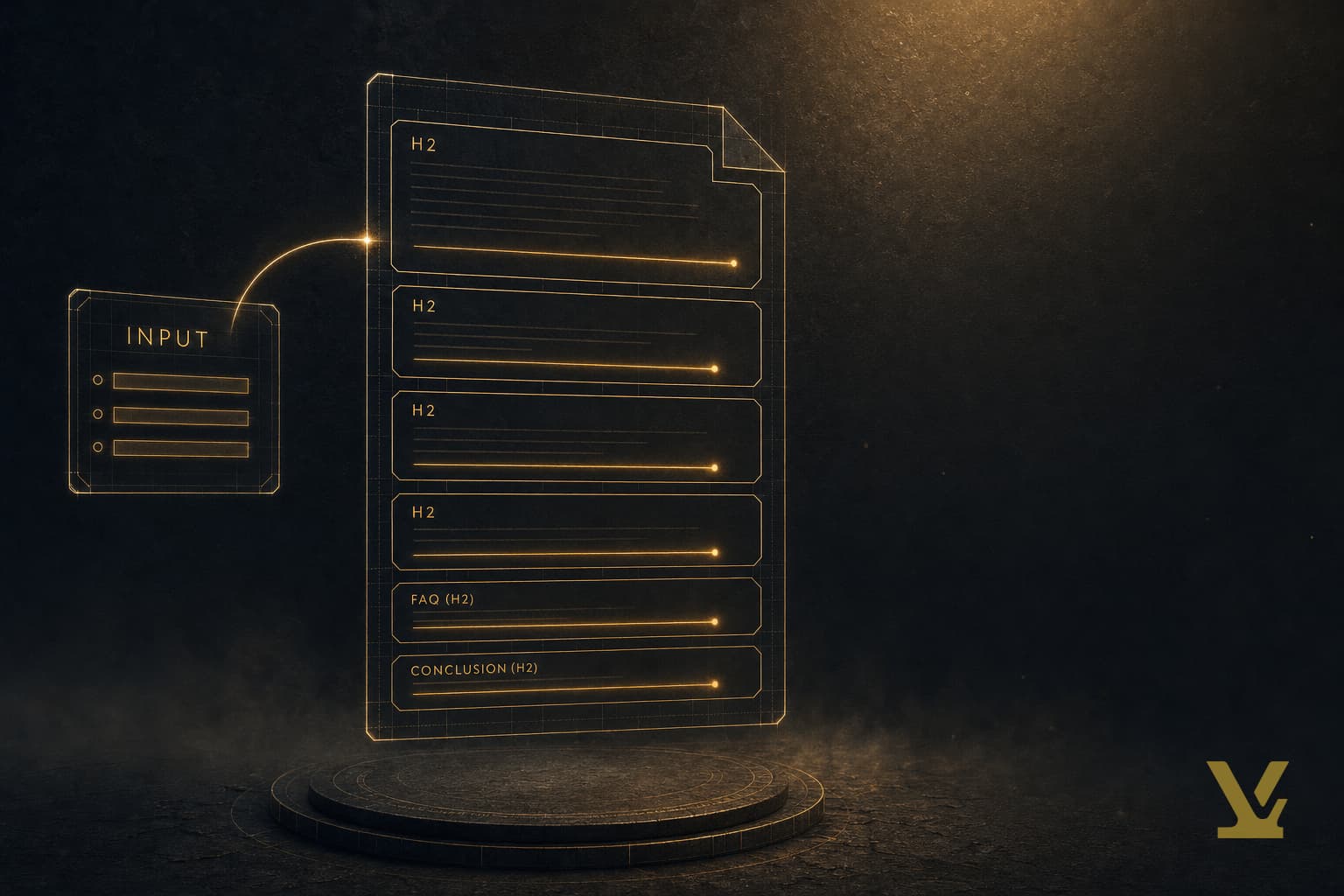
A topic landed on your desk and you have an hour to hand a writer something to draft against. This guide shows how to outline an SEO article in five minutes using one paste-ready LLM prompt and a free model. No SurferSEO, no Frase, no MarketMuse. The output is an editorial-grade outline — H2/H3 structure, key points, internal-link anchors, acceptance criteria, reader Q&A.
Works in ChatGPT, Claude, or Gemini on any free tier. The catch most generic "free outline" guides miss is structure: dump a vague topic into a model and you get a flat list of subheads any competitor could produce. The prompt below forces niche context into every section.
What separates a good SEO outline from a bad one
A bad outline reads like a Wikipedia table of contents. Generic H2s, no point of view, no acceptance criteria. The writer who picks it up has to redo the strategic thinking, which means a slow draft or a generic one.
A good outline answers four questions before any prose gets written. Who is the reader? What is the angle a smaller site can win with? What does each section have to prove? What does the article have to do that the top three results do not? Miss any one and the article needs a rewrite.
Search intent is the silent gate underneath all four. Classify the keyword first — see the five-minute search intent workflow for the four-bucket call. The prompt below produces a different shape for informational, commercial, and transactional keywords.
How niche context changes the outline (why generic templates fail)
Generic templates personalize only the title. The H2s, the key points, the Q&A — all of it could have been written for a competitor in a different industry. That is why generic outlines rarely beat the top three on Google: the top three already cover the obvious shape.
Niche context is the leverage. Two articles on "keyword research for beginners" should not share an outline if one is for solo Etsy sellers and the other is for B2B SaaS founders. The reader's workflow, tools, and search language bend the H2 order and which questions are worth answering. The prompt below makes the niche line required — skip it and the model defaults to generic.
Running the "Outline a single article" prompt: topic plus niche as input
The prompt does five things in one round-trip. Classifies the intent. Proposes the angle. Builds an H2/H3 skeleton. Writes acceptance criteria. Drafts a reader Q&A block.
Inputs: a topic in one phrase, a niche line in one sentence, the primary keyword. No SERP scrape, no competitor URL, no API key. Drop the three lines into the prompt and paste into ChatGPT, Claude, or Gemini.

Prompt to paste:
- CONTEXT — Topic: <one-phrase topic>. Niche: <one-sentence niche, including reader and main pain>. Primary keyword: <keyword>. Search intent: <informational | commercial | transactional>.
- TASK — Produce a writer-ready outline for an SEO article on the topic above, scoped to the niche, targeting the primary keyword.
- STRUCTURE — Return six sections in order: 1) Reader and angle paragraph. 2) Outline as H2 list (6-8 H2s, with 2-4 H3 sub-points where useful). 3) Per-section key points (3-5 bullets per H2). 4) Suggested internal-link anchors (3-5, with the section each belongs in). 5) Acceptance criteria (one sentence per H2 stating "this section is done when X"). 6) Reader Q&A block of 5 questions a real reader of this niche would type into Google.
- RULES — No invented search volumes. No invented competitor names. No SEO platitudes. Each H2 must do a different job. The angle must be one a smaller site can win with. Markdown only, no preamble.
The constraints carry the weight. "No invented search volumes" stops hallucinated numbers. "Each H2 must do a different job" prevents redundant sections. "The angle must be one a smaller site can win with" forces a point of view. If the output is bland, your niche line is doing too little work.
What the output includes: structure, criteria, reader Q&A
A clean run returns six artifacts in one response. Each one feeds a specific downstream step.
- Reader and angle paragraph. One paragraph naming the reader and stating the angle. Paste into the brief verbatim.
- H2/H3 outline. Six to eight H2s with H3 sub-points where useful. Order: problem, workflow, objections, conversion.
- Per-section key points. Three to five bullets under each H2. A writer knows what evidence each section needs without redoing strategy.
- Suggested internal-link anchors. Three to five anchors mapped to sections. Cross-check against your real interlink graph before publishing.
- Acceptance criteria. One sentence per H2: "this section is done when X." The editor's checklist; the writer's safeguard against scope creep.
- Reader Q&A block. Five reader-grade questions in the language a real reader types into Google. Doubles as the article's Q&A section and FAQPage structured data raw material.
Acceptance criteria are the artifact simple outline prompts skip, and the one that most changes how a draft turns out. With them, an editor signs off section by section. Without them, the whole article gets re-litigated at QA.
A real run for "keyword research for ecommerce founders"
Niche line: "Solo Shopify store owners under $500k GMV who do their own marketing and have never paid for an SEO tool." Primary keyword: "keyword research for ecommerce."

In about 30 seconds the model returns the six artifacts. The angle paragraph proposes "the keyword research a Shopify owner can do without paying for Ahrefs." The seven H2s walk through the reader's actual pain — seeding from product pages, mining Google Search Console, validating intent against Shopify analytics — instead of a generic opener.
Internal-link anchors slot into relevant sections — an anchor to a free keyword research tool alternative belongs under "no Ahrefs, no Semrush." Acceptance criteria read "this section is done when the reader has at least 20 seed terms from their own store data." The angle — "the workflow that runs entirely on data you already have" — is a slice Ahrefs cannot credibly own.
How to hand this to a writer (or use it yourself)
Five steps once the model returns the six artifacts.
- Read it once, fast. Skim for hallucinations — invented competitors, fabricated stats, generic H2s.
- Lock the angle. If sharp, paste into the brief verbatim. If bland, rewrite the niche line and re-run.
- Cross-check internal-link anchors. Check each against your actual posts; replace anything that does not exist.
- Tighten the acceptance criteria. Sharpen so a junior editor signs off without asking questions.
- Hand brief and outline together. Writers do better drafts when they see the strategic reasoning, not just the section list.
Once tightened, hand the outline to a free content brief generator or build the brief manually.
Do this in 5 minutes: how to outline an SEO article from one prompt
The end-to-end run, with no prep besides the three input lines.

- Minute 0 — Open ChatGPT, Claude, or Gemini. Have your three input lines ready: topic, niche, primary keyword.
- Minute 1 — Paste the prompt above. Replace CONTEXT with your three lines plus the search intent label. Hit enter.
- Minute 2 — Skim for hallucinations. Delete invented competitors, fabricated stats, repeat-beat H2s.
- Minute 3 — Cross-check the suggested internal-link anchors against your real published posts.
- Minute 4 — Tighten the acceptance criteria so each passes the "junior editor signs off" test.
- Minute 5 — Paste the cleaned outline into the brief. Attach the Q&A block. Send to the writer.
Total elapsed: under five minutes. Every downstream hour — research, drafting, editing — now points at the right target.
Weaknesses & Drawbacks
Five minutes and a free model gets you 80% of the way to a structured outline — that is a real win over a blank page. The other 20% is where this workflow breaks down. Be honest about it before you scale this to thirty articles.
Where the free LLM approach falls short
- The outline is generic to the niche, not to the SERP. The model has no idea which pages are actually winning for your target query, so the structure reflects what an article on this topic usually looks like — not what is beating the current top 10.
- Internal-link suggestions are guesses. The model does not know your sitemap, so it either invents plausible-sounding slugs or stays vague ("link to a related pillar page"). You still have to map every suggestion to a real URL by hand.
- The reader Q&A block is invented, not derived from search. Questions are reasoned from the topic rather than pulled from real "People Also Ask" data or the query clusters your audience actually types.
- There is no competitor weakness signal. The "what we will do better" angle comes from intuition — the model cannot tell you that the #2 result skips a comparison table or that nobody on page one addresses pricing objections.
- Acceptance criteria — target word count, content type, depth — are educated defaults. Without SERP data, "aim for 1,800 words" is a guess, not a calibration against what is currently ranking.
What it takes to fix this at scale
Each weakness above maps to a missing input the free workflow does not have. If you are running this on more than a couple of articles a month, those inputs become non-negotiable. Concretely:
- Real SERP data for your target query, so H2s and angles are calibrated against the pages currently ranking — not the model's prior on what the topic looks like.
- A crawl of your own site's URLs, so internal-link suggestions resolve to pages that actually exist (and gaps surface as "desired" links to seed future content rather than invented slugs).
- Reader Q&A derived from clustered query intent against your real target keywords, not freeform invention.
- A reference set of top-ranking competitors with rank position and query coverage, so the writer can see exactly who and what they are up against.
- Computed scope guardrails — max sections bounded by ceil(wordCountMax / 250), content type inferred from SERP shape, competitive angle drawn from actual competitor weaknesses — instead of educated defaults.
The free prompt gets you a structured outline in five minutes; that is a real win over a blank page. The inputs above are what turn an outline that "covers the topic" into one calibrated to beat the pages currently ranking. Once you are shipping at volume, that is the gap to close.
How VarynForge fits in
Running the prompt once is easy. Running it across thirty topics without losing outputs, angles, or criteria is the harder problem. VarynForge keeps the "Outline a single article" prompt in a saved library alongside six others — niche research, keyword brainstorm, search intent decode, content-gap audit, page analysis, titles — and persists every output under the topic it was run against. The full brief generator extends the outline with live SERP data, capped at ten free briefs per 24 hours. Create a free VarynForge project to use the prompt library.
Frequently Asked Questions
How is this different from a paid outline tool like SurferSEO or Frase?
Paid tools pull live SERP data. The prompt does the same strategic job — angle, structure, criteria, Q&A — against the model's training data. For an early-stage site shipping one to three articles a week, the prompt is enough.
Can I trust the LLM to write good acceptance criteria?
For first-pass criteria, yes. For sharpness, no. Treat the criteria as a draft you tighten by hand. The two-minute pass is the highest-leverage editorial work in the whole outline.
What if the LLM makes up internal-link anchors that do not exist on my site?
Expect this. The model is good at suggesting shapes of anchors; it is bad at knowing whether the URL exists. Cross-check every anchor and drop what does not exist.
Should I run this prompt before or after I do the keyword research?
After. The prompt assumes a primary keyword and a search intent classification. Outline before the keyword is locked and you rewrite the H2s when it shifts.
Which model produces the best outlines — ChatGPT, Claude, or Gemini?
All three on free tiers. Claude writes the cleanest acceptance criteria. ChatGPT GPT-4o is strongest on Q&A phrasing. "Use whichever you have open" is a fine rule.
Key Takeaways
A writer-ready SEO outline is six artifacts: angle, H2/H3 skeleton, per-section key points, internal-link anchors, acceptance criteria, and a reader Q&A block. Five minutes of prompt work replaces an hour of strategy work. The leverage is the niche line — one specific reader pain produces an angle a smaller site can win with, while a vague niche line produces a generic outline that lands at position 14.
Run the prompt, skim for hallucinations, cross-check the anchors against your real corpus, sharpen the criteria by hand, then hand the outline to the writer with the brief. The whole loop is under five minutes once you have your three input lines ready, and the resulting draft will not need a strategic rewrite at QA time.
Further Reading
- How to Determine Search Intent for Keywords (5-Minute Method)
- Free Keyword Research Tool Alternative: 5-Min ChatGPT Workflow
- Niche Research for SEO: A Four-Axis Map for Content Plans
- SEO Article Title Ideas Generator: From Outline to Title in 5 Minutes
- Free Content Brief Generator: From Outline to Brief in 5 Minutes
- Keyword Clustering for Content Planning: Free Workflow
- Best Content Strategy Tools for Faster Briefs and Outlines
- Types of Search Intent: A Vector Framework for Content Teams
Sources
Frequently asked questions
How do I outline an SEO article in five minutes?
Use the article's paste-ready Outline a single article LLM prompt. The prompt takes three inputs: the topic, a one-line niche statement, and the primary keyword. In one round-trip on a free-tier model it returns six writer-ready artifacts: an angle paragraph, an H2 and H3 skeleton, per-section key points, suggested internal-link anchors, acceptance criteria for the draft, and a reader Q&A block. The whole loop fits inside five minutes once you have the three inputs ready, and the output drops straight into a brief without manual restructuring.
What artifacts does the outline prompt return?
Six artifacts in one round-trip. First is an angle paragraph that names the differentiated stance the article will take. Second is the H2 and H3 skeleton with section labels. Third is per-section key points, which give the writer the load-bearing claims to cover. Fourth is a list of suggested internal-link anchors so the article ships with link planning, not as an afterthought. Fifth is acceptance criteria, the explicit pass-fail conditions an editor can use. Sixth is a reader Q&A block, which doubles as FAQ schema fodder and as a list of objections the article must address inside the body.
What is the difference between an outline and a brief?
An outline is the structural skeleton: angle, H2 and H3 hierarchy, and the load-bearing claims under each heading. A brief is the outline plus everything the writer needs to execute it: target keyword, intent, audience, voice constraints, internal-link list, acceptance criteria, and reference reading. The article's outline prompt returns six of those brief components alongside the structure, which is why it is positioned as a strategic outline pass rather than a pure heading list. A pure heading list is faster but leaves the writer without enough scaffolding to make local decisions.
Do I need a paid brief tool to outline an article?
No. The article's premise is that one well-structured LLM prompt covers the strategic layer that paid brief tools charge for: angle, intent-aware structure, internal-link planning, acceptance criteria, and reader Q&A. Paid tools add value when you batch hundreds of briefs and need integrations to a content management system, but for a single article the prompt is faster and produces equivalent or better output. The article frames the choice as a portfolio decision: paid for scale, free prompt for strategic single-article briefs and for cases where the team is still figuring out the angle.
How do I write the inputs the outline prompt needs?
Three inputs, each one to two lines. The topic is the working subject, expressed as the working title or a sentence that captures what the piece is about. The niche statement is the same one-line definition used in the four-axis niche model: market plus personas plus anchor asset. The primary keyword is the exact phrase you intend to rank for, no synonyms folded in. The article emphasizes that input quality determines output quality. A vague topic and a missing niche line produce a generic outline. A precise topic and a tight niche line produce an outline you can hand to a writer immediately.