
Niche Research for SEO: A Four-Axis Map for Content Plans
Skip the niche definition and your SEO content stalls. Run the four-axis niche research for SEO model and a copy-paste LLM prompt to map yours fast.
Most content programs fail in week one — not at the keyword spreadsheet, but at niche research for SEO. Skip the niche definition and you spend the next six months writing competent articles for a market you cannot win, because the niche is too broad, the personas are too vague, and the competitors are not who you think.
This guide hands you the four-axis niche model we run on the VarynForge dogfood project — market, personas, competitors, anchor asset — plus a copy-paste "Expand my niche" prompt for ChatGPT or Claude and a five-minute workflow that turns vague positioning into a keyword-intent map. By the end you will have a niche structure on one screen, twelve sub-niches ranked by intent, and the next step you owe a writer ready to hand off.
Why shallow niche definitions kill content strategies
A shallow niche reads like an elevator pitch: "we help small SaaS teams with SEO." That is positioning, not a niche. A niche is the specific market territory you can defensibly own — narrow enough that your H1 can credibly out-rank the top result, and broad enough that the cluster has real demand.
The cost of getting it wrong is silent. Articles publish, get a few impressions in Google Search Console, never break out of position 30, and you blame the model when the real failure happened before you opened a draft. Christensen's Jobs-to-be-Done framing in HBR is direct: people don't buy products that match a demographic, they hire products to do a specific job in a specific situation. Niche research for SEO is the same problem — you are mapping the territory of jobs your content can credibly do.
What a structured niche actually looks like

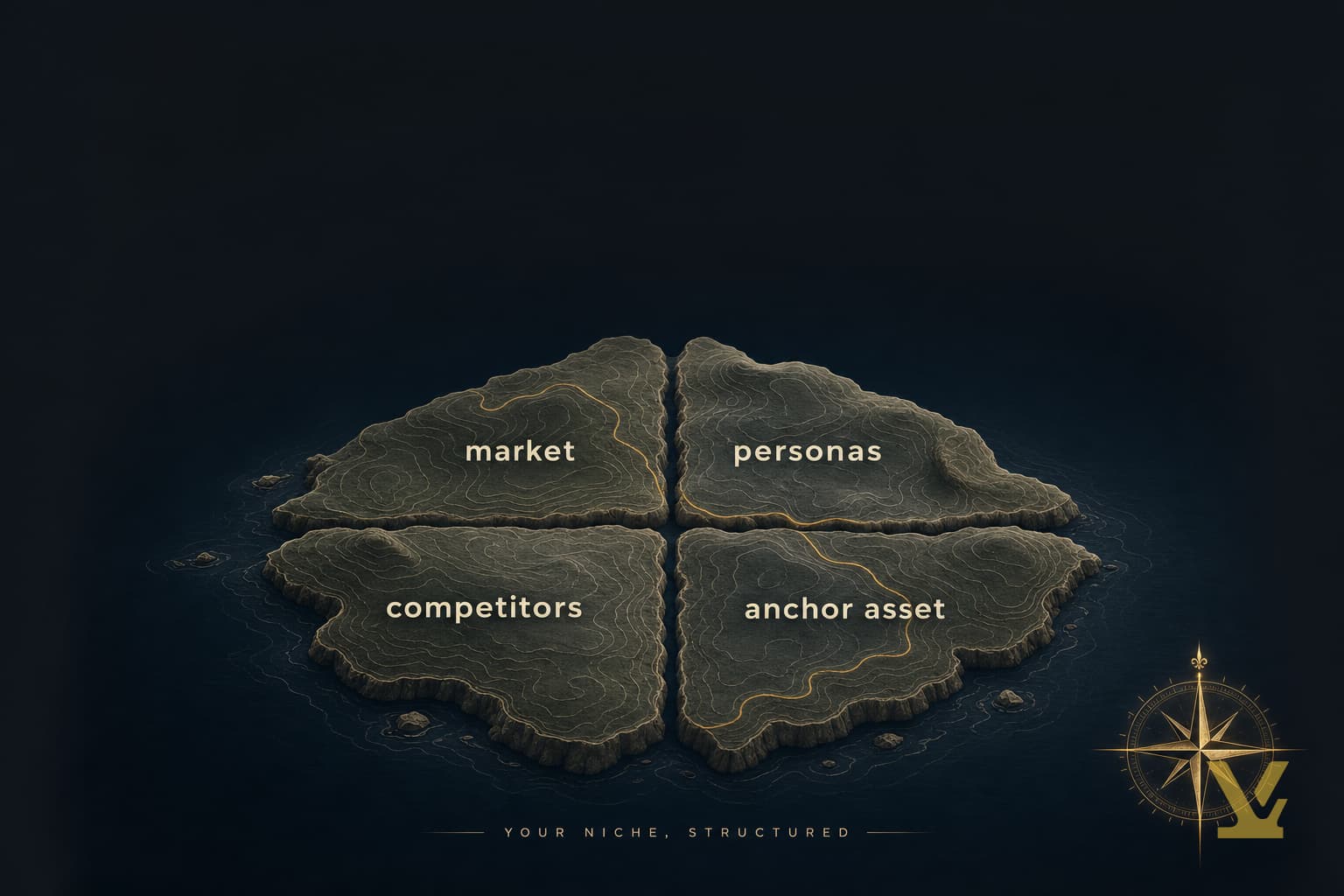
The Varyn niche model has four axes. Each one answers a question the next axis depends on. Get them in order and the keyword research that follows almost writes itself.
- Market. The buying context, narrowed to one industry plus one operating mode (e.g. "B2B SaaS with annual contracts and a product-led trial," not "SaaS"). The market sets which keywords carry commercial intent at all.
- Personas. Two or three actual humans inside that market who hire content. Each persona has a role, a stage, and a recurring job-to-be-done.
- Competitors. Pages currently ranking for the keywords your personas search. Not "competitor companies" — competitor URLs. Half the time the page winning the SERP is owned by a sibling industry.
- Anchor asset. The one piece of content (calculator, framework, dataset, opinionated guide) the rest of the niche orbits. Without an anchor every article is a one-off; with one, internal links and topical authority compound.
These are axes, not stages. Every keyword you target needs a defensible coordinate on each. The six-artifact content strategy framework treats this niche map as the input that feeds positioning, taxonomy, and brief template — change the niche and every artifact downstream changes too.
Run the "Expand my niche" prompt in ChatGPT or Claude

The fastest way from "I sort of know my niche" to a structured map is to run a single prompt and react to its output. The prompt below is the one we paste into a fresh ChatGPT or Claude session — it produces a four-axis niche map, then expands sub-niches and adjacent topics in a format you can take straight into keyword research.
Open a new chat and paste the prompt below. Replace the bracketed placeholders with your own context. Do not edit the structure — it is shaped to produce keyword-ready output.
Prompt to paste:
- ROLE — You are a senior SEO strategist. Map my niche on four axes: market, personas, competitors, anchor asset. Output exactly the headings I describe — no preamble, no closing remarks.
- CONTEXT — My product is: [one-sentence description]. My target market is: [industry plus operating mode]. My current top three keywords are: [list].
- STRUCTURE — Market: one paragraph naming the industry, the operating mode, and two adjacent industries that share queries. Personas: a numbered list of three personas, each with role, stage, and one job-to-be-done in the form "When [situation], I want to [motivation], so I can [outcome]." Competitors: five URLs that currently rank for my top three keywords (best guess, flag any uncertain). Anchor asset: one sentence proposing the single piece of content this niche should orbit, plus one sentence on why a competitor has not built it.
- EXPANSION — Then list twelve sub-niches as keyword phrases (3–5 words each), each tagged with one of [informational, commercial, navigational, transactional]. List five adjacent topics my niche should not own but should link to. Stop after the adjacent topics — do not summarize.
Read the output once, then re-read asking three questions. Did it name a real industry plus operating mode, or did it reach for "SaaS" and stop? Are the personas distinguishable, or three rephrasings of the same role? Do the competitor URLs look like pages you have actually seen ranking for your terms? An honest "no" is the signal to refine inputs and re-run, not push forward with bad axes.
What the output gives you
A clean run produces four artifacts. The market paragraph and persona list go straight into your content strategy positioning doc. The competitor URLs become the input for a SERP teardown — open each, capture the H1, the first H2, and the page's anchor asset. The twelve sub-niches map directly to keyword research; the five adjacent topics are your outbound-linking pool.
The one part you should never skip is the jobs-to-be-done line. JTBD links a search query to a real moment in someone's day — and it prevents the most common SEO failure, writing for a keyword nobody actually hires content to do. If a persona's JTBD reads as a generic outcome ("learn about X"), refine until you have a situation, a motivation, and an outcome you could write a paragraph about without making anything up.
Map the output back to keyword intent clusters

Sub-niches from the prompt are keyword phrases with intent tags — that is the bridge to real keyword research. Group the twelve phrases by tag. Informational and commercial typically cluster cleanly; transactional and navigational are usually thinner and need manual grading.
Each cluster needs at least one persona, one job-to-be-done, and one competitor URL whose page you can credibly out-rank. A cluster with three keywords and no competitor URL means your niche is too narrow; a cluster with eight keywords and four competitor URLs means it is too broad. The types of search intent guide is the right second pass once you have rough clusters.
From there, every sub-niche becomes a candidate brief. Use the seed-to-target pipeline in keyword research for SEO and the topic-cluster process in how to do keyword research for topic clusters to pick which clusters ship first.
The 5-minute niche research for SEO workflow
The whole thing, end to end, fits in five minutes once your context is ready.
- Minute 0–1 — Write the bracketed inputs in a doc, not in the LLM. Force a one-sentence product description, an industry plus operating mode, and three current keywords. If you cannot write those in sixty seconds, the project needs a positioning conversation first.
- Minute 1–2 — Paste the inputs into the prompt template, send to ChatGPT or Claude, read the output once without editing. The first read is for sanity, not capture.
- Minute 2–3 — Capture the four-axis map. Re-write the market paragraph in your own words — the LLM's version is almost always one notch too generic. Keep the persona list verbatim if the JTBD lines pass the situation-motivation-outcome test; rewrite if not.
- Minute 3–4 — Open each competitor URL. Note the H1, first H2, and whether the page has an anchor asset. Three of five will usually match the LLM's prediction; the other two reveal a gap in your inputs.
- Minute 4–5 — Group the twelve sub-niches by intent tag. Drop each cluster into a keyword tool that lets you re-confirm market, personas, and anchor asset before it expands the seeds — that is the difference between a niche map that survives the calendar and one that drifts back to generic by week three.
Why your seed keywords need their niche context attached
Once the four-axis map is on paper and the twelve sub-niches are clustered, the highest-leverage next step is to load your seed keywords into a tool that keeps the niche context attached. Most keyword tools treat your seed list as decontextualised phrases and produce candidate lists that ignore your niche; you spend an hour deleting irrelevant keywords. The fix is to use a wizard that confirms market, personas, and anchor asset before it expands the seeds, then carries that context into keyword expansion, intent classification, and brief generation. It is the same workflow described in building a content plan with one keyword research tool, just with the niche scaffolding pre-loaded.
Where the free workflow falls short
The four-axis prompt is the right way to start. It is not the right way to finish. Be honest with yourself about what a stock LLM running on stale training data can actually see — and what it cannot.
The limits of running this prompt against a stock LLM
- Sub-niches and personas come back confident and ungrounded. The model is fluent, not informed — every axis is a plausible guess shaped by training data, not by anything happening in your market this quarter.
- Demand is invisible. The twelve sub-niches read interesting on the page, but the prompt cannot tell you which clusters carry real audience pull and which only sound like they should.
- Training cutoffs are months to years stale. New entrants, repositioning incumbents, and emerging sub-niches that have appeared since the model last trained simply will not show up — even when they already dominate the SERP.
- Personas read generic because they are not built from how actual ranking competitors describe their customers. You get archetypes; you do not get the specific vocabulary buyers in your niche already respond to.
- Outputs overweight the obvious centre of the niche and underweight the edges, which is exactly where the unclaimed sub-niches and intent gaps tend to live.
- Competitor URLs are best-guesses. The model is recalling URLs from training data, not opening Google in a fresh tab — half the time the page that actually wins your SERP is not in the list.
- The output is one frozen snapshot. Re-run the prompt next month and you start from scratch — there is no curated competitor set, no learned context, no way to make next quarter's run sharper than this one.
What changes when the niche map is built from live SERP data
- Sub-niches and topic clusters get derived from real ranking competitors and live SERP composition — not guessed by a model with no eyes on the market this week.
- Personas inherit the actual customer language from the top-ranking pages in your niche, so the vocabulary in your briefs already matches the vocabulary buyers respond to.
- Topic clusters get validated against live search-volume data instead of LLM intuition about which sub-niches "feel" big — so the clusters you commit to writing against are the ones with measurable demand, not the ones the model found pleasing to enumerate.
- Competitor weaknesses surface as part of the niche analysis itself — explicit gaps you can claim, not vibes you have to verify by hand.
- Curation persists across re-runs. You flag which competitors actually matter once, and your niche definition gets sharper every cycle instead of resetting on every fresh chat.
- The whole map stays project-aware. Niche, personas, competitors, and anchor asset are loaded once and threaded through every downstream prompt and brief — you never re-paste your context to make the next artifact useful.
The free workflow is the right starting point. Treat its output as a draft drawn from memory; the upgrade is what you get when you temper that draft against live SERP data and a competitor set that learns over time.
How VarynForge fits in for niche research
VarynForge ships the four-axis niche map as the first artifact of every free project: the niche-import wizard captures market, personas, competitors, and anchor asset once, then carries that context into the seven-prompt library, the keyword-import wizard, and a free brief generator capped at ten briefs per twenty-four hours. Create a free VarynForge project and your niche context is pre-loaded into every prompt and brief from the first run.
Key Takeaways
Niche research for SEO is the silent gate every content program passes through, whether the team noticed or not. Skip it and you get articles that publish and stall; structure it and the keyword research, briefs, and internal links downstream all converge on territory you can defensibly own. Run the four-axis model — market, personas, competitors, anchor asset — once at the start of any project, then re-run it whenever a quarter's content stops compounding. The "Expand my niche" prompt and the five-minute workflow are the cheapest way to keep that discipline alive.
Frequently Asked Questions
What is niche research for SEO and how is it different from keyword research?
Niche research for SEO defines the market territory you intend to win — industry, personas, competitors, and the anchor asset the rest of your content orbits. Keyword research lives one rung down: it takes that defined territory and produces specific search phrases worth targeting. Run niche research first; treating keyword research as a substitute is the most common reason content programs publish for six months and rank for nothing.
How do I define my niche for content marketing without overthinking it?
Use the four-axis model and a single LLM run. Write your market, personas, competitors, and anchor asset on one page; paste the "Expand my niche" prompt with those inputs; pressure-test the output with three questions about specificity. The full loop is a five-minute exercise on its first pass and a thirty-minute exercise the first time you do it carefully — not a quarterly strategy offsite.
When should I niche down further versus expand my SEO strategy?
Niche down when your sub-niche clusters return five-plus competitor URLs you cannot credibly out-rank. Expand when your clusters return zero or one competitor URL — that signals demand is too thin to support sustained content. The signal lives in the SERP, not in keyword volume; a low-volume cluster with no defensible competitor is often a better bet than a high-volume cluster crowded with category leaders.
What does jobs-to-be-done mean for SEO content?
Jobs-to-be-done frames a search query as a situation a reader is in, a motivation they have, and an outcome they want. It replaces vague demographic personas ("small business owners") with specific moments ("the founder finishing a Q3 board deck on a Sunday night"). For SEO content, JTBD is the bridge between a keyword and a real reader — the difference between writing something that ranks and writing something that gets cited.
Further Reading
- Free Keyword Research Tool Alternative: A Five-Bucket ChatGPT Prompt
- How to Determine Search Intent for Keywords
- Free Content Gap Audit: Find What Competitors Cover and You Do Not
- Harvard Business Review — Know your customers’ jobs to be done
- Moz — Beginner’s guide to SEO with niche-selection chapters
Sources
Frequently asked questions
What is niche research for SEO?
Niche research for SEO is the upstream step that turns a vague positioning sentence into a concrete keyword-intent cluster map. Without it, every later step (keyword research, briefs, content calendar) inherits ambiguity that compounds. The article uses the four-axis Varyn niche model. The four axes are market, personas, competitors, and an anchor asset. You define each axis in one or two lines, then feed them to an LLM with the paste-ready Expand my niche prompt to produce a cluster map you can immediately brief writers against.
What are the four axes of the Varyn niche model?
The four axes are market, personas, competitors, and anchor asset. Market is the buying category in plain language. Personas are the two or three buyer archetypes whose decisions you can plausibly influence. Competitors are the three or four sites whose SERPs you actually overlap with, not the aspirational list. Anchor asset is the single piece of content or product you can credibly defend as the entry point. Filling all four axes takes a few minutes and is the input to the LLM prompt that returns a keyword-intent cluster map. Skipping any one axis shows up later as a fuzzy brief or a misaligned cluster.
How long does niche research take with this model?
About five minutes once you know the four axes. The article uses a paste-ready Expand my niche prompt that takes the market line, personas list, competitor list, and anchor asset as inputs. The LLM returns a keyword-intent cluster map split by buyer stage and persona. The constraint is that you must answer the four axes honestly first. Teams that rush this step and put aspirational competitors or vague personas in the prompt get a cluster map that looks plausible but cannot be briefed. The five minutes are spent on the prompt round-trip, not on the upstream thinking.
How is niche research different from keyword research?
Niche research defines the boundary inside which keyword research is allowed to operate. Keyword research without a niche layer drifts toward whatever has volume and easy difficulty, regardless of whether your team can credibly rank or convert there. The four-axis model decides which keywords are in scope before a single seed term is pulled. The output of niche research is the cluster map. The output of keyword research is a writeable target list inside that map. Reversing the order is one of the most common reasons a content program publishes consistently and still drifts away from the audience over a quarter.
Why does VarynForge pre-fill niche context on every project?
Every VarynForge project starts with the same four-axis niche context because every downstream workflow (search intent, content gap audit, brief generation) reads from those four fields. Filling the niche once means every later prompt inherits the right market, personas, competitor list, and anchor asset without re-prompting. The article frames this as the same shape used by the free-tier workflows so that operators get the same answer the platform would return. The niche layer is the single source of truth that prevents intent drift across the program's lifecycle.