How Long Does SEO Take? Realistic Timelines and Milestones in 2026
How long does SEO take? Realistic 2026 ranges by site type, plus a 0-30/30-90/90-180/180-365+ milestone framework with KPIs to report monthly.

"How long does SEO take" is the question every founder asks the week they finally publish. The honest, evidence-based answer is "between three and twelve months for meaningful traffic, two-plus years for top rankings on competitive terms" - but that range hides a lot of variance, and "results" itself is doing heavy lifting in the question. This guide pins down realistic timelines by site type, defines which signals to expect when, and gives a 90/180/365-day milestone framework you can lift directly into a client report.
Quick answer: how long does SEO take in 2026?
For a fresh site with clean technical foundations and steadily-published content, expect first impressions in Search Console within 1-4 weeks, the first ranked clicks in 2-3 months, a measurable traffic curve in 4-6 months, and competitive-keyword wins between 8 and 18 months. Established sites improving existing pages see lifts much faster - often inside 30 days for technical fixes and refreshed content.
Ahrefs analyzed two million random keywords and found that only 5.7% of newly published pages reach the top 10 within a year - and the median age of a top-10 page is over two years. That is your hard ceiling for "fast SEO" on competitive queries; everything below assumes long-tail and lower-difficulty selections.
What "results" means: early, mid, and late SEO signals
Before you can answer how long SEO takes, you have to define what counts as a result. Treat the question as a stack of leading indicators that fire in order:
- Indexed pages (week 1-4). The page exists in Google's index. Verify in Search Console's Pages report, not by site:domain queries.
- Impressions (week 2-8). GSC reports impressions for queries you appear on, even at position 80. Rising impressions means the page is being considered.
- Clicks at long-tail rank (month 2-4). Tail queries get clicks at position 5-20 because the SERP is thin. This is your first real traffic signal.
- Top-10 rankings (month 4-12). For non-trivial queries, you cross from "appearing" to "competing." CTR jumps materially.
- Conversions (month 6-18). Now traffic is shaped enough that conversion rate becomes informative. Earlier, sample sizes are too small to trust.
If a stakeholder asks for "results" at week six, what they reasonably mean is impressions and indexing, not conversions. Aligning that definition up front saves a lot of awkward client calls. Our breakdown of compounding versus bleeding traffic explains why early signals matter more than vanity rank reports.
Key factors that change how long SEO takes
The published timelines on every blog are averages; your site is not average. The variables that move the curve fastest, in order of impact:
- Keyword difficulty. A long-tail informational query can rank in 90 days; a head term against domain-authority 80 publishers takes 18-36 months. Topic selection swamps every other variable.
- Site age and accumulated authority. Established domains rank new pages in days. Brand-new domains spend the first 3-6 months earning crawl frequency and topical breadth before Google trusts them on competitive queries.
- Technical health. Crawl errors, slow Core Web Vitals, and broken canonical chains cap the entire site. Fixing them is one of the few SEO actions that produces visible movement inside 30 days.
- Content depth and intent fit. Pages that match query intent rank without much link-building; pages that miss intent never rank, regardless of links. Always reverse-engineer the SERP first.
- Backlinks and topical authority. Backlinks accelerate ranking on borderline queries. Their effect compounds over months, not weeks - links acquired today usually surface in rankings 4-12 weeks later.
How SEO timelines vary by site type
Same calendar, very different curves. Use these as anchor expectations when scoping projects:
- Brand-new site (no domain authority). Expect 3-6 months before first meaningful clicks. Compete on long-tail and local queries; head terms are out of reach inside year one.
- Small or local business. Local-pack inclusion possible inside 30-90 days with a verified Google Business Profile and consistent NAP citations. Organic web rankings follow on the longer 6-12 month curve.
- Established site improving existing pages. Refreshes lift the fastest of any scenario - re-indexing in days, ranking movement inside 2-6 weeks, traffic deltas visible in 30-60 days.
- Competitive keywords on a strong domain. Plan for 8-18 months on commercial head terms even with 70+ DR; the "incumbents have a 2-year head start" rule from the Ahrefs data still applies.
Concrete milestone timeline: 0-30, 30-90, 90-180, 180-365+ days

Use this as a reporting cadence with clients or stakeholders - the milestones are deliberately sized so each window contains one or two leading indicators worth reporting.
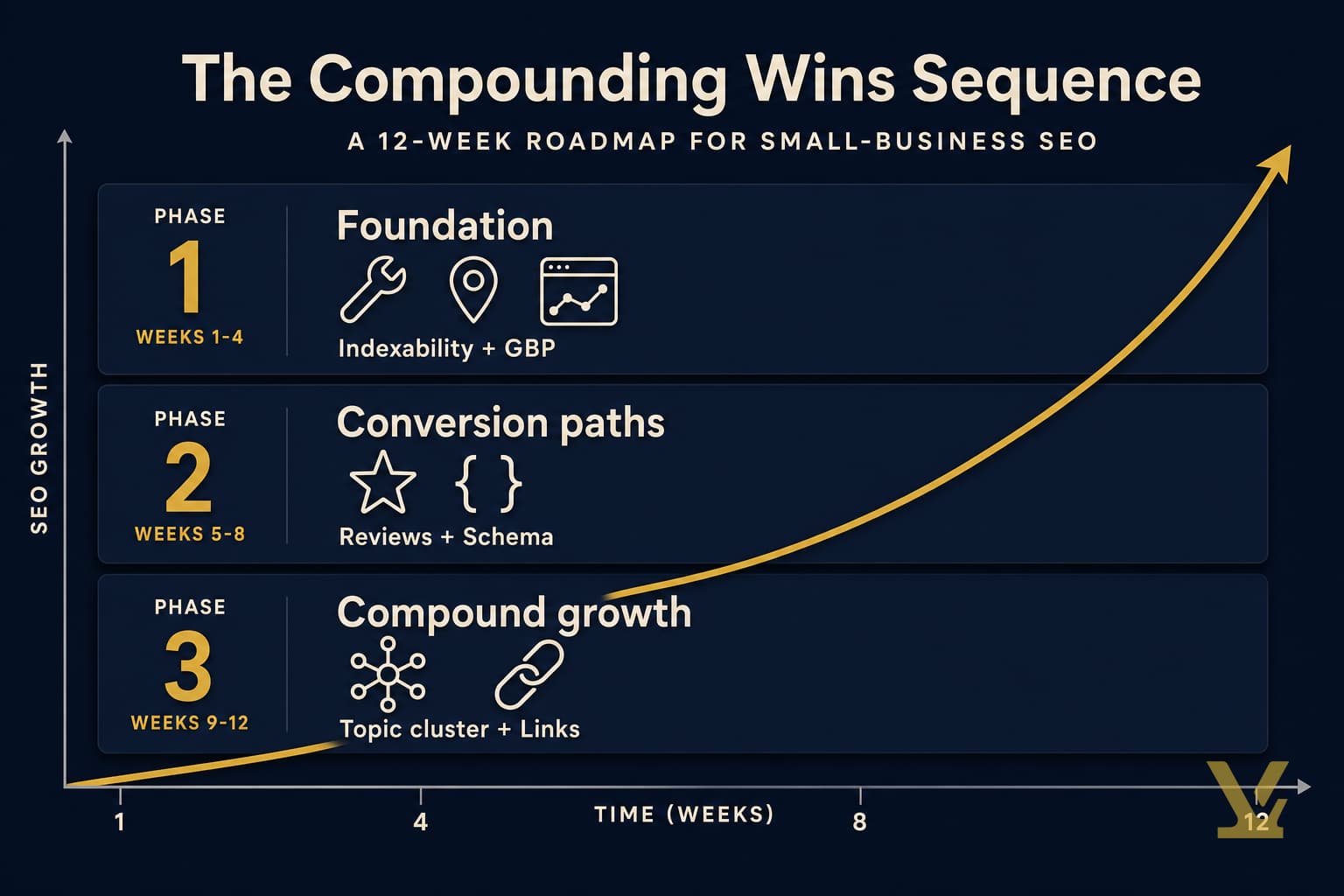
- Days 0-30 (foundations). Crawl audit complete, sitemap submitted, GSC and GA4 wired, top-priority technical fixes shipped. Expected KPI: indexed pages climbing toward 100% of the publish queue. No traffic claims yet.
- Days 30-90 (signal). Refresh and ship 6-12 priority pages, build internal links between them. Expected KPIs: impressions trending up week-over-week, first long-tail clicks, average position improving on 10-30 queries.
- Days 90-180 (lift). Cluster expansion, targeted link earning, conversion-rate audit on the highest-traffic pages. Expected KPIs: organic clicks rising, top-10 rankings on at least a handful of intent-aligned queries, first attributable conversions.
- Days 180-365+ (compounding). Topic clusters maturing, branded search rising, repeat-visitor share climbing. Expected KPIs: organic now a top-3 channel by traffic share, top-10 rankings on commercial queries, content ROI calculable.
How Google indexing and updates affect visible results

Indexing and ranking are different. Indexing is "Google has the page in its database"; ranking is "Google decides where to show it." Indexing usually happens within hours to days for established sites, days to weeks for new ones. Ranking adjustments roll continuously - Google rolls out core updates several times a year which can shift visible positions by 20-40% within 1-2 weeks of completion.
After publishing or updating a page, expect: re-crawl within 1-7 days for active sites, re-indexing in 24-72 hours after crawl, and ranking adjustments stabilizing 2-4 weeks later. If a refresh shows nothing in 30 days, the issue is not "Google has not noticed yet" - it is intent fit, content depth, or technical blocker.
Measuring progress: tools and KPIs that actually inform decisions

Forget vanity rank-tracking dashboards for the first 90 days. The reports that move decisions:
- Google Search Console. Impressions, clicks, average position, and the Pages and Coverage reports. Free, primary-source, and the only place to see real query data.
- GA4 (or any analytics). Organic-channel sessions, engaged-session rate, conversions per page. Pair with GSC to attribute traffic to specific queries.
- A rank tracker for top 50-200 queries only. Tracking everything is noise; tracking the 50-200 commercial-intent queries you care about is signal.
- Crawl + log-file audits quarterly. Screaming Frog or Sitebulb for crawl, server logs for what Googlebot is actually doing. Most useful for diagnosing why traffic is not moving despite shipping content.
Actionable tactics to shorten the timeline
Most "fast SEO" advice is wishful thinking. The handful of tactics that reliably compress time-to-results, with realistic payoff windows:
- Pick lower-difficulty, intent-aligned queries first. This is the single biggest lever. See our long-tail keyword tool guide for the prioritization rubric. Payoff in 60-120 days.
- Refresh existing pages before publishing new ones. Updating a page that already ranks position 8-15 with stronger content and a tightened title beats publishing a brand-new URL almost every time. Payoff in 14-45 days.
- Fix technical blockers first, content second. If GSC shows crawl errors, soft-404s, or canonical conflicts, fix those before adding pages. Payoff in 7-30 days as re-crawl propagates.
- Build internal-link clusters around your money pages. Use topic-cluster keyword research to plan the network. Payoff in 30-90 days.
- Earn 3-5 high-authority links per quarter, not 50 mediocre ones. Quality, not quantity, moves rankings on the queries that matter. Payoff 4-12 weeks after acquisition.
How VarynForge fits into a faster SEO timeline
VarynForge front-loads the part of the timeline that compounds most: keyword prioritization. By scoring every candidate query for intent, difficulty, and business value before you commit a brief, you avoid burning four months on pages that were never going to rank or convert. Try VarynForge if you want the same intent-aware research that powered the milestone framework in this article.
Frequently Asked Questions
How long until I see the first increase in organic traffic after publishing SEO-optimized content?
For an established site, expect impressions in GSC within 1-2 weeks and the first long-tail clicks in 4-8 weeks. Brand-new domains usually wait 2-4 months before any meaningful click volume because Google takes time to assess crawl frequency, topical relevance, and trust signals.
When should I expect meaningful ranking improvements for a competitive keyword?
Plan for 8-18 months on commercial head terms even with strong technical foundations and consistent content. The Ahrefs study showing the median age of top-10 pages exceeds two years is the binding constraint - shortcuts mostly do not exist on competitive SERPs.
How long does it take Google to index new or updated pages?
Active sites with healthy crawl budgets see new URLs indexed in hours to a few days; new domains can wait one to four weeks. Submit URLs through Search Console for priority. Indexing alone does not equal ranking - expect another 2-4 weeks before positions stabilize.
Do backlinks speed up ranking improvements, and how long do their effects take?
Yes, but the effect is gradual. High-quality backlinks usually surface in rankings 4-12 weeks after acquisition because Google needs to crawl the linking page, evaluate context, and recompute authority signals. Spammy or paid links can delay or reverse progress.
How does site age or domain authority change the time it takes to see results?
Established domains often rank new pages in days because crawl frequency, topical breadth, and trust signals are already established. Brand-new sites typically need 3-6 months building those signals before they can compete on anything beyond pure long-tail and branded queries.
Can technical fixes produce immediate SEO results?
Yes - the fastest wins in SEO are technical. Fixing blocked crawls, broken canonicals, slow Core Web Vitals, and indexability issues can move rankings inside 7-30 days because Google re-evaluates the affected URLs as soon as they are re-crawled.
Further Reading
- Ahrefs - How Long Does SEO Take to Show Results
- Search Engine Land - SEO timeline guide
- SEO.com - How Long Does SEO Take in 2026
- Belt Creative - Practitioner SEO timeline view
- Google Search Central - SEO Starter Guide
Sources
- Ahrefs - 5.7% of new pages reach top 10 in a year
- Google Search Central - Core update cadence
- Google - Crawling and indexing overview
- Google - SEO Starter Guide
- Search Engine Land - SEO timeline guide
Key Takeaways
How long SEO takes depends less on the calendar than on the queries you choose, the site you start from, and whether you fix technical foundations before publishing. The honest range is 3-6 months for first meaningful traffic on a clean execution, 8-18 months for top-10 rankings on competitive terms, and 2+ years to seriously challenge established incumbents. Use the 0-30/30-90/90-180/180-365+ milestone framework above so the timeline becomes a reporting cadence rather than a stretch goal - the work compounds, but only if you protect the early windows for technical and intent fit before chasing scale.
Frequently asked questions
How long until I see the first increase in organic traffic after publishing SEO-optimized content?
For an established site, expect impressions in Search Console within one to two weeks and the first long-tail clicks in four to eight weeks. Brand-new domains usually wait two to four months before any meaningful click volume because Google takes time to assess crawl frequency, topical relevance, and trust signals. Treat results as a stack of leading indicators that fire in order: indexed pages in week 1 to 4, impressions in week 2 to 8, clicks at long-tail rank in month 2 to 4, top-10 rankings in month 4 to 12, then conversions in month 6 to 18.
When should I expect meaningful ranking improvements for a competitive keyword?
Plan for 8 to 18 months on commercial head terms even with strong technical foundations and consistent content. The Ahrefs study showing the median age of top-10 pages exceeds two years is the binding constraint — shortcuts mostly do not exist on competitive SERPs. Only 5.7 percent of newly published pages reach the top 10 within a year. That is your hard ceiling for fast SEO on competitive queries. Lower-difficulty long-tail informational queries can rank in 90 days, but head terms against domain-authority 80 publishers take 18 to 36 months.
How long does it take Google to index new or updated pages?
Active sites with healthy crawl budgets see new URLs indexed in hours to a few days; new domains can wait one to four weeks. Submit URLs through Search Console for priority. Indexing alone does not equal ranking — expect another two to four weeks before positions stabilize. After publishing or updating a page, expect re-crawl within one to seven days for active sites, re-indexing 24 to 72 hours after crawl, and ranking adjustments stabilizing two to four weeks later. If a refresh shows nothing in 30 days, the issue is not Google has not noticed yet — it is intent fit, content depth, or a technical blocker.
Do backlinks speed up ranking improvements, and how long do their effects take?
Yes, but the effect is gradual. High-quality backlinks usually surface in rankings 4 to 12 weeks after acquisition because Google needs to crawl the linking page, evaluate context, and recompute authority signals. Spammy or paid links can delay or reverse progress. Backlinks accelerate ranking on borderline queries; their effect compounds over months, not weeks. The honest target is three to five high-authority links per quarter rather than 50 mediocre ones — quality, not quantity, moves rankings on the queries that matter.
How does site age or domain authority change the time it takes to see results?
Established domains often rank new pages in days because crawl frequency, topical breadth, and trust signals are already established. Brand-new sites typically need three to six months building those signals before they can compete on anything beyond pure long-tail and branded queries. Refreshes lift the fastest of any scenario — re-indexing in days, ranking movement inside two to six weeks, traffic deltas visible in 30 to 60 days. Local businesses can hit local-pack inclusion inside 30 to 90 days with a verified Google Business Profile and consistent NAP citations.
Can technical fixes produce immediate SEO results?
Yes — the fastest wins in SEO are technical. Fixing blocked crawls, broken canonicals, slow Core Web Vitals, and indexability issues can move rankings inside 7 to 30 days because Google re-evaluates the affected URLs as soon as they are re-crawled. Crawl errors, slow Core Web Vitals, and broken canonical chains cap the entire site — fixing them is one of the few SEO actions that produces visible movement inside 30 days. Use the days 0 to 30 foundations window to ship priority technical fixes before publishing new content.
What does a 30-60-90-180-365 day milestone framework look like?
Days 0 to 30 are foundations: crawl audit complete, sitemap submitted, Search Console and GA4 wired, top technical fixes shipped, indexed pages climbing toward 100 percent. Days 30 to 90 are signal: refresh and ship 6 to 12 priority pages, build internal links, watch impressions trend up week-over-week. Days 90 to 180 are lift: cluster expansion, targeted link earning, conversion-rate audit on highest-traffic pages. Days 180 to 365 are compounding: topic clusters maturing, branded search rising, organic now a top-3 channel by traffic share.