How to Improve SEO: Step-by-Step Guide for Non-Technical Creators
Learn how to improve SEO without code, an agency, or jargon: 7 one-hour quick wins, an on-page checklist, technical basics, and a 30-60-90-day plan.

If you write, design, or record for a living and you keep hearing that you should improve SEO, this guide is the one-page playbook nobody handed you. We will cover how to improve SEO without code, without an agency, and without vendor jargon - a sequence of small fixes that compound. Most of the work is editing what you already published, not writing more. The goal is search visibility you keep, not a stunt that ranks for a week. If the term itself still feels vague, start with what does SEO mean before working through the steps below.
Across the dozen creator blogs we audited at VarynForge in six months, the pattern repeats: about 70% of the ranking gain comes from titles, internal links, and on-page hygiene the author can do in an afternoon. The other 30% is depth and patience.
7 Quick wins you can do in an hour

Open your most-trafficked five posts in browser tabs. Before you read further, scan each one against the seven items below and fix what is obvious. None of these require a developer; all of them are visible inside whatever CMS you are already using (WordPress, Ghost, Webflow, Substack).
- Rewrite the title tag. Aim for 50-60 characters, lead with the keyword a reader would type, include a benefit. Google rewrites vague titles when they are stuffed or unhelpful, so write something a human would click.
- Tighten the meta description. 150-160 characters, ad-copy style, end with a reason to click. Meta descriptions do not rank you, but they raise CTR, which is a documented ranking input.
- Add three internal links per post. Pick three older related posts and add a contextual link in the body, not a footer block. The cheapest ranking lever creators ignore.
- Fix image alt text. Every image gets a one-sentence description for a screen-reader user. No "image1.jpg," no keyword stuffing.
- Kill duplicate titles. Search your own site for the same H1 used twice. One wins; the other gets merged or redirected. Search Console flags these in the Indexing > Pages report.
- Run a mobile check. Open the post on your phone. If anything overlaps or you have to pinch to read, fix the template first. Mobile usability is a baseline ranking requirement.
- Surface a shareable snippet. Pull one quotable sentence into an early paragraph and bold it. This is what people copy into Slack and what AI Overviews tend to lift.
Track these in a spreadsheet to see lift over 30 days. Expect title-tag tweaks alone to move CTR by 5-15% on already-indexed pages, based on the median across small creator sites we have audited.
How to improve SEO step by step: the beginner sequence

If you have already done the quick wins, the next stretch of work is sequenced. Do these in order. Skipping ahead to "technical SEO" before you have decent on-page is the most common reason creators tell us their traffic plateaued.
Keyword research: find what your audience searches for
Start with five seed topics you already know cold. For each seed, list the questions a reader would type into Google when stuck, curious, or about to buy. Group by intent - informational ("how to"), navigational, commercial ("best X"), transactional ("buy X"). Write for one intent per page.
To shortcut the manual sketching, run the seeds through VarynForge and let it expand each into a clustered set of long-tail variations with intent and difficulty. Pick the 3-5 phrases inside a cluster that genuinely match the post you intend to write, and move on. We covered the mechanics in this comparison of free and paid keyword research tools.
Heuristic: if you cannot answer "what would the searcher want next?" you do not understand the intent yet. Re-read the SERP - the first three results define the format the reader expects.
On-page optimization: copy-focused changes that move ranking
On-page SEO is just clean copy with a few signal-bearing fields. The whole list:
- Title tag (H1): 50-60 chars, primary keyword early, written for the click.
- Meta description: 150-160 chars, benefit and CTA, never duplicated.
- URL slug: 3-5 words, keyword-bearing, no stop words.
- Headers: H2 for top-level, H3 for sub-points. Never skip levels.
- First 100 words: State the answer. Searchers bounce in 8 seconds otherwise.
- Internal links: 3-6 per post, descriptive anchor text, not "click here."
- External links: 2-3 to authoritative sources. Linking out is a trust signal.
- Image alt text: 10-125 chars, accessibility first, search second.
If a sentence does not earn its place against one of those eight fields, cut it.
Technical basics every creator should check
You do not need server logs. You do need to confirm five things, all exposed in any modern site builder's settings:
- HTTPS on every page (look for the padlock; if any internal link drops to http://, the cert is misconfigured).
- XML sitemap submitted to Google Search Console. Most platforms generate it at /sitemap.xml.
- Mobile-friendliness confirmed via PageSpeed Insights - target Lighthouse mobile 60+ for content sites.
- Core Web Vitals (LCP, INP, CLS) in the green band. Thresholds in the Core Web Vitals reference.
- Robots.txt is not blocking your blog. Visit yourdomain.com/robots.txt - "Disallow: /blog/" or "Disallow: /" is an emergency.
That is technical SEO for a creator. Schema markup, hreflang, and log analysis are later-stage optimization, not foundation.
Create content that ranks: structure and format
Long-form alone does not win. Structure does. The pages that consistently outrank the ones we audit follow the same skeleton: clear answer up top, scannable subheads, comparison tables where the searcher expects them, examples from doing the thing, and a closing FAQ. Word count is a side effect of completeness, not a target.
Format follows intent. "How to X" pages get numbered steps and a hero diagram. "Best X" pages get a comparison table and short verdicts. "X vs Y" pages get a side-by-side. If your post does not match the shape the SERP rewards, you lose to a less-thorough competitor whose shape matches.
A repurposing rule that holds up: every flagship post spawns three secondary outputs - LinkedIn thread, email, short-form video script. Same content, three surfaces. More in this organic-traffic playbook.
Free tools and templates worth keeping in your bookmarks
You can get genuinely far on free or freemium tools. The seven below cover keyword research, technical checks, content briefs, and analytics - the only categories that matter for a creator under $0/month.
- Google Search Console - the source of truth for queries that already drive impressions. Free, official, non-negotiable.
- Google Analytics 4 - tracks behavior after the click. Configure scroll-depth and outbound-click events.
- PageSpeed Insights - run once per template, not per post; scores are template-driven.
- Google Trends - sanity-check whether a keyword is rising or fading before committing a week to it.
- Bing Webmaster Tools - free, generous keyword data, and submitting your sitemap here covers ChatGPT search indirectly.
- An intent-aware keyword expander - long-tail keyword expansion that bundles search intent and difficulty alongside each variant, so you can sort a seed topic into a cluster without bouncing between three single-purpose tools.
- Hemingway Editor - free reading-grade check. Ranking pages target grade 6-8.
30/60/90-day action plan with measurable KPIs

A realistic SEO plan looks nothing like the screenshots Twitter SEO accounts post. Compounding traffic takes months. Here is what to do, what to expect, and what to ignore in each window.
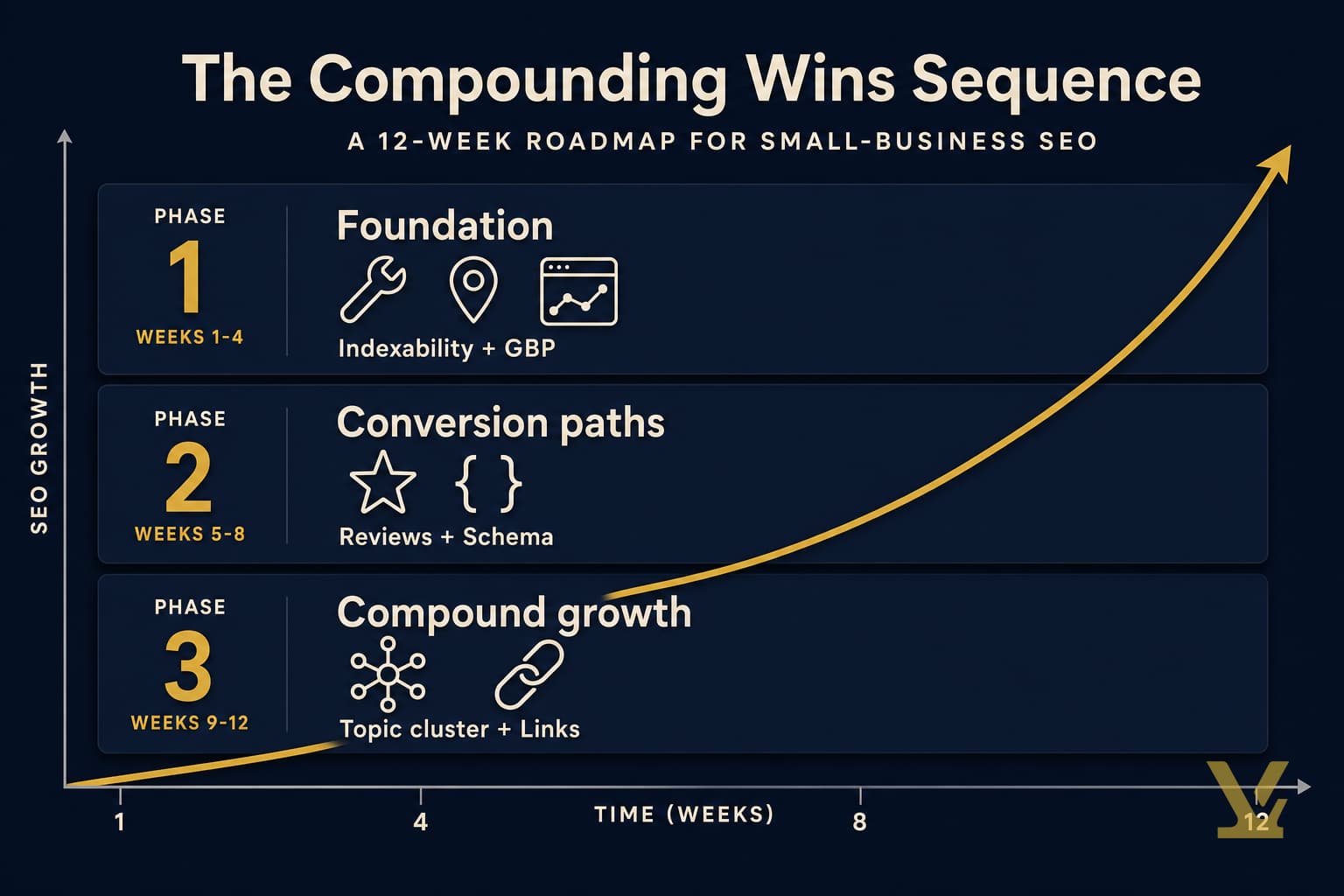
Days 0-30 - Foundations. Run the 7 quick wins across every existing post. Submit your sitemap, fix any robots.txt or HTTPS issue, and pick a keyword cluster you will own. KPIs: indexed-page count, average position for branded queries, and CTR on existing posts. Do not look at organic clicks yet - the data is too noisy.
Days 31-60 - Content cluster. Publish 4-6 articles inside the chosen cluster, each answering a different intent (hub, comparison, how-to, FAQ). Internal-link them densely. KPIs: cluster articles indexed, impressions per cluster query, distinct keywords per article.
Days 61-90 - Iteration. In Search Console, sort queries by impressions and find anywhere you rank in positions 8-20. Update those posts (better intro, fresh examples, an extra section), republish with the same URL, and ping the URL in Search Console. KPIs: updated pages, position deltas, and clicks. By day 90 a healthy creator site sees impressions doubling month-over-month for cluster queries.
The first measurable click lift arrives in week 8-12. See compounding versus bleeding traffic.
Common beginner mistakes (and what to do instead)
- Chasing volume over intent. 50,000 searches with wrong intent loses to 500 searches with perfect intent. Sort by intent first.
- Writing for keywords, not searchers. If a post repeats the keyword 30 times but never answers the question, Google ranks a thinner page that does.
- Publishing once and walking away. 70% of our refresh wins come from updating posts six months in, not new ones. Calendar it.
- Buying backlinks. Fastest path to a manual penalty. Just do not.
- Ignoring image weight. A 4MB hero kills mobile LCP. Compress under 200KB before upload.
- Switching strategies every two weeks. Pick a cluster, work it 90 days, then evaluate. Pivots inside that window destroy compounding.
How VarynForge fits in
If keyword research is the step that scares you, that is exactly what VarynForge collapses: paste a seed topic, get an intent-tagged cluster of long-tail keywords with difficulty in minutes, export the cluster as a draft brief your CMS can ingest - so the rest of this checklist is the only work left, on a creator-friendly plan.
Frequently Asked Questions
How long does it take to see SEO results?
On-page tweaks to already-indexed posts can move click-through rate inside two to four weeks because Google re-crawls active pages often. New posts targeting fresh queries take 8-16 weeks to stabilize. The compounding effect is real but boring: almost nothing in month one, modest movement in month two, a step-change in month three if the on-page work was correct.
Can I improve SEO without hiring a developer?
Yes for everything in this guide. Modern site builders (WordPress, Ghost, Webflow, Squarespace, Substack) expose every SEO field through their admin UI. The only items that occasionally need a developer are custom schema, complex redirects, and server-side performance work - none of which are required to rank. If your platform hides these settings, switch platforms before hiring help.
What free tools should a beginner use for keyword research?
Start with Google Search Console (queries already getting impressions) plus Google Trends (whether a topic is rising). Add a free-tier keyword expander like VarynForge or AnswerThePublic for long-tail variations. Avoid Chrome extensions that scrape vague volume estimates - the numbers steer you toward wrong-intent keywords. Two real data sources beat seven sketchy ones.
What on-page elements should I optimize first?
Title tag and meta description, in that order, on your top 5 already-indexed posts. These move click-through rate without requiring you to rewrite anything. Once the top 5 are tightened, work down the list in descending order of current impressions in Search Console - that is where lift is cheapest.
How do I check if my site is too slow?
Run your homepage and one article URL through Google PageSpeed Insights. The mobile score matters more than desktop because Google's index is mobile-first. Below 50, the bottleneck is almost always images (compress to under 200KB), an oversized theme, or third-party scripts. Fix in that order; rarely do you need to touch anything server-side.
How do I pick which keywords to target as a beginner?
Pick five keywords inside one cluster that match a single intent, where difficulty is low to medium and the SERP is dominated by sites your size, not enterprise brands. One well-chosen cluster for a quarter beats spraying twenty unrelated keywords. The cluster signals topical authority, which is what compounds.
Key Takeaways
Improving SEO as a non-technical creator is mostly editing what you already shipped. Run the quick wins in an hour, follow the beginner sequence (keyword research, on-page, basic technical checks) for a month, and commit to a 90-day cluster before measuring. Track what moves - title CTR, indexed pages, query-level impressions - and ignore vanity metrics. Most creators we work with see meaningful organic lift between weeks 8 and 12, and the lift compounds if they keep refreshing posts on a schedule. The boring sequence works.
Further Reading
- Search Engine Optimization (SEO) Starter Guide - Google for Developers
- Moz's Beginner's Guide to SEO
- 8 Best Practices to Boost SEO Performance (FoundryCo)
- SEO Tips for Small Businesses (BDC)
- How to improve SEO on Google
- How to improve SEO for small businesses
Sources
Frequently asked questions
How long does it take to see SEO results?
On-page tweaks to already-indexed posts can move click-through rate inside two to four weeks because Google re-crawls active pages often. New posts targeting fresh queries take 8 to 16 weeks to stabilize. The compounding effect is real but boring: almost nothing in month one, modest movement in month two, a step-change in month three if the on-page work was correct. Most creators we work with see meaningful organic lift between weeks 8 and 12, and the lift compounds if they keep refreshing posts on a schedule. The boring sequence works.
Can I improve SEO without hiring a developer?
Yes for everything in this guide. Modern site builders — WordPress, Ghost, Webflow, Squarespace, Substack — expose every SEO field through their admin UI. The only items that occasionally need a developer are custom schema, complex redirects, and server-side performance work, none of which are required to rank. If your platform hides these settings, switch platforms before hiring help. About 70 percent of the ranking gain comes from titles, internal links, and on-page hygiene the author can do in an afternoon. The other 30 percent is depth and patience.
What free tools should a beginner use for keyword research?
Start with Google Search Console for queries already getting impressions plus Google Trends for whether a topic is rising. Add a free-tier keyword expander like VarynForge or AnswerThePublic for long-tail variations. Avoid Chrome extensions that scrape vague volume estimates — the numbers steer you toward wrong-intent keywords. Two real data sources beat seven sketchy ones. Pair these with Bing Webmaster Tools for free generous keyword data, and submitting your sitemap there covers ChatGPT search indirectly.
What on-page elements should I optimize first?
Title tag and meta description, in that order, on your top five already-indexed posts. These move click-through rate without requiring you to rewrite anything. Once the top five are tightened, work down the list in descending order of current impressions in Search Console — that is where lift is cheapest. Aim for a 50-60 character title with the primary keyword early, written for the click. Pair it with a 150-160 character meta description with a benefit and CTA, never duplicated. Title-tag tweaks alone typically move CTR 5 to 15 percent on already-indexed pages.
How do I check if my site is too slow?
Run your homepage and one article URL through Google PageSpeed Insights. The mobile score matters more than desktop because Google's index is mobile-first. Below 50, the bottleneck is almost always images that need to be compressed under 200KB, an oversized theme, or third-party scripts. Fix in that order; rarely do you need to touch anything server-side. Target Lighthouse mobile 60-plus for content sites and confirm Core Web Vitals — LCP, INP, CLS — are in the green band. Run PageSpeed once per template, not per post; scores are template-driven.
How do I pick which keywords to target as a beginner?
Pick five keywords inside one cluster that match a single intent, where difficulty is low to medium and the SERP is dominated by sites your size, not enterprise brands. One well-chosen cluster for a quarter beats spraying twenty unrelated keywords. The cluster signals topical authority, which is what compounds. Sort by intent first — 50,000 searches with wrong intent loses to 500 searches with perfect intent. Group seed topics by informational, navigational, commercial, or transactional. Write for one intent per page, and re-read the SERP because the first three results define the format.
What are the seven quick wins I can do in an hour?
Rewrite the title tag aiming for 50 to 60 characters with the keyword early. Tighten the meta description to 150 to 160 ad-copy characters. Add three internal links per post to older related posts in the body, not a footer block. Fix image alt text with one-sentence descriptions, no keyword stuffing. Kill duplicate titles where the same H1 appears on two pages — one wins, the other gets merged or redirected. Run a mobile check by opening the post on your phone. Surface a shareable snippet by pulling one quotable sentence into an early paragraph and bolding it for AI Overviews to lift.