
How to Generate Organic Traffic: Actionable Steps for Content Creators
Generate organic traffic as a creator with a priority framework, technical SEO checklist, precision keyword workflow, and a 90-day measurement loop.
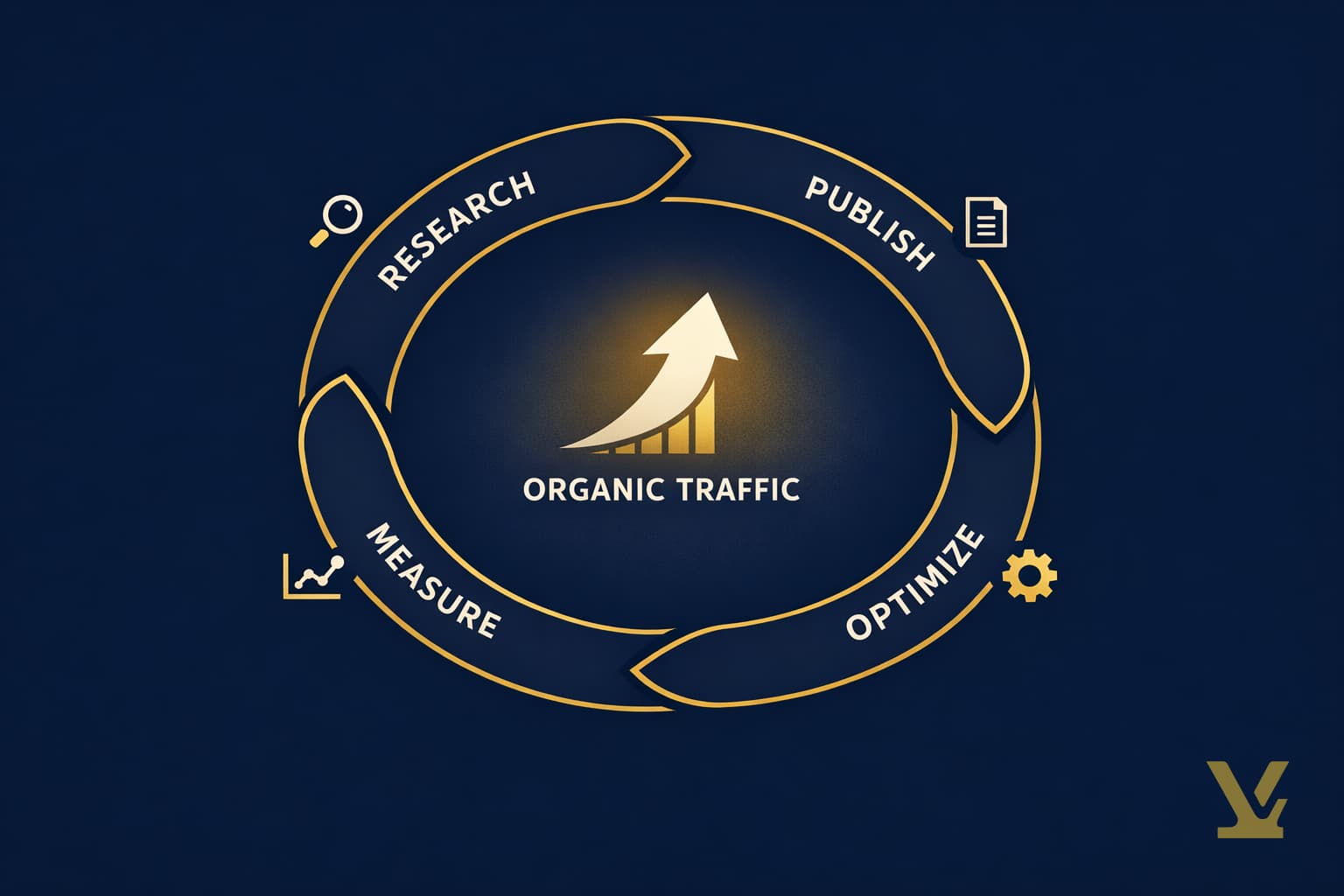
Most advice to generate organic traffic is aimed at agencies with budget and backlinks already in motion. This guide is different. It is a prioritized, creator-scale playbook for solo operators and small teams who need to compound visits without hiring an SEO agency, running ads, or guessing which tactic to try next.
If you have already read our pieces on growing traffic without ad spend and on compounding versus bleeding content, this article is the layer underneath: the technical foundation, keyword workflow, and measurement loop that make those strategies actually work in a real week of real writing time.
What this guide covers and who it is for
Organic traffic is the visits a site earns from unpaid search results. The four KPIs that matter for creators are organic sessions (how many visits), organic users (how many distinct humans), click-through rate from the SERP, and the conversion rate once visitors land. Pageviews without sessions or users is vanity; sessions without CTR tracking hides the sentence-level fix to low-performing titles.
This playbook assumes you write your own content, own your own site, and have no agency behind you. It is especially useful for technical blogs, niche newsletters, solo SaaS founders writing their own marketing blog, and creator-operators juggling one more channel on top of their main craft.
Core principles to generate organic traffic as a creator
Every tactic below is ordered by the same rule: impact divided by effort, applied to a single creator's weekly budget. That one constraint reorders most SEO advice, because moves that look equally valid for an agency diverge sharply once one person owns both the writing and the technical work.
Use this decision rule for every new tactic you consider: will this, in the next 30 days, either (a) raise the probability of indexation, (b) raise click-through from an existing impression, or (c) raise the conversion rate of an existing clicker? If the answer is no to all three, it goes at the back of the queue regardless of who recommended it.
Technical SEO checklist every creator must complete

Technical SEO is not optional. If search engines cannot crawl, render, and index a page, nothing downstream matters. Work through this list once, then re-verify monthly. The whole section takes an afternoon and catches most of the silent-failure modes that keep creator sites invisible.
- Crawlability: confirm pages return HTTP 200 and that no accidental noindex tags are set by a theme or plugin. Use the URL Inspection tool in Google Search Console to verify.
- Indexing: every article you want traffic on should appear as indexed in Search Console within about seven days. If it stalls, request indexing manually and investigate root cause before publishing more.
- Sitemap: publish an XML sitemap and submit it in Search Console; include only canonical, indexable URLs. See the Google sitemap overview.
- Robots.txt: allow crawling of content directories, disallow staging and admin paths. Reference: Google's robots.txt introduction.
- Canonicalization: every page declares a self-referential canonical tag to prevent duplicate-URL splitting of ranking signals (Google canonicalization docs).
- Structured data: add Article or BlogPosting JSON-LD so Google can render rich results (Structured data intro).
- Core Web Vitals: target LCP under 2.5 seconds, INP under 200 ms, and CLS under 0.1 on mobile, per the Google Core Web Vitals reference. These are ranking signals and correlate tightly with bounce.
If you run WordPress, the fastest way to check most of this is a single plugin audit. Our WordPress SEO plugin comparison covers which plugins surface each of these checks without wiring them up manually.
Keyword research and content planning with a precision-first approach

Most creators fail at keyword research by running on instinct: pick a topic that sounds interesting, then guess at the keyword. Precision-first flips the order. Start with a short, tested list of target queries, then write the article each query demands.
The precision-first loop has four steps. First, seed with five real questions pulled from your inbox, community Discord, or support threads. Second, expand each seed through a keyword tool to surface variants and volume. Third, filter by intent (informational, commercial, etc.) and by realistic difficulty for a site at your current Domain Authority. Fourth, rank the survivors by impact over effort and pick the top three for the next 30 days.
This is where a tool like VarynForge earns its keep: the platform ingests your niche, runs the expansion and filtering in one pass, and returns a prioritized shortlist so you are not fighting a spreadsheet. For deeper tool comparisons, see our true-cost keyword research buyer's guide and the free SEO tools picks for creators on a budget.
Prioritize keywords and map them to content types
Intent dictates the format. Mapping it wrong is the most common reason creator articles underperform: a comparison page written for an informational query will lose to a how-to guide every time, no matter how well the comparison is written.
- Informational ("how does X work") maps to a how-to guide or explainer, 1,200 to 2,000 words, heavy on examples.
- Navigational ("X documentation") maps to a pillar page or resource hub that links out to the detailed docs.
- Commercial ("best X for Y") maps to a comparison article with a true-cost table and a clear verdict.
- Transactional ("buy X", "X pricing") maps to a landing page with a CTA, not a blog post.
Create content that ranks and converts
Google's Helpful Content guidance rewards articles written for people by someone with first-hand experience of the topic. For a creator, that is a real advantage over agency writers: you have done the thing. Surface it. Include the specific version number you tested, the exact error you hit, the configuration that finally worked. Generic synthesis loses to specific lived experience every time.
On-page mechanics still matter. Put the primary keyword in the title, H1, first paragraph, and at least one H2. Write a meta description in 150 to 160 characters that makes a concrete promise. Use descriptive anchor text on every internal link. Break paragraphs at 150 words maximum so readers on mobile do not abandon.
For the strategic layer, including why to build evergreen pages instead of news posts and how to spot bleeding content early, read the deep dive on compounding versus bleeding content. That piece lays out the editorial policy the tactics here plug into.
Distribution, repurposing, and engagement signals
Fresh content with zero distribution sits below the indexation fold for weeks. Every article should ship with a small, repeatable distribution checklist: post to a primary newsletter, share in one or two niche communities where it genuinely helps an active thread, and repurpose the strongest section into a standalone social post.
Distribution is the chapter most agency playbooks get wrong for creators, because they assume paid amplification. For the no-budget 30-60-90 day quick-wins framing tuned for creators specifically, the companion guide on growing organic traffic without ad spend covers the channel mix in depth. This section here is only the minimum every article should clear before calling it published.
Link acquisition and outreach tactics for creators
Backlinks still correlate tightly with rankings, but the classic agency link-building tactics (HARO at scale, link farms, aggressive guest-post outreach) do not survive at creator scale. What does survive: building a single resource page other creators will naturally reference, contributing one thoughtful comment per week on a niche newsletter, and swapping deep-dive links with one complementary site per month.
Measure link ROI by a single proxy: referring-domain growth per hour invested. A link from a site with 500 engaged readers in an exact-match niche usually beats a link from a high-DR directory, because the first drives compounding referrals and the second decays the moment search engines deprioritize that directory class. Evaluate links the way you evaluate followers: quality, not count.
Measure, test, and iterate: analytics and experiments

A measurement stack at creator scale needs only three things: Google Search Console for impressions, clicks, CTR, and position; a simple analytics tool (GA4, Plausible, or Fathom) for sessions and conversions; and a spreadsheet to track weekly deltas. If you cannot answer "did last week's change move the needle?" in under 60 seconds, the stack is too complicated.
The iteration loop is diagnostic, not experimental. When a page underperforms, diagnose which of three failure modes hit: low impressions means indexation or keyword-mismatch; low click-through on decent impressions means the title or meta needs a rewrite; low conversion on decent clicks means the on-page CTA or intro is weak. Fix one lever per cycle, wait 14 days, re-measure. Do not stack changes.
90-day actionable plan and quick checklist
Spend week one on the technical checklist and the first five keyword targets. Weeks two through four: publish two articles tied to the top two keywords, each with inline citations. Weeks five through eight: publish two more plus the first internal-link pass across the existing stack. Weeks nine through twelve: measure winners, double down on the top two, retire or rewrite the bottom two. Ninety days is enough to know whether a cluster has legs; if none of your top picks have moved past page three by day 90, the brief was wrong, not the writing. For the zero-budget version of this same sequence, see how to get organic traffic to your website for free.
Frequently Asked Questions
How long before I see meaningful organic traffic growth?
Most creator sites see first meaningful impressions within four to eight weeks of publishing and first meaningful clicks within twelve to sixteen weeks. Under three months is usually too soon to judge a keyword; past six months without movement usually means the intent-to-content match was wrong rather than the writing.
Which technical SEO issues block small creator sites most often?
In order: accidental noindex tags pushed by a theme or plugin update, duplicate canonicals caused by CMS query parameters, slow Largest Contentful Paint on image-heavy posts, and sitemaps that silently stop updating after a new post publishes. The seven-item technical checklist earlier in this article catches all four.
How do I prioritize keywords with limited content capacity?
Rank every candidate by estimated monthly traffic multiplied by your probability of ranking in the top 10 at your current Domain Authority, divided by hours to write. The top three by that ratio are what you ship this month. Anything below rank five is a distraction until the top three either rank or fail.
Can I generate organic traffic without building backlinks?
For low-difficulty informational queries at Domain Authority under thirty, yes: topical depth, internal linking, and on-page quality alone will rank you. For commercial or competitive queries, backlinks are still the tiebreaker. Creators should treat link acquisition as a slow, quality-over-quantity effort rather than skipping it entirely.
Further Reading
- SEO Starter Guide (Google Search Central)
- Moz's Beginner's Guide to SEO
- Learn Performance (web.dev)
- How to raise organic traffic of a new website from zero (Reddit r/SEO)
- How To Increase Organic Traffic: 7 Strategies (Yotpo)
- How to get organic traffic for free
- Increase website traffic free: zero-budget tactics
Sources
- Google Search Central: Core Web Vitals
- Google Search Central: Introduction to Structured Data
- Google Search Central: Canonicalization
- Google Search Central: Introduction to robots.txt
- Google Search Central: Sitemaps Overview
- Google Search Central: Creating Helpful Content
How VarynForge fits in
VarynForge maps the organic-traffic playbook above onto your own niche: ranked keyword opportunities grouped by cluster, with content briefs attached so you can write (or generate) without rebuilding strategy each time. It compresses the planning loop — research, prioritization, brief — into one queue. See current VarynForge pricing.
Key Takeaways
Generate organic traffic as a creator by ruthlessly prioritizing. Start with the technical SEO checklist so nothing silently blocks indexation. Run keyword research on an impact-over-effort basis and let intent dictate format. Write from first-hand experience at every step rather than generic synthesis. Distribute every article through a minimum, repeatable channel mix before declaring it shipped. Measure three levers (impressions, clicks, conversions) on a 14-day cadence and fix one at a time. Lean on the internal-linking layer: cross-linking deep-dive pieces is itself a ranking signal and a shortcut for both readers and search engines.
Frequently asked questions
How long before I see meaningful organic traffic growth?
Most creator sites see first meaningful impressions within four to eight weeks of publishing and first meaningful clicks within twelve to sixteen weeks. Under three months is usually too soon to judge a keyword. Past six months without movement usually means the intent-to-content match was wrong rather than the writing. Diagnose by mode: low impressions points to indexation or keyword mismatch, low click-through on decent impressions points to a title or meta rewrite, low conversion on decent clicks points to a weak on-page CTA or intro.
Which technical SEO issues block small creator sites most often?
In order: accidental noindex tags pushed by a theme or plugin update, duplicate canonicals caused by CMS query parameters, slow Largest Contentful Paint on image-heavy posts, and sitemaps that silently stop updating after a new post publishes. The seven-item technical checklist in this article catches all four. Re-verify monthly because each of these can be reintroduced by a routine plugin update or theme change — they are silent-failure modes, not one-time fixes.
How do I prioritize keywords with limited content capacity?
Rank every candidate by estimated monthly traffic multiplied by your probability of ranking in the top 10 at your current Domain Authority, divided by hours to write. The top three by that ratio are what you ship this month. Anything below rank five is a distraction until the top three either rank or fail. The decision rule for any new tactic: will this in the next 30 days raise indexation probability, click-through from an existing impression, or conversion rate of an existing clicker? If no, it goes at the back of the queue.
Can I generate organic traffic without building backlinks?
For low-difficulty informational queries at Domain Authority under thirty, yes — topical depth, internal linking, and on-page quality alone will rank you. For commercial or competitive queries, backlinks are still the tiebreaker. Creators should treat link acquisition as a slow, quality-over-quantity effort rather than skipping it entirely. Measure link ROI by referring-domain growth per hour invested. A link from 500 engaged readers in an exact-match niche usually beats a link from a high-DR directory because the first drives compounding referrals.
How do I match keyword intent to the right page format?
Intent dictates format. Informational queries like how does X work map to a how-to guide or explainer of 1,200 to 2,000 words, heavy on examples. Navigational queries like X documentation map to a pillar page or resource hub linking out to the detailed docs. Commercial queries like best X for Y map to a comparison article with a true-cost table and a clear verdict. Transactional queries like buy X or X pricing map to a landing page with a CTA, not a blog post. Mapping format wrong is the most common reason creator articles underperform.
What does a 90-day creator publishing plan look like?
Spend week one on the technical checklist and the first five keyword targets. Weeks two through four publish two articles tied to the top two keywords with inline citations. Weeks five through eight publish two more plus the first internal-link pass across the existing stack. Weeks nine through twelve measure winners, double down on the top two, retire or rewrite the bottom two. Ninety days is enough to know whether a cluster has legs. If none of your top picks have moved past page three by day 90, the brief was wrong, not the writing.