Find High-Value Keywords Like a Google Ads Keyword Strategy Pro
Map paid CPC data into organic content using the CPC Floor Test, a six-step workflow, and a 30 and 90 day plan that scales winners across both.
A google ads keyword strategy only earns its name when it changes two decisions, not one. The first is which keywords to bid on this quarter; the second is which keywords to build organic pages around next quarter. Most articles on the topic treat those as separate jobs run by separate teams. The thesis here is the opposite: paid-search data is the single highest-fidelity organic-intent signal you have, and an experienced Google Ads operator running a 90-day search-terms report already knows which organic pages your editorial team should build.
What follows is the workflow I use with PPC managers and SEO leads on the same engagement: a discovery model borrowed from advertisers, a clustering method that ports cleanly between ad groups and topic clusters, and a 30/90-day testing plan. The load-bearing rule — the CPC Floor Test — sits at the centre of the prioritisation section.
How Google Ads pros prioritise keywords (principles, not tools)
Experienced advertisers stopped thinking about keywords as "search terms" years ago. They think about them as commercial bets with five attached prices: value per conversion, conversion rate, click-through rate, cost per click, and budget opportunity cost. Volume is a tie-breaker, not an input. A query with 200 monthly searches and a $14 CPC beats one with 20,000 searches and a $0.40 CPC almost every time, because the auction is pricing intent the way a market prices risk (Google Ads API reporting overview).
Three principles fall out of that mindset. Intent is whatever the auction says it is. Match types and negative keyword lists are the steering wheel — they decide which adjacent queries qualify, the same problem editors face when assigning cluster boundaries. The testing mindset is short, ruthless, and budgeted: campaigns earn a fixed-window trial, hit a minimum-data threshold, and either scale, hold, or die.
Your organic team should inherit this model. Most SEO teams plan content from a Keyword Planner export sorted by volume; an advertiser would never sort that export by volume first. The advertiser sorts by value per click (CPC x conversion rate x average order value) and routes only the survivors to the editorial calendar. That single re-sort is the difference between a content plan that pays for itself in two quarters and one that does not.
A step-by-step google ads keyword strategy workflow for paid and organic

Run this workflow once per category per quarter. Six steps, in order, with explicit hand-offs between the PPC and content owners. Anything that survives all six is investable on both surfaces.
- Seed expansion against the auction. Start with 8-12 head terms. Run them through Keyword Planner, autocomplete, and "People also ask" — same starting pass an SEO would do, with one addition: pull CPC ranges and bid estimates for every term via the historical-metrics API. Target 200-400 candidates with both volume and a CPC attached.
- Intent classification by SERP and SQR. For each candidate, do two passes: tag the organic SERP intent, and check whether the term has appeared in your campaigns' search terms report. SQR rows are pre-validated by real searchers and ad clicks — stronger than any third-party tool.
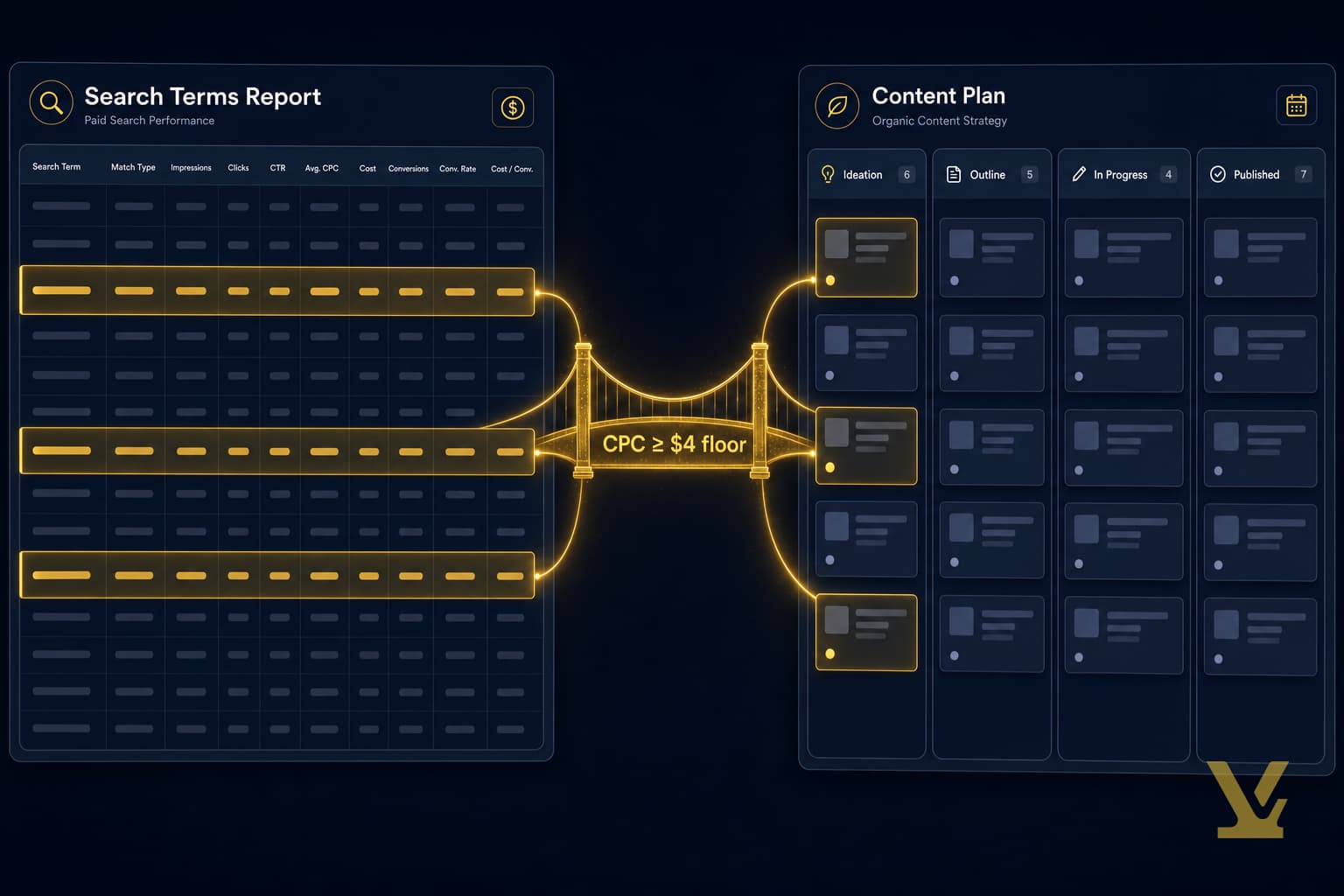
- CPC Floor Test. The central filter. Set a CPC threshold that signals strong commercial intent in your category — usually $4 in mid-market B2B SaaS, $1.50 in lifestyle DTC, $25 in legal/financial. Anything at or above the floor stays in the prioritisation pool. Below the floor is either pure information-seeking (route to thought leadership) or noise.
- Competitor overlap pass. Use auction-insights data (Google Ads overview) to see which advertisers consistently outbid you on the survivors. Three-of-five overlap with your top organic competitors = high-EV target; zero overlap = one-bidder anomaly, verify before committing budget.
- Value-per-click ranking. Rank survivors by CPC x estimated conversion rate x average order value. Top quartile is your paid-and-organic priority list; middle two quartiles are paid-only or organic-only depending on margin; bottom is parked.
- Cluster and assign. Group survivors into clusters, then assign each one a dual asset: one ad group plus one pillar-or-cluster page. The boundary is identical on both surfaces — that constraint is what makes the workflow scale. For the assignment math see our topic-clusters keyword-research guide.
Tools and signals to triangulate high-value keywords
No single tool answers the value question. The cheapest reliable stack is Google Keyword Planner for volume and CPC, Search Console for intent validation, the search terms report for downstream conversion data, and a free clustering pass on top of all three. Paid tools add velocity, not accuracy. For free workflows that read the same signals see our practical guide to free Google keyword tools, and for Keyword Planner's known measurement errors see accurate Google keyword research.
Keyword clustering and campaign-or-content grouping

Clustering is where most paid-and-organic crossovers fall apart. The PPC manager wants ad groups tight enough to support a single ad headline; the content lead wants topic clusters wide enough to support a 2,000-word pillar. The reconciliation is a three-layer model: a theme (one editorial pillar and one campaign), a cluster (one cluster page and one ad group), and an exact keyword (one bid and one in-page H3). Themes contain 4-10 clusters; clusters contain 8-30 exact terms.
Same boundary rule on both surfaces: if two terms cannot share an ad headline, they cannot share an ad group, and they should not share a page. The discipline cuts both content sprawl and ad-group sprawl in one motion. For a reproducible clustering walkthrough see our keyword-clustering method, and for the seed-to-prioritised pipeline that feeds it see the seed-to-high-intent walkthrough.
Grouping tactics: match types, negatives, and naming conventions
Match types are the API the auction gives you for telling Google how loose or tight to be. The 2026 default: broad match plus Smart Bidding for discovery, exact match for proven clusters, phrase match only during legacy migrations. Pair every broad-match campaign with a negative keyword list that grows weekly from the search terms report; the absence of a negatives discipline is the most common reason a "scaled" campaign quietly bleeds budget.
Naming conventions matter more than they look. A pattern of {theme}/{cluster}/{intent} lets a freelancer onboard in an afternoon and survives every account migration. Reuse the same convention on the organic side as the URL slug and the editorial calendar's row labels.
Aligning paid keyword research with organic content strategy

This is where the CPC Floor Test pays off. Mapping a paid keyword cluster into a content brief is mechanical once the floor has done the filtering: every cluster above the floor earns a money page; every cluster below the floor earns a thought-leadership piece that links to the money page. The architecture is bottom-of-funnel on top, middle-of-funnel underneath, with internal links pointing upward.
Three illustrative engagement archetypes, aligned with Google's own framing on search ads incrementality. A mid-market B2B SaaS firm with a $4 CPC floor mapped 92 surviving keywords into 14 cluster pages and produced a meaningful lift in organic conversions inside a quarter versus a volume-sorted control. A DTC skincare brand with a $1.50 floor mapped long-tail variants into 22 pillars and pulled paid spend down as organic took over bottom-of-funnel terms. A regional law firm with a $25 floor produced exactly nine survivors — and those nine produced two new client matters in six weeks.
Two structural notes. The post you write for a high-CPC cluster should still answer the informational question completely — Google's helpful-content guidance rewards depth. And the landing page the ad points to and the organic page that ranks for the same term should be the same URL — splitting them halves your authority on the cluster. For the wider planning context see our content-strategy primer.
Measure value: cost, conversions, signals for scaling or killing
Three metrics carry the weight, and they apply identically to paid and organic decisions once you collect them per cluster rather than per keyword.
- Value per click. Conversion rate multiplied by average order value, expressed in the same currency as your CPC. A cluster where value per click is at least 1.5x the median CPC is profitable on the paid surface and a credible organic target. Below 1x, kill the bid and reroute the cluster to thought leadership only.
- Search-term coverage ratio. Unique converting search terms (the auction-validated quality-score input set) divided by total query matches for the cluster. A healthy cluster grows this ratio quarter over quarter as Smart Bidding learns; a flat or declining ratio signals the cluster is over-fitted or the ad copy is misaligned.
- Organic capture share. Once the organic page indexes, divide the share of cluster impressions captured organically against the share captured by your paid ad. Crossing 30% organic capture is the trigger to reduce paid spend on that cluster.
Minimum thresholds keep the scale-or-kill decisions honest. A cluster needs 1,000 impressions and 30 clicks before the metrics are reliable on either surface; 30 aggregate conversions before you change the bid strategy. Below that, hold the line.
Implementation checklist and 30/90-day testing plan
Days 0-30 — calibrate the floor, build the list, ship the first dual asset.
- Pull the last 90 days of search terms data and compute the median CPC of converting queries in your category — that is the starting floor.
- Run the six-step workflow on one category. Target 30-60 keywords above the floor, grouped into 4-8 clusters.
- Map each cluster to a dual asset: one ad group, one pillar-or-cluster page. Confirm the URL slug, ad-group name, and brief title all use {theme}/{cluster}/{intent}.
- Ship the first dual asset end-to-end. Bid 14 days paid; publish the page organic; instrument both into a shared dashboard.
Days 31-90 — drip the cluster, measure, scale or kill.
- Publish three to six cluster pages per month, in lockstep with paid expansion on the same clusters.
- Weekly negatives audit on paid; weekly search-term coverage review on both surfaces.
- Day 60: retire any cluster whose value-per-click is below 1x the floor on both surfaces.
- Day 90: clusters above 1.5x earn next-quarter budget; clusters between 1x and 1.5x stay on one surface only; clusters below 1x are sunsetted.
Common pitfalls when porting Google Ads tactics to organic
Three failure modes account for most bad outcomes. Over-weighting volume — a high-volume keyword with sub-floor CPC rarely repays the content investment. Mis-mapping intent — an "informational" SERP that returns commercial intent inside the auction is a paid-and-organic target; one that returns informational intent in the auction is thought-leadership only. Ignoring margin — a $40 CPC on a category with $80 AOV prices the cluster at half your contribution margin; even at 5% conversion you bid into a structural loss. The CPC Floor Test is necessary, not sufficient; pair it with a margin-floor cross-check. For the wider tool-economics view see our true-cost buyer guide to keyword research tools.
How VarynForge fits in
Running the CPC Floor Test plus the six-step workflow across a real account means juggling three spreadsheets per cluster across two teams — which is where the discipline usually slips. VarynForge is built for exactly this: auction-priced intent scoring on each cluster, dual-asset assignment between ad groups and pillar pages, and a brief-to-publish pipeline that keeps the paid-and-organic boundary in sync as both sides scale.
Further Reading
- Google - Find Your Campaign Keywords with Keyword Planner
- Google Ads API - Keyword Planning overview
- Think with Google - Search ads incrementality
- Google - AI-powered ads at Google Marketing Live
- Wikipedia - Pay-per-click
Sources
- Google Ads API - Reporting overview
- Google Ads API - Generate historical metrics
- Wikipedia - Google Ads
- Wikipedia - Negative keyword
- Wikipedia - Quality Score
- Google Search Central - Creating helpful content
- Wikipedia - Pay-per-click
Key Takeaways
A Google Ads keyword strategy worth running for paid is almost always worth running for organic too — provided you sort in the right order. The CPC Floor Test re-prioritises a Keyword Planner export by auction-priced commercial intent rather than by volume, and the same cluster boundaries port cleanly between ad groups and pillar pages. The 30/90-day plan tests the floor inside one quarter and scales the winners across both surfaces in the next.
This gives PPC managers and SEO leads a shared decision contract. The PPC manager bids the floor; the content lead writes for the floor's survivors; the data flows in one direction. Pick a category this quarter, calibrate the floor against your own search-terms data, and let the workflow do the prioritising.
Frequently asked questions
How do I find keywords for Google Ads that are likely to convert rather than just have high volume?
Stop sorting your Keyword Planner export by search volume. Sort it by value per click instead, which is cost per click multiplied by your estimated conversion rate multiplied by your average order value. The auction is already pricing commercial intent for you, so high-CPC terms in your category are usually the ones that convert. Apply a CPC Floor Test — set a minimum CPC that signals strong commercial intent in your vertical, around four dollars for mid-market B2B SaaS, one fifty for lifestyle DTC, twenty-five for legal or financial services — and only keep terms at or above that floor. Cross-check the survivors against your existing search terms report; rows that have already produced conversions in your account are the strongest signal you will ever get, stronger than any third-party estimate. Volume is a tie-breaker once the floor and the value-per-click ranking have done their work, not the primary input.
What signals from Google Keyword Planner should I combine with search terms and account data to prioritize keywords?
Pull four signals together and read them as a stack. From Keyword Planner take the CPC range and the bid estimate for the top of the page — those two together are the market-priced intent score. From your search terms report take the actual converting queries and their attached conversion rate. From Search Console take the impressions and click-through rate for the same terms on the organic side, which tells you whether the SERP intent matches the auction intent. From Auction Insights take the overlap rate with your top three competitors. A term that has a CPC above your floor, a real conversion history in your account, a non-trivial organic click-through rate, and significant competitor overlap is a paid-and-organic priority. Missing any one of those four is a yellow flag; missing two is a parked cluster.
How do I cluster keywords into ad groups and topic clusters without creating overlap or cannibalization?
Use a three-layer model with the same boundary on both surfaces. Themes are the widest layer and map to one campaign and one editorial pillar. Clusters sit inside themes and map to one ad group and one cluster page. Exact keywords sit inside clusters and map to one bid and one in-page subheading. The single rule that prevents cannibalization is the ad-headline test — if two terms cannot share a single ad headline, they cannot share an ad group, and they should not share a page either. Apply that rule and you cut paid cannibalization and content sprawl in one motion. On the organic side, pair each cluster page with a clear internal link up to the pillar and across to sibling clusters, and use a naming convention like theme over cluster over intent so the URL slug, the ad-group name, and the brief title all match. The boundary holds because it is encoded the same way three times.
What match types and negative keyword strategies should I use when scaling keywords across campaigns?
For 2026, the default that survives audits is broad match plus Smart Bidding for the discovery phase, exact match for the proven-cluster phase, and phrase match only when migrating off a legacy account structure. Google now recommends the broad-match-plus-Smart-Bidding pattern explicitly because the bidding signals carry more of the intent work than match-type narrowing used to. The catch is that broad match without aggressive negative keyword discipline burns budget fast. Run a weekly negatives audit on every broad-match campaign — pull the search terms report, tag every irrelevant query, and add it to a campaign-level or account-level negative list. Build at least three reusable negative lists: a brand-protection list for competitor terms you intentionally avoid, a job-seeker list for free or career-related variants, and a wrong-product list for adjacent categories you do not serve. The absence of a negatives discipline is the most common reason a scaled campaign quietly bleeds margin.
How long should I run a keyword test in Google Ads before deciding to scale or pause it?
Use minimum data thresholds, not calendar days, as your stop rule. A cluster needs at least one thousand impressions and thirty clicks before any conversion-rate signal is reliable, and at least thirty aggregate conversions before you change the bid strategy. In most mid-market accounts that lands at fourteen to twenty-one days for a properly budgeted test on a single cluster. Run the test, hit the thresholds, then decide. If the value per click is at least one and a half times your CPC floor, scale the cluster on both paid and organic surfaces; if it is between one and one and a half times, keep the cluster alive on one surface only; if it is below one, sunset it entirely. The discipline that matters is resisting the urge to optimize on noise. A cluster that looks bad after three days and three conversions is not a bad cluster; it is a cluster that has not finished its test yet.
How can I use paid keyword performance to prioritize organic content creation?
Treat your paid account as a discovery engine for your editorial calendar. Every quarter, pull the last ninety days of converting search terms above your CPC floor, deduplicate them into clusters using the same boundary rule you use for ad groups, and route the survivors to the content brief queue. The clusters that pass the floor become money pages — pillar pages or cluster pages with clear bottom-of-funnel calls to action — while clusters below the floor become thought-leadership pieces that link upward to the money pages. The architecture is bottom-of-funnel on top, middle-of-funnel underneath, with internal links pointing toward conversion. Once an organic page captures at least thirty percent of cluster impressions, reduce the paid spend on that cluster by the corresponding fraction; paid was always a learning vehicle and a coverage tool, not a perpetual subsidy. The clusters that fail on both surfaces stop everywhere — a clean, defensible decision contract between the PPC manager and the content lead.