How to Improve SEO for Small Businesses: A Step-by-Step Checklist
Most SEO checklists fail because of order, not tasks. The Compounding Wins Sequence fixes indexability first, conversion paths second, and topic clusters last.
Most small-business SEO advice hands you a list and tells you to start checking boxes. Order matters more than effort. The owners who stall are not lazy — they are doing weeks 9 to 12 work in week 1.
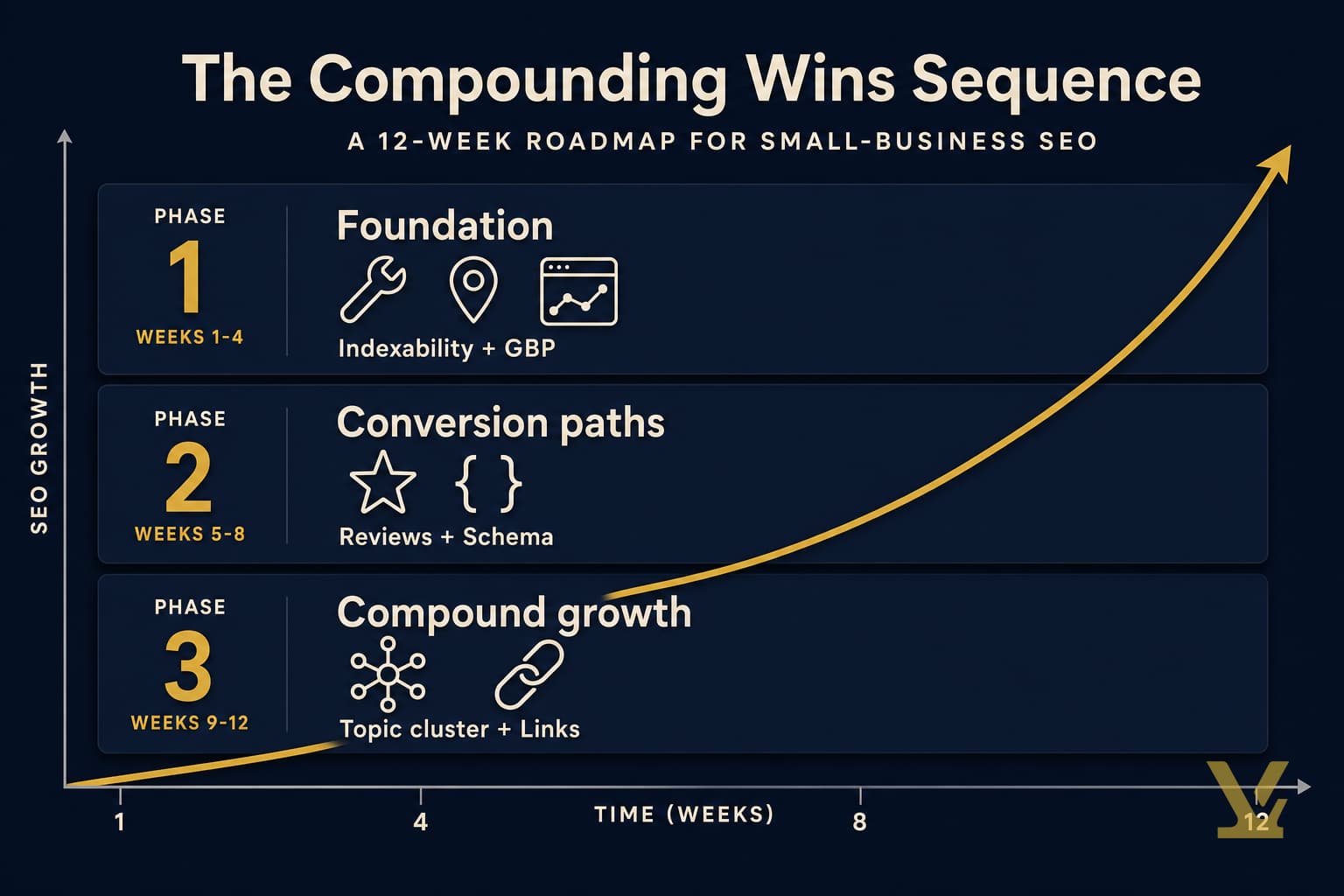
This is the step-by-step playbook for how to improve SEO for small business in 90 days. The Compounding Wins Sequence puts each task in the slot where it pays. Foundation first. Conversion paths next. Compounding work last.
How to improve SEO for small business: the Compounding Wins Sequence
Three phases, four weeks each. Each phase has one exit criterion. Hit it before you move on. Skip ahead and the new work has nothing to compound on top of.
- Weeks 1 to 4 — Foundation. Indexability fixes plus Google Business Profile. Exit when GBP is verified and Search Console reports zero indexing errors on your top 5 pages.
- Weeks 5 to 8 — Conversion paths. Three service pages with schema, plus a reviews flywheel. Exit when each service page loads under 3 seconds and you have collected 10 new reviews.
- Weeks 9 to 12 — Compound growth. Topic cluster build and earned local links. Exit when one pillar page plus 4 spoke posts are live and 3 local sites link to your homepage.
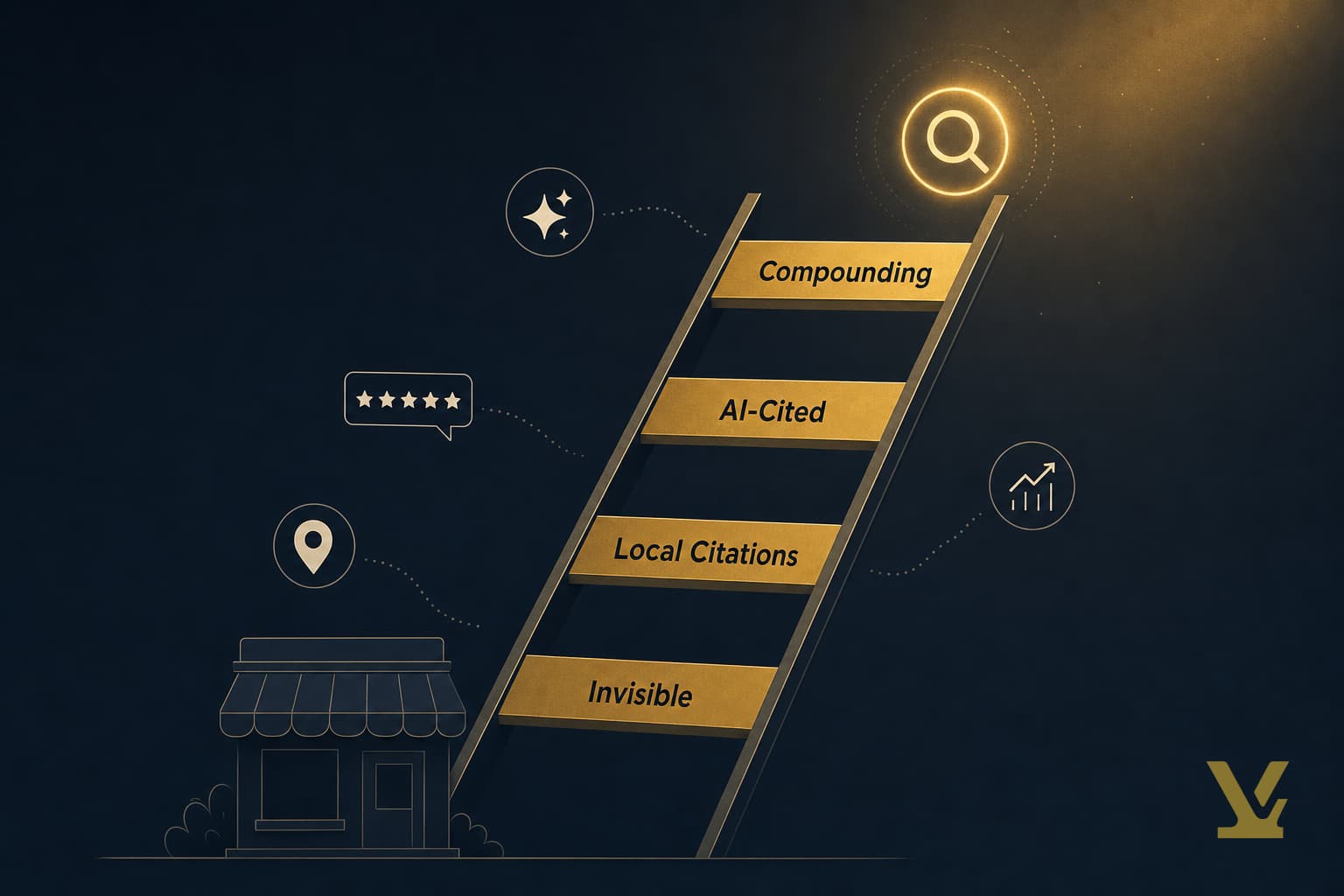
The order is the framework. Most checklists invert it — they send owners chasing blog posts before Google can crawl the site, or asking for reviews before any landing page converts the traffic. If you are wondering which rung of the maturity ladder you are on, start there, then come back for the execution order.
Weeks 1 to 4: lock in the foundation

Phase 1 is unglamorous and the highest-ROI work you will ever do. The payoff lands in days. Skip it and every other dollar wastes itself on a site Google cannot read.
Set goals you can measure in dollars
Pick one number. Phone calls per week, booked appointments, or form fills that turn into quotes. Every SEO task for the next 12 weeks has to point at that number. If a task does not, drop it.
Fix indexability before you write anything new
Verify Google Search Console. Sign in at Google Search Console. Verify ownership. Submit your sitemap. In the Pages report, anything in "Not indexed" with a soft 404, redirect issue, or noindex tag is a leak — fix those first. Per Google Search Central, sitemaps tell Google which pages matter.
Run PageSpeed once. Open PageSpeed Insights on your home page. Mobile under 50? Three fixes move the needle: oversize hero images (compress to <200KB), unused JavaScript (drop plugins you do not use), missing image dimensions (add width/height). Per Think with Google, mobile bounce probability jumps 32% as load goes from 1 to 3 seconds.
Add the basics. A robots.txt allowing everything except admin paths, an XML sitemap, a canonical tag on every page. On Wix, Squarespace, Shopify, or WordPress, the platform handles most of this — confirm, don't configure.
Complete your Google Business Profile end to end
This is the highest-ROI hour of the 12 weeks for any business with a service area. Go to google.com/business. Verify ownership. Then fill every field — categories (primary plus 2 secondary), service area, hours, products, services, attributes, photos, posts. Per BrightLocal's Local Consumer Review Survey, 87% of consumers read reviews. Profiles that skip GBP categories miss the map pack entirely.
Clean up NAP citations in one afternoon
NAP means name, address, phone — same exact spelling everywhere. Pick the canonical form, then list it on Yelp, Bing Places, Apple Business Connect, your chamber, your industry directory, and Facebook. Inconsistent NAP confuses Google's local algorithm and quietly suppresses visibility. One 90-minute block clears it.
Weeks 5 to 8: build the conversion paths

Phase 1 made you findable. Phase 2 makes the traffic worth something. Rankings without a conversion path is leaky-bucket SEO.
Write 3 service pages with schema
Pick your top 3 revenue-generating services. One page each. The structure that ranks: H1 with service plus city, a 60-word answer to "what is this service" under it, a trust strip (license number, years in business, review count), benefits, process, FAQ, click-to-call. Add LocalBusiness plus Service schema (schema.org Service, Google LocalBusiness docs). Test in Rich Results Test before publishing.
Write title tags and meta descriptions that include the service and city
Title tag pattern: "[Service] in [City] | [Brand]" under 60 characters. Meta description: a single sentence that promises a specific outcome plus a call to action, under 160 characters. Example: "AC Repair in Tucson, AZ | DesertCool HVAC" / "Same-day AC repair across Tucson. Licensed since 2008, 4.9 stars. Call (520) 555-0142 for a free diagnostic." Specific beats clever every time.
Light the reviews flywheel
Goal: 10 new Google reviews in 4 weeks. Method: send the GBP review link to every customer 24 hours after the job — generate yours in the GBP dashboard (see Google Business Profile). Per BrightLocal's review survey, 89% of consumers read responses. Reply within 48 hours. The flywheel: more reviews lift map-pack ranking, ranking brings more calls, calls produce more review opportunities.
Build internal links between service pages and your home page
Add a "Services" nav block on your home page linking each service page with the service name as anchor text — not "click here". From each service page, link to the other two with phrases like "we also handle drain cleaning". Internal links pass authority. For the anchor-picking strategy, see our guide on types of keywords and intent.
Weeks 9 to 12: switch on compounding

Weeks 9 to 12 are where SEO starts paying you back. Topic clusters and links are where most small-business checklists begin — and that is why they fail. By now you have a foundation links and content can compound on.
Build one pillar page plus 4 spoke posts
Pick the broadest informational keyword your customers search before buying — "how to choose an HVAC contractor" or "small kitchen remodel cost guide". That is your pillar. Write 4 narrower posts that each link up to the pillar and to the relevant service page. Per Google Search Central Starter Guide, organized topical depth signals authority. Our writeup on keyword research for topic clusters shows the grouping method.
Earn 3 local links the cheap way
Skip paid directories. Three free patterns work for any small business: sponsor a local team or charity that publishes sponsor pages (~$200 plus a homepage link), get listed on your chamber of commerce site, and pitch the local newspaper or industry publication on a story angle. Per Moz local search ranking factors, links from .edu, .gov, and locally owned sites carry disproportionate weight for local rankings.
Add the supporting tools when free runs out
Search Console plus GBP Insights cover phases 1 and 2. Once a topic cluster is running, the free tools feel cramped. Our best SEO tools for small teams roundup covers the affordable next step.
Measure ROI without dashboard theater
Three numbers. Anything else is noise.
- Calls and form fills attributed to organic search. Set this up in Google Analytics 4 with phone-call tracking and form events. Without it you cannot tell which channel paid for itself.
- Map-pack impressions and clicks. GBP Insights shows this. Trend it monthly. Two flat months in a row is the signal that you stalled in phase 1 work.
- Top 10 priority queries. The 10 phrases that would change the business if you ranked. Track in Search Console weekly. Move them up the SERP one at a time.
Realistic timelines: GBP impressions in 14 to 30 days, first map-pack click within 60 days, first organic-attributed booked job by month 4, compounding traffic at month 9 to 12. Anyone selling "rank in 30 days" is selling phase 1 results in a phase 3 wrapper. For the cost curve vs. ads, see grow organic traffic without ad spend.
Common mistakes that invert the sequence
- Writing blog posts before fixing crawl errors. If Google cannot index it, nobody finds it.
- Asking for reviews before service pages convert. Reviews lift ranking. If the landing page doesn't convert, more ranking means more wasted clicks.
- Buying links before earning trust. Per Google's spam policies, paid links without rel="sponsored" or rel="nofollow" can trigger manual actions.
- Chasing keyword volume on day one. Top 10 for "plumber" is national brands with thousand-link profiles. Start with "emergency plumber [your city]" — same intent, 1/100th the competition.
- Treating GBP as a one-time setup. A profile with 3 photos and no recent posts ranks like a stale one. Add 3 photos a week and 1 post a month, minimum.
Frequently Asked Questions
Is SEO worth it for a small business with a limited marketing budget?
Yes — if you have time. SEO trades dollars for hours in the first 90 days, then trades them back at a discount for 24 months. A $500/month Google Ads budget produces traffic only while the card is charged. The same hours spent on phase 1 and 2 keep producing calls 18 months later. The trap is paying an agency $1,500/month before phase 1 is done.
How long does it usually take to see SEO results?
GBP-driven impressions appear in 14 to 30 days. First map-pack clicks within 60 days. First organic-attributed booked job by month 4. Compounding revenue at month 9 to 12. The timeline is shorter than most owners are told — they get phase-3 timelines while doing phase-1 work and confuse order with speed.
Which SEO tasks deliver the biggest impact in the first 90 days?
In order: complete the Google Business Profile end to end, fix Search Console indexing errors on your top 5 pages, write 3 service pages with LocalBusiness plus Service schema, collect 10 new Google reviews, clean up NAP on the top 6 directories. Together these handle ~70% of any 90-day traffic gain.
How should a local business optimize its Google Business Profile?
Verify ownership. Pick the narrowest primary category — "Italian Restaurant" beats "Restaurant". Add 2 secondary categories. Fill the service area, hours, products, services, attributes, and description. Upload 12+ photos in month one, then 3 a week. Post weekly. Reply to every review within 48 hours. Owners who do this routinely outrank thin profiles from bigger brands.
What technical SEO checks can a non-technical owner run themselves?
Four checks. Run PageSpeed Insights on your home page for a mobile score. Test 3 pages with Google's mobile-friendly test. In Search Console, check the Pages report for indexing errors. Test schema in Rich Results Test. None need a developer. If a test fails and you cannot fix it in 30 minutes, that is when you call one.
How do I attribute leads or sales to organic search?
Two integrations. Set up Google Analytics 4 with form-submission events for every form. Then use a call-tracking number (CallRail, CallTrackingMetrics, or Google's call tracking) routed into GA4. Now every call and form fill ties back to the channel that earned it. Without this, ROI is a guess.
How VarynForge fits this sequence
VarynForge is built for owners running phases 2 and 3 without an agency — keyword research, competitor outlines, briefs, and the interlinking graph in one workspace, so you write instead of stitching five tools. Read more about VarynForge to decide if it fits your stage.
Further Reading
- 10 Reasons Why SEO Is Important for Small Businesses (Fort Lewis College)
- What Is SEO? Search Engine Optimization Best Practices (Search Engine Land)
- What Is SEO and Why Is It Important? (Digital Marketing Institute)
- What Is SEO and Why Is It Important for Business? (Conductor)
- Local Search Ranking Factors (Moz)
Sources
- Google Search Console
- Google Search Central — Sitemaps overview
- Google PageSpeed Insights
- Think with Google — Page load and bounce rate
- BrightLocal — Local Consumer Review Survey
- Google Search Central — LocalBusiness structured data
- Schema.org — Service type
- Google Search Central — SEO Starter Guide
- Google Search Central — Spam policies
- Google Analytics 4 — Event tracking setup
Key Takeaways
Most small-business SEO checklists fail because of the order, not the tasks. Foundation in weeks 1 to 4, conversion paths in weeks 5 to 8, compounding work in weeks 9 to 12. Skip a phase and the next has nothing to compound on. Pick today's task off phase 1: complete the Google Business Profile this Saturday, or submit the sitemap in Search Console right now. The Compounding Wins Sequence works because it stops you from doing the right work in the wrong week.
Frequently asked questions
Is SEO worth it for a small business with a limited marketing budget?
Yes, if you have time. SEO trades dollars for hours in the first 90 days, then trades them back at a discount for 24 months. A $500 a month Google Ads budget produces traffic only while the card is charged. The same hours spent on phase 1 and phase 2 of the Compounding Wins Sequence keep producing calls 18 months later. The trap is paying an agency $1,500 a month before phase 1 is done. SEO is the cheapest customer-acquisition channel a small business owns when ordered correctly: foundation in weeks 1 to 4, conversion paths in weeks 5 to 8, compounding work in weeks 9 to 12.
How long does it usually take to see SEO results?
GBP-driven impressions appear in 14 to 30 days. First map-pack clicks within 60 days. First organic-attributed booked job by month 4. Compounding revenue at month 9 to 12. The timeline is shorter than most owners are told because they get phase-3 timelines while doing phase-1 work and confuse order with speed. Per Think with Google, mobile bounce probability jumps 32 percent as load goes from 1 to 3 seconds, which is why PageSpeed fixes pay off in days. Per BrightLocal, 87 percent of consumers read reviews and 89 percent read responses, so the reviews flywheel compounds quickly.
Which SEO tasks deliver the biggest impact in the first 90 days?
In order: complete the Google Business Profile end to end, fix Search Console indexing errors on your top 5 pages, write 3 service pages with LocalBusiness plus Service schema, collect 10 new Google reviews, clean up NAP on the top 6 directories. Together these handle roughly 70 percent of any 90-day traffic gain. Write a single number you are optimizing for (phone calls per week, booked appointments, or form fills that turn into quotes) and drop any task that does not point at it. The Compounding Wins Sequence puts each task in the slot where it pays.
How should a local business optimize its Google Business Profile?
Verify ownership. Pick the narrowest primary category like Italian Restaurant beats Restaurant. Add 2 secondary categories. Fill the service area, hours, products, services, attributes, and description. Upload 12-plus photos in month one, then 3 a week. Post weekly. Reply to every review within 48 hours. Owners who do this routinely outrank thin profiles from bigger brands. Goal: 10 new Google reviews in 4 weeks. Method: send the GBP review link to every customer 24 hours after the job. The flywheel compounds because more reviews lift map-pack ranking, ranking brings more calls, and calls produce more review opportunities.
What technical SEO checks can a non-technical owner run themselves?
Four checks. Run PageSpeed Insights on your home page for a mobile score. Test 3 pages with Google's mobile-friendly test. In Search Console, check the Pages report for indexing errors. Test schema in Rich Results Test. None need a developer. If a test fails and you cannot fix it in 30 minutes, that is when you call one. Three fixes typically move the PageSpeed needle: oversize hero images (compress to under 200KB), unused JavaScript (drop plugins you do not use), and missing image dimensions (add width and height). On Wix, Squarespace, Shopify, or WordPress, the platform handles most setup, so confirm rather than configure.
How do I attribute leads or sales to organic search?
Two integrations. Set up Google Analytics 4 with form-submission events for every form. Then use a call-tracking number (CallRail, CallTrackingMetrics, or Google's call tracking) routed into GA4. Now every call and form fill ties back to the channel that earned it. Without this, ROI is a guess. Three numbers matter once attribution is wired: calls and form fills attributed to organic search, map-pack impressions and clicks visible in GBP Insights trended monthly, and your top 10 priority queries tracked in Search Console weekly. Two flat months on map-pack impressions is the signal you stalled in phase 1 work.
What common mistakes invert the SEO sequence?
Five mistakes. Writing blog posts before fixing crawl errors, because if Google cannot index it nobody finds it. Asking for reviews before service pages convert, because more ranking only means more wasted clicks. Buying links before earning trust, because Google's spam policies treat paid links without rel=sponsored or rel=nofollow as a manual-action risk. Chasing keyword volume on day one, because top 10 for plumber is national brands; start with emergency plumber [your city] for the same intent at one one-hundredth of the competition. Treating GBP as a one-time setup, because a profile with 3 photos and no recent posts ranks like a stale one.