
What Are Long-Tail Keywords and Why They Matter for Digital Marketing
Long-tail keywords are not just easier rankings — they are the mechanism that turns scattered pages into a defensible content asset, scored by CES.
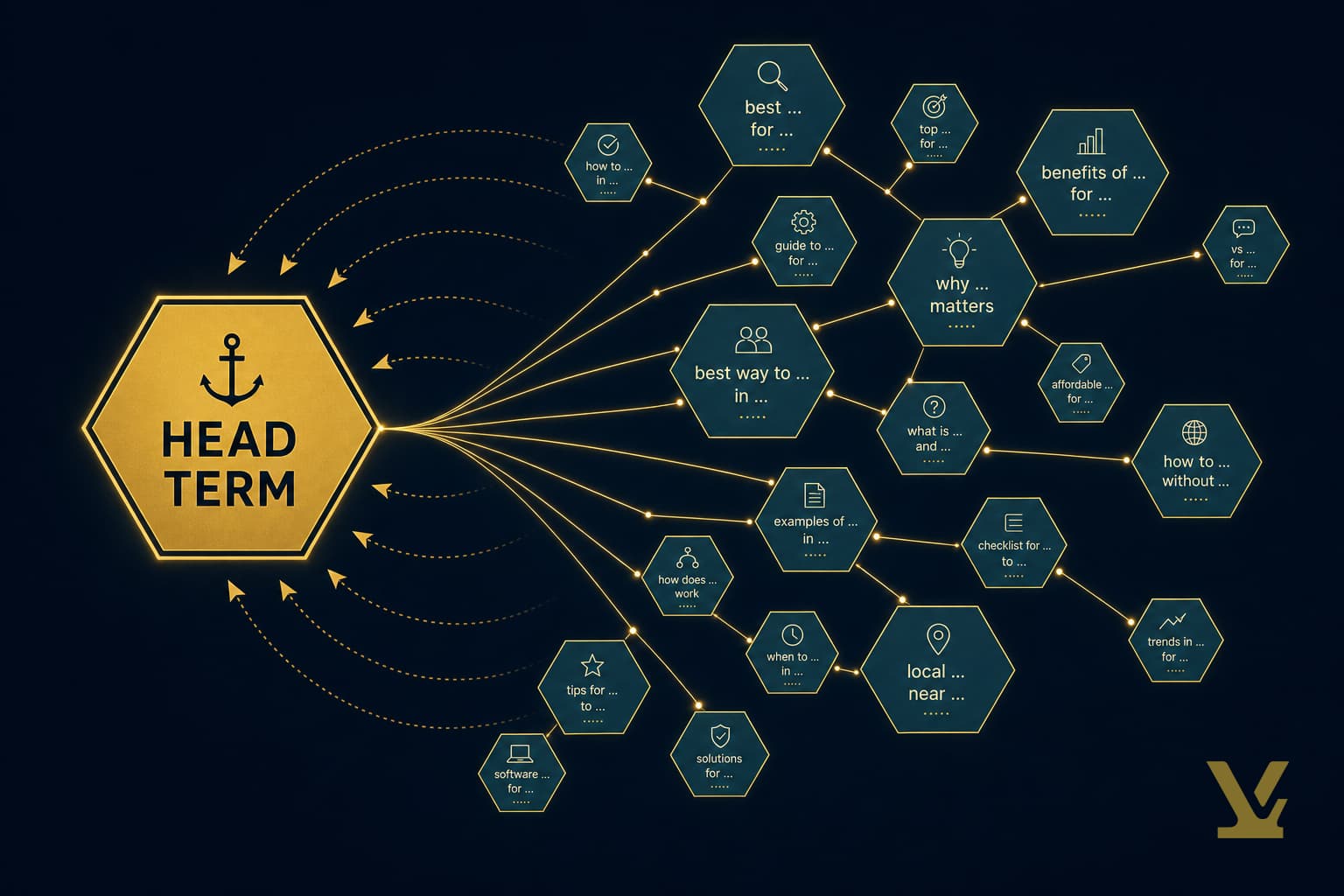
Most guides treat long-tail keywords as a tactic — easier to rank, lower competition, modest traffic per query. That framing buries the real value. The strategic case for long-tail is portfolio economics: head terms are anchor positions on the balance sheet; long-tail clusters are the compounding pipeline that collateralizes those anchors over time. Win a single long-tail SERP and you have a ranking. Own the cluster around it and you have a defensible asset. This article derives a Conversion Economics Score for prioritizing long-tail targets.
What are long-tail keywords? Clear definition and core characteristics
A long-tail keyword is a search query whose specificity narrows the population of likely searchers and crystallizes their intent. Length is the most visible proxy for that specificity, but it is not the definition. A three-word query like "buy used Trek bike" can be economically long-tail; an eight-word query like "what is digital marketing strategy 2026" often is not. The signal is specificity x intent depth, with length only the surface artifact. Semrush frames long-tail queries as precise and lower-volume; the more useful framing is that the searcher has already narrowed their decision space before typing.
The core characteristics flow from that definition: lower individual search volume, higher conversion intent, lower keyword difficulty, and a head-and-tail distribution where the long-tail collectively dwarfs head-term volume. The classic statement of this distribution is documented at length across the statistical literature on demand curves.
Concrete examples of long-tail keywords across niches
Six examples across niches:
- E-commerce: "women's waterproof hiking boots size 8 narrow" — product, fit, and use-case locked.
- SaaS: "how to export Stripe disputes to Google Sheets automatically" — signals tool stack.
- Local services: "emergency plumber open Sunday Brooklyn 11215" — time, location, urgency crystallized.
- Creator: "best DSLR for filming YouTube tutorials in low light under 1500" — budget and environment stated.
- B2B: "GDPR-compliant cookie consent banner for Next.js 15 App Router" — stack and compliance explicit.
- YMYL: "HSA-eligible expenses for orthodontia adult 2026" — eligibility, year, profile pinned down.
None are simply "longer." Each one has narrowed the decision space until the result page becomes a near-deterministic match. The signal is reduced ambiguity, not extra words.
Why long-tail keywords matter: portfolio economics, not just rankings

Treat the keyword universe as a portfolio. Head terms are anchor positions — high notional value, expensive to acquire, slow to compound, essential for category presence. Long-tail clusters are the compounding pipeline: each individual position is small, but the topical mass they accumulate collateralizes the head term you actually want to win. That portfolio logic isn't unique to organic keywords — the same long tail in digital marketing shows up in paid search, content topics, and SKUs.
This reframing changes the success metric. Ranking a single long-tail page is trivial. Owning the cluster — every reasonable variant interlinked into a topical hub — is the moat. Anyone can publish 200 long-tail posts. Building an interconnected cluster where every page reinforces the others requires intentional architecture. That is what topic cluster research is really about.
Three downstream consequences make the portfolio frame load-bearing:
- Compounding traffic. Cumulative volume across a long-tail cluster routinely exceeds the head term it sits under — no single user types the head query while a hundred users each type a unique tail variant.
- Lower paid-search competition. Long-tails have systematically lower CPCs because fewer advertisers bid on them. Ahrefs documents the volume-vs-competition curve directly.
- AI Overview citation surface. Generative results favor specific, intent-matched answers. Google notes that AI surfaces cite pages that answer narrow questions directly — the long-tail shape.
For stakeholders who read income statements, the frame is: head terms are revenue concentration risk; long-tail clusters are revenue diversification.
How long-tail keywords work: search intent, volume, and the cluster fan

Search engines treat long-tail not as a special category but as the natural shape of demand. Most studies of search-query distributions find the bulk of unique queries Google sees in a week are long-tail. Google Search Central instructs creators to write for the searcher, not the keyword — match the specific question, do not stuff the head term.
Three forces make long-tail tractable:
- Intent crystallization. A searcher typing "best CRM for solo real-estate agents under 30 dollars a month" has already filtered the result set in their head. Intent includes the unspoken already-eliminated set.
- Lower SERP-feature contention. Head terms attract PAA, knowledge panels, AI Overviews, and shopping carousels that compress organic real estate. Long-tails often have plain blue-link SERPs where a clear answer wins outright.
- Cluster fan effect. One head term has one query; the cluster around it has hundreds of fan-out variants. Sum the fan, not the head.
For classifying queries by intent and deciding which page they belong on, the Types of Keywords decision tree is the companion piece.
How to find long-tail keywords: a research workflow
The workflow below is intentionally tool-agnostic at the manual layer and tool-specific where premium tooling adds leverage. Follow it once on a single seed term to feel the shape, then operationalize it for a content sprint.
Manual techniques for discovering long-tail keywords
- Seed and expand. Start with a head term you would not realistically rank for in twelve months. Type it into Google with a trailing space and screenshot autocomplete.
- Mine People Also Ask. Click into one autocomplete result and harvest the PAA stack. Fifteen minutes usually yields 30+ candidate phrases.
- Pull Search Console. Filter queries to positions 8-30 and impressions above zero — pre-qualified long-tail targets Google already finds you relevant for.
- Read communities. Subreddits, Discords, and Quora threads phrase questions the way users phrase them. Verbatim copies become page headings.
- Reverse the SERP. Pull the top ten pages for a near-neighbor head term and extract every H2/H3. Duplicates reveal dominant intent; gaps reveal the opening.
Using premium tools to scale discovery
Manual discovery breaks at scale. Once you have more than a dozen seed terms, a premium keyword research tool collapses the workflow from days to hours. The pattern is the same regardless of vendor: seed > expand > intent-tag > prioritize > cluster.
A representative end-to-end run: enter five seed terms; export the long-tail expansion (typically 200-2,000 phrases per seed); auto-tag intent (informational, commercial, transactional, navigational); filter to keyword difficulty under your domain's earned threshold; cluster the survivors into 8-15 topical hubs; and export the result as an editorial calendar. For a deeper walkthrough, see building a content plan with one tool. For tool selection itself, the true-cost buyers guide covers what to evaluate beyond list price.
How to target long-tail keywords: the Conversion Economics Score

Most teams prioritize by "sort by volume, descending" — the wrong heuristic for long-tail. Use a Conversion Economics Score (CES) that captures the four levers that drive ROI:
CES = (Intent Depth x Cluster Fan Volume) / (Marginal Content Cost + Topical Drift Cost)
- Intent Depth (1-5): how decision-narrowed the query is. Transactional with stack and budget specified scores 5; generic informational scores 1.
- Cluster Fan Volume: sum of monthly searches for the cluster, not the keyword in isolation.
- Marginal Content Cost: hours-to-publish for the next page, accounting for templates, link reuse, and existing topical authority.
- Topical Drift Cost: how far the topic strays from your domain's core authority. Drifting too far costs ranking velocity.
Numerator high, denominator low — the publishing decision in one fraction. The model exposes its own assumptions, which is the actual benefit: when a stakeholder asks "why this keyword," the answer is no longer vibes.
Page-type decision follows directly from intent depth: how-to for informational, comparison for commercial-investigation, product detail for transactional, FAQ for question-shaped. Every long-tail page links up to its cluster anchor; the anchor links down to its three highest-CES spokes. The organic-growth playbook walks through the cluster-level linking pattern.
Measuring success and prioritizing what to refresh
Position is noisy at the long-tail (volatile, feature-poor SERPs), so the leading indicators sit upstream:
- Cluster coverage: percent of identified variants with a published page. Below 60% the cluster is incomplete and the head term has nothing to anchor against.
- Internal-link density: inbound links per cluster page. Below 2, the cluster is disconnected nodes, not a hub.
- Search Console impressions per cluster: fires before rankings or sessions move. Watch the slope, not the absolute number.
- Assisted conversions: long-tail pages sit upstream of purchase. Last-click attribution undervalues them; multi-touch catches the lift.
Refresh works the same way: re-run CES quarterly on the lowest-performing pages and let the score tell you where the marginal hour belongs.
Common mistakes and advanced tips for scaling long-tail coverage
Five failure modes recur across audits, and each one breaks the portfolio frame in a specific way:
- Cannibalization. Two pages targeting near-identical long-tails compete with each other, splitting link equity. Consolidate or de-duplicate.
- Volume worship. Picking long-tails by descending search volume ignores intent depth entirely. A 10/month query with crystallized buyer intent outearns a 500/month informational query.
- Cluster drift. Each new page strays a little further from the anchor topic until the cluster no longer reads as a coherent hub to either users or Google.
- Anchor neglect. Building the long-tail spokes without an authoritative head-term anchor leaves the cluster ungrounded. The fan needs something to fan from.
- Template dependence. Programmatic long-tail pages without genuine differentiation collapse under Helpful Content updates. Templates accelerate publishing — they do not substitute for original value.
How VarynForge fits in
Running CES against a real candidate list is the moment most teams stall — exporting from one tool, intent-tagging in a spreadsheet, and clustering by hand burns the wall-clock budget that should go to writing. VarynForge collapses seed-to-cluster into a single workflow: paste your seed terms, get intent-tagged long-tail expansions and pre-built topical hubs, and export the calendar with cluster anchors and spokes already wired. See VarynForge pricing if you want to make the prioritization step the cheap step.
Frequently Asked Questions
How do I find long-tail keywords for my specific niche?
Start with five seed terms drawn from your top-converting product pages. Run each through Google autocomplete, harvest People Also Ask, pull Search Console queries at positions 8-30, and read three relevant subreddit threads. A single-niche pass usually surfaces 50-150 candidate phrases before you open a paid tool.
What is the difference between long-tail and short-tail keywords?
Short-tail (head) keywords are broad, high-volume, intent-ambiguous queries like "shoes" or "CRM." Long-tail keywords narrow the searcher population and crystallize intent — "comfortable wide-fit running shoes for plantar fasciitis." Target head terms as portfolio anchors and long-tails as the compounding pipeline that collateralizes them.
How many long-tail keywords should I target per page?
One primary long-tail keyword as the H1 and meta-title anchor, plus three to seven semantically related variants distributed across H2s and body copy. Beyond seven, the page loses intent focus; below three, you leave cluster relevance on the table.
Do long-tail keywords still matter in 2026?
More than they did in 2018. AI Overviews and LLM search reward pages that answer specific questions directly — the long-tail target profile exactly. Generic head-term content is increasingly summarized rather than clicked; specific long-tail pages remain the citable primary sources AI surfaces link out to.
How do I measure whether my long-tail strategy is working?
Watch four leading indicators per cluster: coverage percent, internal-link density, Search Console impressions, and assisted conversions. Position-tracking tools are noisy at the long-tail and lag the real signal by weeks. Quarterly CES re-runs tell you where the next refresh hour earns the most.
What are common mistakes when using long-tail keywords?
Cannibalization, volume worship, cluster drift, anchor neglect, and template dependence — the five failure modes above. Each one breaks the portfolio thesis differently. Audit for them quarterly: a clean cluster is a defensible asset, a drifting one is editorial debt waiting to compound.
Further Reading
- Long-Tail Keywords: The Ultimate Guide for 2025 (Semrush)
- Long-tail keywords: why they deserve your focus (Yoast)
- Long-Tail Keywords: A Better Way to Think About Them (Ahrefs)
- What is a long-tail keyword (BrightEdge)
- The Long Tail (Wikipedia overview of the underlying distribution)
Sources
- Google Search Central — SEO Starter Guide
- Google — Generative AI in Search
- Semrush — Long-Tail Keywords Guide
- Ahrefs — Long-Tail Keywords
- Wikipedia — The Long Tail
Key Takeaways
Long-tail keywords are not just easier rankings — they are the mechanism that turns a list of pages into a defensible content asset. Define them by specificity and intent depth, not word count. Score targets with CES, not raw volume. Use head terms as anchors and long-tail clusters as the pipeline that collateralizes them. Audit quarterly for cannibalization, drift, and anchor neglect. The VarynForge blog collects the related playbooks.
For more on fast wins and a 90-day plan for getting more traffic, see our guide to how to get more traffic to your website.
Frequently asked questions
What are long-tail keywords?
Long-tail keywords are specific, multi-word search queries with lower individual volume but higher intent depth than head terms. They are the part of the demand curve where most real buying questions live, even though no single phrase generates large traffic on its own. The article rejects the common framing that they are simply easier to rank for. Long-tail keywords matter because they cluster around buying intent, which is where conversions happen, and because the cluster compounds in topical authority faster than scattered head-term wins.
Why do long-tail keywords matter for digital marketing?
Long-tail keywords matter because their value comes from portfolio compounding, not individual ranking. A single long-tail post rarely moves the traffic chart. A cluster of fifty long-tail posts, all anchored to the same head term and tightly internally linked, builds topical authority that lifts the head-term ranking, defends against competitor encroachment, and converts at much higher rates because each long-tail query is closer to a buying decision. The article argues this is the actual moat: owning the cluster, not winning a single SERP.
What is the Conversion Economics formula for long-tail keywords?
The Conversion Economics formula scores a long-tail target as intent depth multiplied by cumulative cluster volume, divided by marginal content cost plus topical drift cost. Intent depth captures how close the query is to a buying decision. Cumulative cluster volume captures the total demand across the related cluster, not just the single phrase. Marginal content cost is what producing the new post adds. Topical drift cost is what the post takes away from the cluster's coherence. Targets that score high on the numerator and low on the denominator earn a slot in the editorial calendar.
How are head terms and long-tail keywords related?
Head terms are anchor pages and long-tail keywords are the cluster nodes that collateralize the anchor. The article uses a specific structure: each head term has one anchor page, and the long-tail cluster around it consists of supporting articles, comparison posts, and conversion pages that link back to the anchor. The anchor inherits topical authority from every long-tail post that internally links to it. The long-tail cluster inherits trust from the anchor's external links. Head terms without a long-tail cluster never compound. Long-tail clusters without an anchor never convert at the head level.
How many long-tail keywords should be in a cluster?
There is no fixed number. The article frames the answer through the Conversion Economics formula: keep adding long-tail nodes while marginal content cost is below the cluster's incremental value, and stop when topical drift cost starts cannibalizing cluster coherence. In practice, most working clusters land between fifteen and fifty posts around an anchor before drift becomes the binding constraint. Past that point, the new posts dilute the cluster's signal rather than reinforcing it. The right size is the size where the next post no longer earns its slot on the formula.
Are long-tail keywords easier to rank than head terms?
Yes, but the article argues that ease of ranking is not why they matter. Lower competition is a side effect, not the value. The reason long-tail keywords win is that intent depth is much higher than at the head, so the same number of impressions converts at a higher rate. A long-tail post that ranks position one for a query nobody searches can still earn its slot if the intent is deep and the cluster benefits. A long-tail post that ranks easily but sits in a thin cluster with no anchor is a one-off, not a strategy.