Why SEO Is Important for Small Businesses and How to Start
Most small businesses treat SEO as a checklist. Frame it as the Small Business SEO Maturity Ladder and it becomes the cheapest channel you own.
SEO sounds expensive, slow, and technical. It is none of those for a small business that frames it correctly. Most owners treat it as a one-time checklist instead of a maturity progression. Reframe it, and SEO becomes the cheapest customer-acquisition channel you own.
This guide explains why SEO is important for small business owners and gives you a way to know which rung of the Small Business SEO Maturity Ladder you are on — four rungs from Invisible to Compounding, each with its own ROI signature. Most owners stall on rung two. The rest is about getting unstuck.
Why SEO is important for small business owners
SEO means showing up when a customer types your service into Google or asks an AI assistant. The reason it matters is intent. Per Think with Google, 76% of people who run a "near me" search on a phone visit a related business within 24 hours, and 28% of those visits result in a purchase. SEO does three jobs at once: it brings people to your door, it makes you look credible, and it compounds. Paid ads stop the day you stop paying. A page that ranks today keeps earning customers next quarter.
How SEO increases visibility and organic traffic
Higher rank means more impressions and more clicks. Position one captures roughly ten times the clicks of position ten per CTR studies. The high-value visibility lives in three places: the local map pack, the regular blue links, and AI Overviews. Per the 2025 SEMrush AI Overviews study, AI summaries cite local and service-business pages more often than national-brand pages on geographic queries. AI is not killing local SEO — it is helping you compete with the chains.
SEO builds trust, credibility, and brand awareness
Ranking is a credibility signal. Three SERP elements stack to create it: a complete Google Business Profile with reviews and photos, a fast website, and rich snippets pulled from your structured data — review stars, hours, FAQ answers (Google Search Central). When they line up, your listing fills more screen space than the competitor below you. Free billboard space.
Cost-effective customer acquisition and long-term ROI
Paid ads have a cost per click that does not get cheaper as you scale. SEO has a higher upfront cost in time, then the cost per visitor declines toward zero as the page ages. Spend 20 hours on one local landing page plus your Google Business Profile, and that page might bring 30 to 80 monthly visits within six months — with the cost per visit dropping every month it keeps ranking. Our guide on how to grow organic traffic without ad spend walks through the ratio for a service business.
Key benefits: more leads, better-quality traffic, competitive edge
- Higher-intent leads. People searching are looking for what you sell, at the moment they want it.
- Local market dominance. The map pack is winner-take-most for queries with local intent.
- Lower customer-acquisition cost over time, not at month one.
- Reduced ad dependency. SEO traffic insulates you from ad-account issues, algorithm shifts, or rising CPC.
- Free market research. Search Console queries tell you the exact words customers use to find you.
Stop treating SEO as a checklist: the Small Business Maturity Ladder

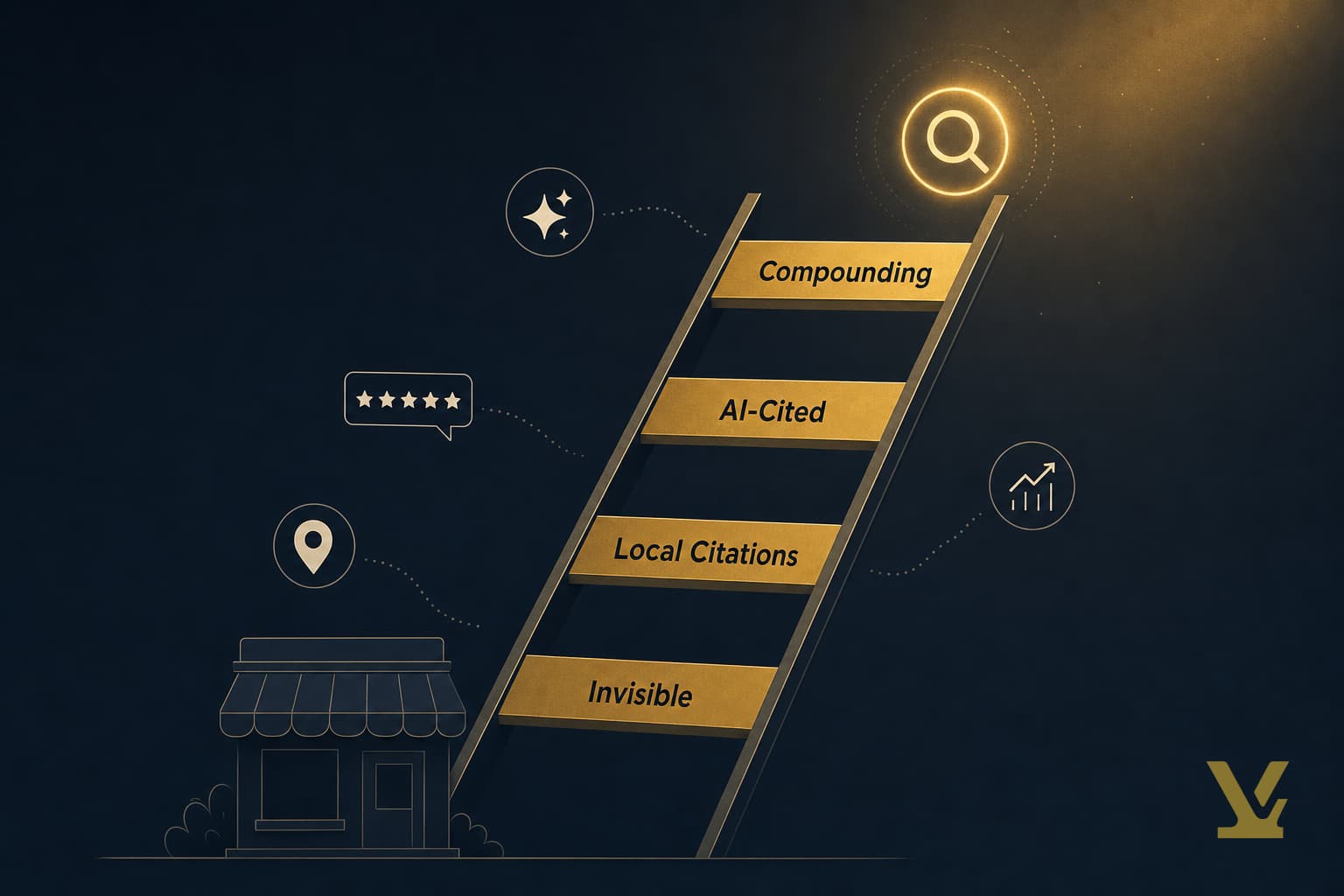
Most owners are missing this framework. SEO is not one project with a finish line. It is a four-rung ladder, and you only invest in the next rung once the current one pays off. Each rung has a distinct ROI signature, cost profile, and stall point. The four rungs:
- Rung 1 — Invisible. No website or an outdated one. No Google Business Profile. Cost to climb: 5 to 10 focused hours. ROI signature: any traffic is a win.
- Rung 2 — Local Citations. Verified GBP, listed on major directories, basic on-page SEO done. Cost: 10 to 20 hours plus review collection. ROI signature: GBP impressions and map-pack clicks start showing. Most owners stall here because they treat setup as the finish line.
- Rung 3 — AI-Cited. Service and location pages with structured data, a small content library answering real customer questions, citations earned by being the most useful answer. Cost: 20 to 40 hours of writing. ROI signature: branded queries rise, AI Overviews quote you.
- Rung 4 — Compounding. Full topic cluster, real internal linking, repeatable production. Cost: ongoing weekly time. ROI signature: organic flywheel, declining acquisition cost, traffic growing month over month with no ad spend.
The stall zone sits between rung 2 and rung 3. Owners see GBP impressions, assume the work is done, then conclude SEO does not work when traffic flatlines. SEO works. They just stopped climbing. If you cannot say which rung you are on this week, the answer is rung 1 — start there.
A practical 90-day SEO starter plan for small businesses
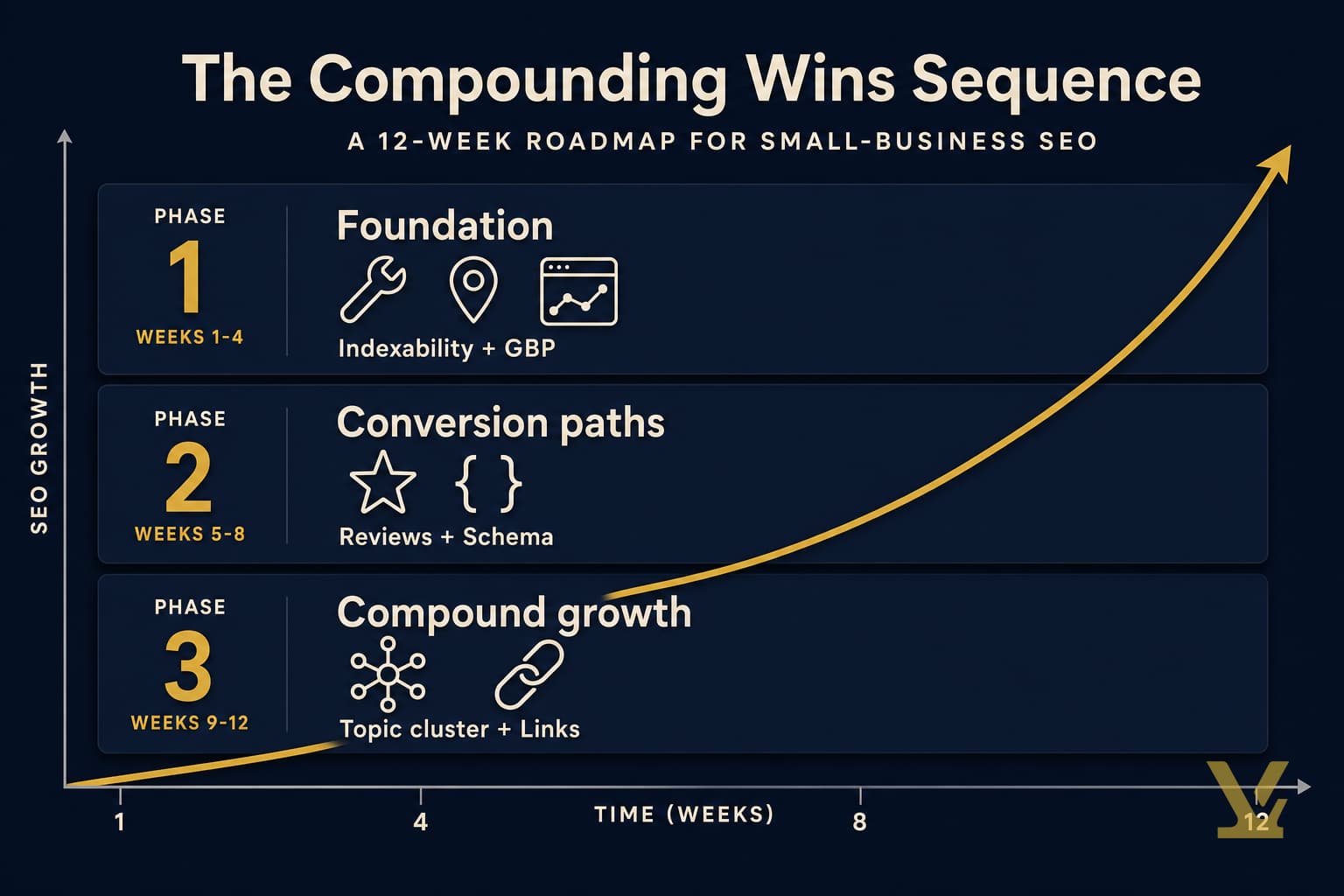
This plan moves you from rung 1 or rung 2 toward rung 3 in 90 days, working two to four hours a week. Order matters.
Days 1–30: Audit and quick wins. Claim and complete your Google Business Profile. Run your home page through PageSpeed Insights — over 60% of small-business traffic is mobile per Statista, so phone load speed is the priority fix (web.dev covers the targets). Install Google Search Console and Google Analytics. Submit your sitemap. Rewrite home-page title and meta description to include the service and city. Add LocalBusiness schema.
Days 31–60: Content and local proof. Publish two or three location-specific service pages targeting your top revenue services. Each page answers one customer question end to end. Ask five recent customers for a Google review with a direct review link. Add three photos a week to GBP.
Days 61–90: Measure and double down. Open Search Console weekly. Note queries you show up for but get no clicks on (rewrite those titles). Identify the page bringing in the most calls or form fills, then write one supporting article that links to it. Use our guide on how to build a content plan for the next ten topics.
Keyword research and content ideas for small businesses
The best keyword source for a small business is the customer service inbox. Pull the last 30 emails or call notes — the exact phrasing customers use is the exact phrasing they will type into Google. Layer that with three free tools: Search Console for queries you already partially rank for, Google's autocomplete for long-tail variants, and Google Trends to confirm a topic is not seasonal. Map each keyword to one of three page types: a service page (transactional), a location page (local), or a guide post (informational). One feeds the next — guide reads, then service page sells.
Our deeper writeup on types of keywords and intent covers the decision tree, and our piece on keyword research for topic clusters shows you how to group them into a publishing plan.
Local search is the cheapest revenue most owners ignore

If you serve customers in a physical area, local SEO is the highest-leverage rung on the ladder. Three things reinforce each other.
Google Business Profile. Set it up at google.com/business and complete every field — categories, service area, hours, products, photos, posts, Q&A. Per BrightLocal's 2024 Local Consumer Review Survey, 87% of consumers read online reviews for local businesses, and 76% trust them as much as personal recommendations. A complete profile with recent photos and 20+ four-star reviews routinely outranks a thin profile from a bigger brand.
Citations and NAP consistency. List your name, address, and phone on reputable directories (Yelp, Bing Places, Apple Business Connect, your local chamber). Same exact details on every site. One focused afternoon. Prioritize local first whenever a customer can buy from you in person — higher conversion, smaller competitive set, faster wins.
Measuring success: KPIs, tools, and when to expect results
Three KPIs matter. Anything else is dashboard theater.
- Calls and form fills attributed to organic search. Set this up in Google Analytics 4. Without it you cannot tell which channel paid for itself.
- Map-pack impressions and clicks. Visible inside GBP Insights. Trend monthly. A flat line for two months is the rung-2 stall signal.
- Top 10 priority keywords. The 10 phrases that would meaningfully change your business if you ranked. Track them in Search Console weekly.
When you outgrow free, our roundup of the best SEO tools for small teams covers the affordable next step. Realistic timelines: rung-1 to rung-2 in 30 to 60 days. Rung-2 stall break in 90 to 180 days. Compounding rung-4 returns at 12 months. Anyone selling you "rank in 30 days" is selling rung-2 results in a rung-3 wrapper.
Compare SEO to paid ads with the cost-per-customer curve

Plot cost per customer over 24 months for two channels. Paid ad cost per customer stays flat or rises as auctions get more competitive — search CPCs trend upward most years per Statista's search CPC tracker. SEO cost per customer starts higher in month one (you are paying yourself in time), crosses below the paid line around month six, and falls to a fraction of the ad curve by month 24. That crossover is the entire business case. You are not choosing between channels in month one — you are choosing what your cost structure looks like in month 24.
Frequently Asked Questions
How does SEO help small businesses get more customers and leads?
SEO puts your business in front of people who are already searching for what you sell, at the moment they are searching. A plumber ranking for "emergency plumber Tucson" meets customers at the second they want to spend. The combination of high intent plus low marginal cost is why SEO leads are typically more profitable than paid social leads.
What are the first three SEO tasks a small business should do this month?
In order: complete your Google Business Profile end to end, install Google Search Console and submit a sitemap, and rewrite your home-page title and meta description so they include the service and city you serve. Each takes under 90 minutes. Together they handle roughly 60% of rung-1 to rung-2 progress.
How long does it take for a small business to see SEO results?
Plan on 30 to 60 days for the first GBP-driven traffic, 90 to 180 days for first-page rankings on long-tail terms, and 12 months for compounding traffic that meaningfully grows the business. Map-pack impressions can spike in a week. Real revenue from organic search rarely shows in less than three months.
What local SEO steps should a brick-and-mortar business prioritize?
Claim and fully complete your Google Business Profile, get your first 10 reviews, audit your name/address/phone across the top 10 directories, add three photos a week to GBP, and write one location-and-service page (e.g. "AC repair in Phoenix, AZ"). Those five tasks move a typical brick-and-mortar from invisible to map-pack-visible in 60 days.
How VarynForge fits in
VarynForge is the SEO research workspace built for owners running rungs 2 through 4 without an agency. It pulls together keyword research, competitor outlines, content briefs, and the interlinking graph so you can see the whole climb in one place. Read more about VarynForge to decide if it fits your stage.
Further Reading
- 10 Reasons Why SEO Is Important for Small Businesses (Fort Lewis College)
- What Is SEO and Why Is It Important? (Digital Marketing Institute)
- Why Is SEO Important for Small Business? (Helium SEO)
- Local SEO: The Definitive Guide (Backlinko)
Sources
- Think with Google — Near-me search behavior
- SEMrush AI Overviews Study (2025)
- Advanced Web Ranking — Google CTR Study
- Google Search Central — Structured data
- BrightLocal — Local Consumer Review Survey 2024
- Statista — Share of mobile web traffic
- Google web.dev — Why page speed matters
- Statista — Search ad cost-per-click trends
Conclusion
SEO is not a 1,000-hour project that maybe pays off in two years. It is a four-rung ladder, and most small businesses can climb the first two rungs in 60 days of part-time work. Compounding starts at rung 3, the flywheel takes hold at rung 4, and no agency contract is required. Pick your rung this week. If you are at rung 1, complete the Google Business Profile this Saturday. If you are at rung 2 and traffic has plateaued, your next dollar belongs in one well-written service page. If you are at rung 3, write the supporting article that links to your top-performing page. The right move depends on the rung, and now you know which one you are on.
Frequently asked questions
How does SEO help small businesses get more customers and leads?
SEO puts your business in front of people who are already searching for what you sell, at the moment they are searching. A plumber ranking for emergency plumber Tucson meets customers at the second they want to spend. The combination of high intent plus low marginal cost is why SEO leads are typically more profitable than paid social leads. Per Think with Google, 76 percent of people who run a near-me search on a phone visit a related business within 24 hours, and 28 percent of those visits result in a purchase. SEO does three jobs at once: it brings people to your door, makes you look credible, and compounds.
What are the four rungs of the Small Business SEO Maturity Ladder?
Rung 1 Invisible: no website or an outdated one, no Google Business Profile. Cost to climb 5 to 10 focused hours; any traffic is a win. Rung 2 Local Citations: verified GBP, listed on major directories, basic on-page SEO done. Cost 10 to 20 hours plus review collection; GBP impressions and map-pack clicks start showing. Most owners stall here because they treat setup as the finish line. Rung 3 AI-Cited: service and location pages with structured data plus a small content library. Cost 20 to 40 hours of writing; branded queries rise and AI Overviews quote you. Rung 4 Compounding: full topic cluster, real internal linking, repeatable production. Ongoing weekly time produces an organic flywheel.
What are the first three SEO tasks a small business should do this month?
In order: complete your Google Business Profile end to end, install Google Search Console and submit a sitemap, and rewrite your home-page title and meta description so they include the service and city you serve. Each takes under 90 minutes. Together they handle roughly 60 percent of rung-1 to rung-2 progress. The Google Business Profile alone is the highest-ROI hour any service business will ever spend on SEO; complete every field including categories, service area, hours, products, photos, posts, and Q&A. Per BrightLocal, 87 percent of consumers read online reviews for local businesses.
How long does it take for a small business to see SEO results?
Plan on 30 to 60 days for the first GBP-driven traffic, 90 to 180 days for first-page rankings on long-tail terms, and 12 months for compounding traffic that meaningfully grows the business. Map-pack impressions can spike in a week. Real revenue from organic search rarely shows in less than three months. Realistic timelines mapped to the maturity ladder: rung-1 to rung-2 in 30 to 60 days; rung-2 stall break in 90 to 180 days; compounding rung-4 returns at 12 months. Anyone selling rank in 30 days is selling rung-2 results in a rung-3 wrapper.
What local SEO steps should a brick-and-mortar business prioritize?
Claim and fully complete your Google Business Profile, get your first 10 reviews, audit your name, address, and phone across the top 10 directories, add three photos a week to GBP, and write one location-and-service page like AC repair in Phoenix, AZ. Those five tasks move a typical brick-and-mortar from invisible to map-pack-visible in 60 days. NAP consistency means name, address, and phone in the same exact spelling on Yelp, Bing Places, Apple Business Connect, your local chamber, and other reputable directories. Inconsistent NAP confuses Google's local algorithm and quietly suppresses visibility.
Which three KPIs prove SEO is paying off for a small business?
Three numbers, anything else is dashboard theater. Calls and form fills attributed to organic search, set up in Google Analytics 4. Without that you cannot tell which channel paid for itself. Map-pack impressions and clicks, visible inside GBP Insights and trended monthly. A flat line for two months is the rung-2 stall signal. Top 10 priority keywords, the 10 phrases that would meaningfully change your business if you ranked, tracked weekly in Search Console. Move them up the SERP one at a time. Realistic checkpoints: GBP impressions in 14 to 30 days, first map-pack click within 60 days, first organic-attributed booked job by month 4.
Why does SEO get cheaper than paid ads over time?
Plot cost per customer over 24 months for two channels. Paid ad cost per customer stays flat or rises as auctions get more competitive, with search CPCs trending upward most years per Statista's search CPC tracker. SEO cost per customer starts higher in month one because you are paying yourself in time, crosses below the paid line around month six, and falls to a fraction of the ad curve by month 24. That crossover is the entire business case. You are not choosing between channels in month one; you are choosing what your cost structure looks like in month 24. Spend 20 hours on one local landing page plus your GBP, and that page might bring 30 to 80 monthly visits within six months.