What Is a Keyword in SEO? Types, Research, and Content Mapping
Learn what a keyword is in SEO, the four types that matter, a five-step research workflow plus a phone-friendly variant, and how to map them.
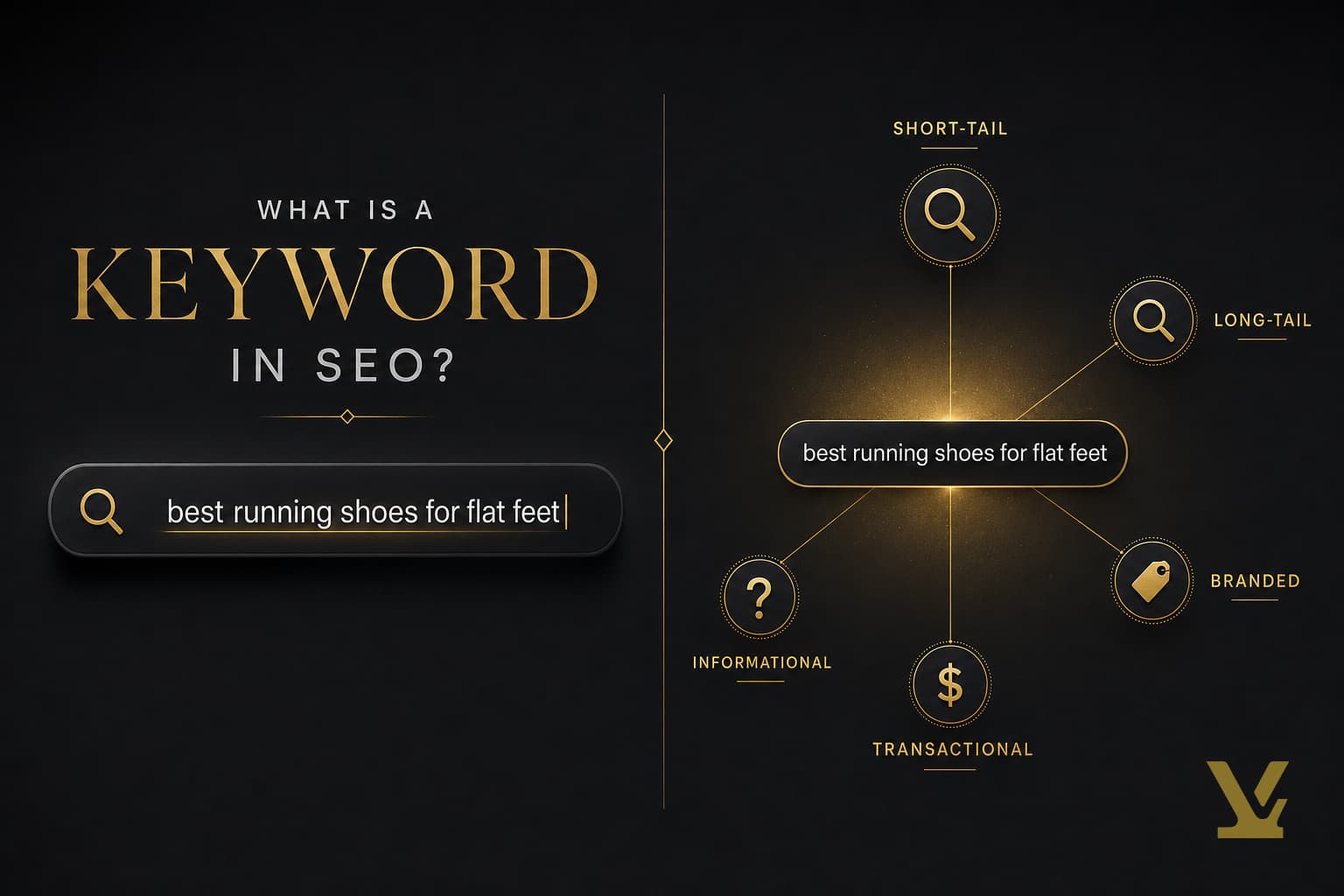
A keyword is the exact phrase someone types into a search engine. The answer to "what is a keyword in SEO" is simpler than most beginner guides admit: it is the bridge between a question in a searcher's head and a page that resolves it. Pick the bridge well and traffic compounds; pick it badly and you write articles nobody asked for. This guide gives you a working definition, the four keyword types that matter, a repeatable research workflow with a phone variant, and a mapping template that turns priorities into briefs the same afternoon.
What is a keyword in SEO: a clear definition and the four types that matter
A keyword in SEO is the search query a page is built to satisfy. Google's How Search Works documentation puts it plainly: the engine matches a query to pages that "have the same keywords as your search terms." That match is fuzzy — BERT and MUM read context, synonyms, and intent — but the typed phrase is still the anchor every signal hangs from. If you want the layer beneath this — what SEO itself means, in plain English, and a sustainable weekly time budget for it — start with our guide on what does SEO mean for small creators.
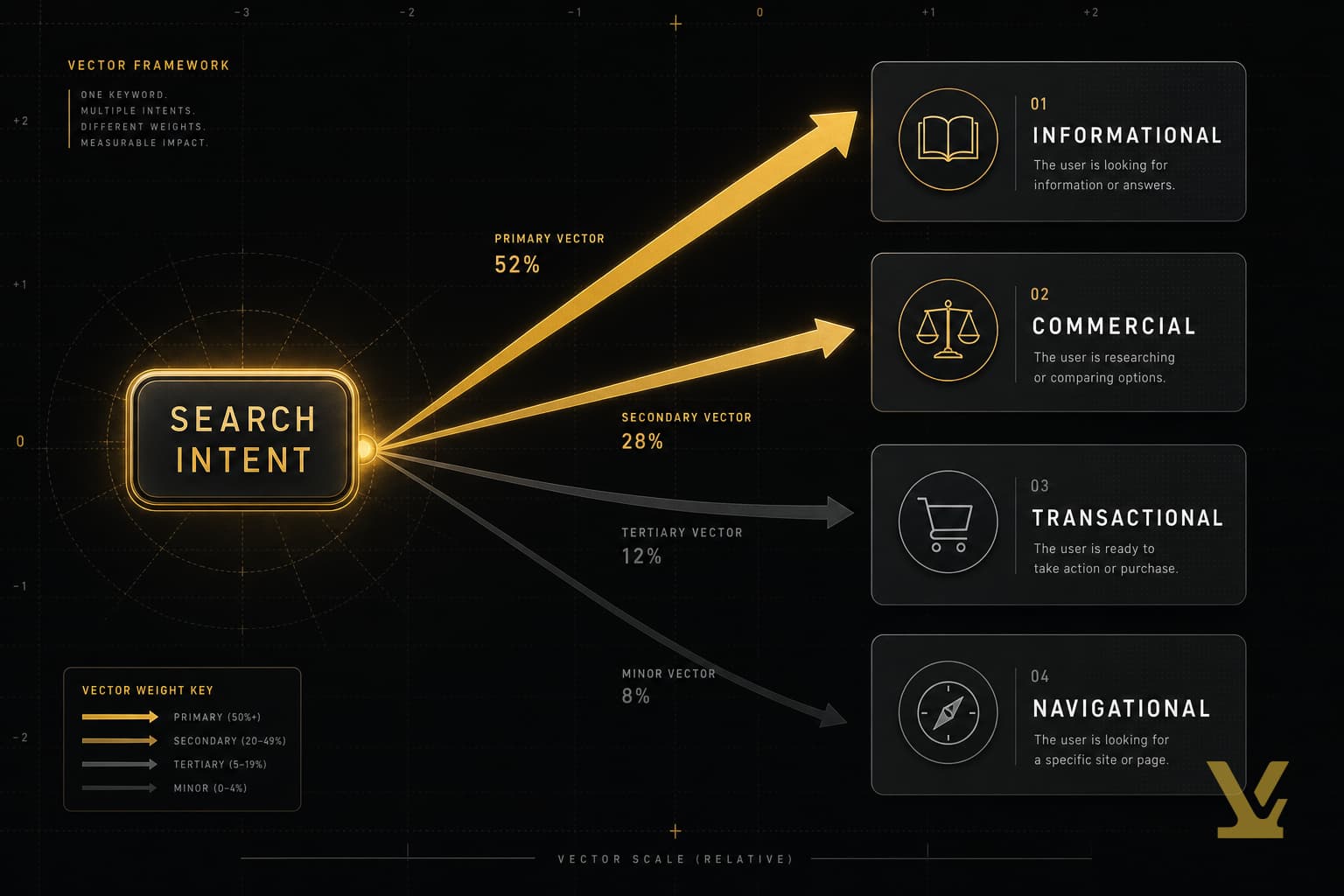
Most beginner guides list eight or nine "types" of keywords. In practice, four buckets cover everything you plan content around. The split below lines up with how Google's Search Essentials think about queries, translated into terms a content team speaks.
The four keyword buckets, with examples
- Informational (Know) - the searcher wants to learn. "what is a keyword", "how does seo work". Best served by guides and explainers.
- Commercial - the searcher is comparing options. "best keyword research tool", "ahrefs vs semrush". Best served by roundups and comparisons.
- Transactional (Do) - the searcher wants to act. "buy keyword research tool", "varynforge pricing". Best served by product and pricing pages.
- Navigational - the searcher already knows where they are going. "varynforge login", "google trends". Best served by branded landings and doc pages.
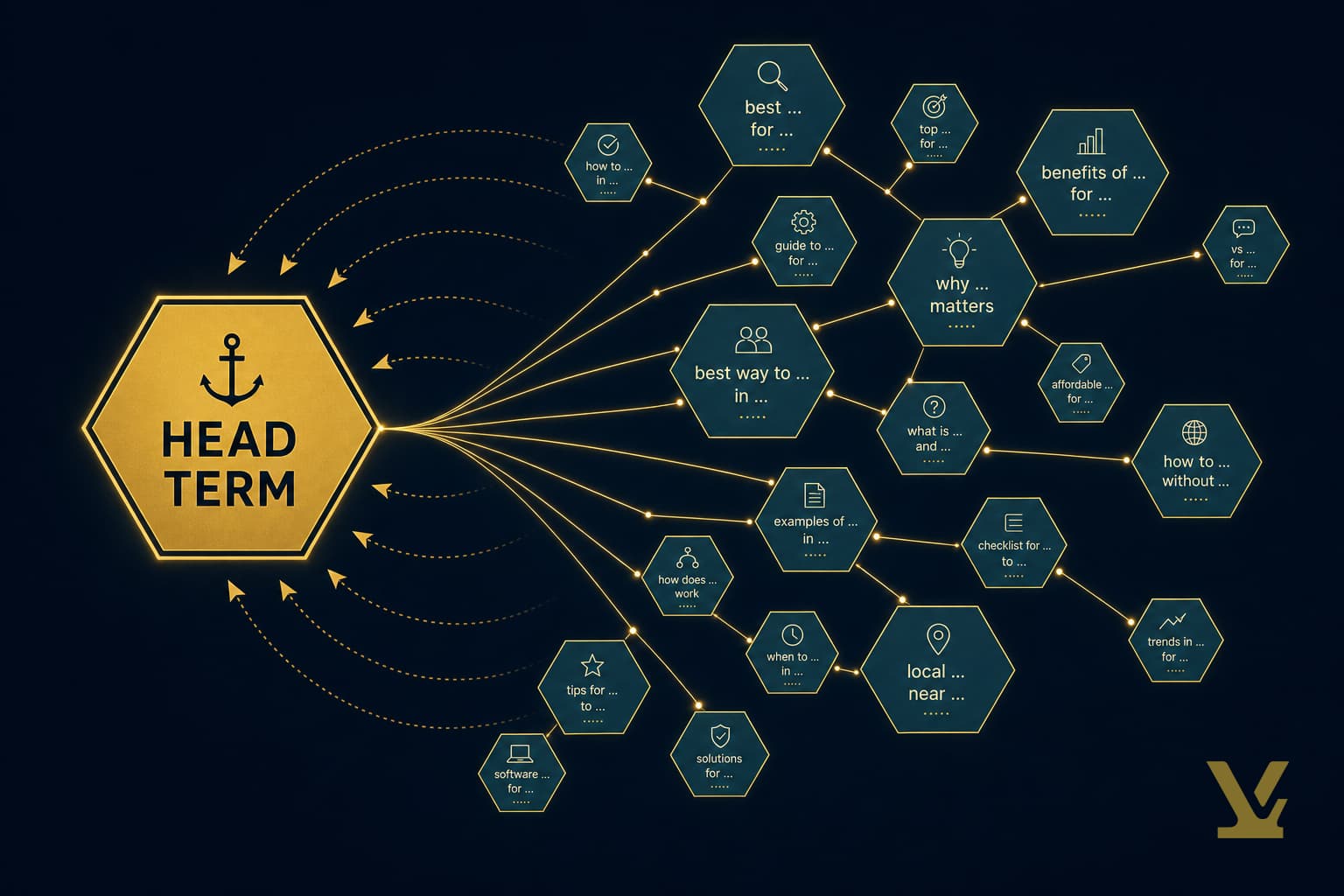
Two cross-cutting flavors sit on top. Short-tail keywords (one to two words, "running shoes") have huge volume and brutal competition. Long-tail keywords (four-plus words, "running shoes for flat feet under 100 dollars") are the opposite — Ahrefs analyzed 1.9 billion queries and found 95% of all keywords get fewer than 10 monthly searches, which is exactly where small sites win. For a deeper decision tree, see our types of keywords decision tree.
Why keywords matter: intent, SERPs, and rankings

Keywords matter because they are the only place a user's intent and your content meet on equal terms. Search engines do not read minds; they read queries and rank pages they predict will satisfy that query best. Pick a keyword whose intent your page does not match and no on-page tuning will rescue the ranking — Google's Helpful Content guidance is explicit that "people-first content created to satisfy a specific search intent" is the bar.
Three things change when you pick well. First, the SERP layout dictates format — if "best keyword tools" returns seven listicles, an essay-form post will not rank. Second, CTR compounds — Backlinko's analysis of 4 million SERPs shows position 1 averages 27.6% CTR while position 10 sits at 2.4%. Third, the keyword decides the link economy — commercial keywords earn backlinks at different rates than informational ones, which shapes off-page planning.
The practical lesson: highest-ROI keywords are rarely highest-volume. A long-tail query with under 50 monthly searches often outperforms a head term because the searcher already knows the problem and your page can resolve it specifically. Volume is a coarse signal; intent fit is the fine one.
Step-by-step keyword research workflow you can run today

A workflow turns a folder of spreadsheets into a calendar of briefs. The five steps below take roughly an hour the first time and produce a prioritized list of 15-25 target keywords with a one-line brief for each.
- 1. Define one specific business goal. Pick a single outcome — "double signups from organic search in Q3" or "rank top 10 for our pricing cluster". Vague goals produce vague lists.
- 2. Generate 10-20 seed keywords. Brainstorm what your best customer would type. Cross-reference Search Console > Performance > Queries and your support inbox.
- 3. Expand each seed into 5-10 variants. Use a tool's "matching terms" or "questions" report. Free options: People Also Ask, Reddit search, autosuggest. Paid tools speed this up by an order of magnitude — see our tool comparison.
- 4. Filter by intent and four metrics. For each candidate, capture intent, monthly volume, keyword difficulty, and the dominant SERP feature. Drop anything where intent does not match the page you can realistically build.
- 5. Prioritize with a value-effort score. Multiply (volume × intent fit × business value) and divide by KD. Sort descending. The top 15-25 become this quarter's content plan.
Each prioritized keyword leaves step 5 with a one-line brief: "Target: [keyword]. Format: [post type]. Intent: [bucket]. Thesis: [one sentence]." Anything that cannot fit on that line needs more research, not more writing. For a deeper version built around topic clusters, see our topic-cluster research guide.
On-the-go keyword research: a 5-step phone workflow
When inspiration strikes on a commute, a phone is enough. This compressed version skips the spreadsheet and produces 5-10 candidates to validate later at a desk.
- A. Type the seed into Google. Note the autosuggest entries — each is a real query.
- B. Scroll to People Also Ask. Tap two questions; the dropdowns surface adjacent intents.
- C. Open Reddit search. Search the seed plus your audience subreddit. Real users phrase queries differently than marketers.
- D. Capture in a single note. Five-keyword max. Anything more is a desk job.
- E. Review at the desk. Validate volume and difficulty in a real tool before promoting to your calendar.
Key metrics, tools, and AI without getting burned
Five metrics carry their weight. Search intent is qualitative — read the top 10 SERP and ask what format wins. Search volume is the monthly query count; treat it as a coarse band because tools disagree by 30-50%. Keyword difficulty estimates ranking effort on a 0-100 scale; below 30 is realistic for a new domain. CPC proxies commercial value. SERP features (snippets, AI Overviews) tell you whether you are competing for the blue link or for a different rectangle entirely.
On tools, categories matter more than brand names. Free workhorses include Google Search Console, Google Trends, and Reddit search. Mid-tier options like Mangools do 80% of what enterprise tools do at 20% of the cost. Ahrefs and Semrush earn their keep past 500 keywords per quarter or for client rank-tracking. For the full breakdown, see our true cost of keyword research tools.
AI-assisted keyword research is the newest category and the most error-prone. LLMs hallucinate search volumes, invent SERP features, and suggest "keywords" nobody actually searches. Use AI where it is strong — seed expansion, topical clustering, brief drafting — and verify volume, KD, and SERP shape against a real tool. Our take on AI SEO tools covers the failure modes and the human checks that catch them.
Mapping keywords to content: a template you can fill in this afternoon

A prioritized list is not a content plan until each keyword is mapped to a format. The mapping is determined by intent, not by your team's preferences. The template below pairs each bucket with the format that wins on the SERP today.
- Informational + short-tail - a long-form pillar guide of 1,500-2,500 words with clear H2 navigation. Example: "what is keyword research".
- Informational + long-tail - a focused 1,000-1,500 word post with a tight FAQ. Example: "how to find keywords for a new website".
- Commercial - a comparison post or roundup with a comparison table. Example: "best free keyword research tools".
- Transactional - a product, pricing, or category page. Example: "buy keyword research tool monthly plan".
- Navigational - a clean doc page or branded landing page; no marketing fluff. Example: "varynforge login".
Once each keyword has a format, write the brief: target keyword, supporting keywords (3-5), primary thesis, three required H2s, the unique angle (the thing the current top 10 are missing), and 2-3 internal links. That brief is the single source of truth a writer needs. For an end-to-end walkthrough of building a content plan from one keyword tool, see our one-tool content plan guide.
How VarynForge fits in
VarynForge collapses the keyword-to-brief loop into one workspace: you point it at a domain, it returns prioritized keywords with intent, volume, KD, and SERP shape, then drafts content briefs you can hand straight to a writer. If you want to skip the spreadsheets and start the workflow in this article from a populated content plan, see pricing and try it free.
Common keyword mistakes and the fixes that close them
Four mistakes account for almost every "we picked keywords and nothing happened" outcome. Each has a fix that takes less than an hour.
- Optimizing for volume, ignoring intent. Read the top 10 SERP for every target before assigning a writer. If the SERP is roundups and your draft is an essay, you are already losing.
- Treating KD as a hard cutoff. A weak SERP at KD 45 beats a strong SERP at KD 25. Look at the actual pages, not just the score.
- Stuffing the keyword. One focus keyword in the title, the first 100 words, and one H2; let synonyms appear naturally everywhere else.
- Publishing and forgetting. Track positions monthly, refresh quarterly, feed underperformers back into step 4. Compounding requires maintenance.
After publishing: connect Search Console, set a monthly cadence, and read our piece on organic traffic compounding vs bleeding to keep wins from leaking out.
Frequently Asked Questions
What is the difference between short-tail and long-tail keywords?
Short-tail keywords are one to two words with high volume and brutal competition; long-tail are four or more words, lower volume, and far easier to rank for. Ahrefs found 95% of all keywords get under 10 monthly searches. New sites should target long-tail first — cumulative traffic from many wins beats one head-term failure, and conversion is usually higher because the searcher is closer to action.
How do I determine search intent before writing?
Open the keyword in an incognito tab and read the top 10 organic results. If listicles dominate, intent is commercial. How-to guides mean informational. Product pages mean transactional. The SERP is ground truth — your hunch about intent matters less than what Google already rewards for that query.
What metrics do I need to prioritize keywords?
Four are enough: search intent (qualitative), monthly volume, keyword difficulty, and the dominant SERP feature. CPC is a useful fifth as a commercial-value proxy. Skip everything else your tool offers — chasing a dozen signals creates spreadsheet theater, not rankings, and slows your cycle from idea to brief.
Can AI generate useful keyword ideas?
Yes for seed expansion and clustering, no for volume and difficulty estimates. Treat AI suggestions as hypotheses to validate against a real tool. Hallucinated volumes are common — an LLM will confidently report "1,200 monthly searches" for a phrase with zero. Cross-check with Search Console, Google Trends, or a paid tool first.
How do I map a keyword to the right content type?
Match intent to format using the table above: informational gets guides, commercial gets comparisons, transactional gets product or pricing pages, navigational gets crisp doc pages. When in doubt, read the SERP — Google has done the matching for you. Your job is to produce a better version of the format already winning.
Further Reading
- What is a keyword? - Yoast SEO for beginners
- Keyword Research: The Beginner's Guide - Ahrefs
- How to Do Keyword Research - Squarespace
- Keyword Research for SEO: The Beginner's Guide - Mangools
- The Basics of Keyword Research - Iowa State CALS
Sources
- Google Search Central - How Search Works
- Google Search Central - Search Essentials and spam policies
- Google Search Central Blog - Helpful Content Update
- Ahrefs - 1.9 billion keywords analyzed: long-tail study
- Backlinko - Google Organic CTR Study (4M SERPs)
Key Takeaways
A keyword is the bridge between a searcher's intent and your page. Use four buckets — informational, commercial, transactional, navigational — to decide format. Run the five-step workflow once a quarter and the on-the-go variant whenever an idea strikes. Validate every AI suggestion against a real tool before it touches your calendar. Map every prioritized keyword to a one-line brief, and refresh underperformers monthly so traffic compounds instead of leaking. Do those five things and "what is a keyword in SEO" stops being a question and starts being a repeatable system.
For more on the basics of what SEO is and how search optimization works, see our guide to what SEO is.
Frequently asked questions
What is a keyword in SEO?
A keyword in SEO is the search query a page is built to satisfy. Google's How Search Works documentation puts it plainly: the engine matches a query to pages that have the same keywords as your search terms. That match is fuzzy because BERT and MUM read context, synonyms, and intent, but the typed phrase is still the anchor every signal hangs from. A keyword is the bridge between a question in a searcher's head and a page that resolves it. Pick the bridge well and traffic compounds; pick it badly and you write articles nobody asked for.
What is the difference between short-tail and long-tail keywords?
Short-tail keywords are one to two words with high volume and brutal competition, like running shoes. Long-tail keywords are four or more words, lower volume, and far easier to rank for, like running shoes for flat feet under 100 dollars. Ahrefs analyzed 1.9 billion queries and found 95 percent of all keywords get fewer than 10 monthly searches, which is exactly where small sites win. New sites should target long-tail first because cumulative traffic from many wins beats one head-term failure, and conversion is usually higher because the searcher is closer to action.
How do I determine search intent before writing?
Open the keyword in an incognito tab and read the top 10 organic results. If listicles dominate, intent is commercial. How-to guides mean informational. Product pages mean transactional. The SERP is ground truth: your hunch about intent matters less than what Google already rewards for that query. Pick a keyword whose intent your page does not match and no on-page tuning will rescue the ranking. Google's Helpful Content guidance is explicit that people-first content created to satisfy a specific search intent is the bar for ranking.
What metrics do I need to prioritize keywords?
Four are enough: search intent (qualitative), monthly volume, keyword difficulty, and the dominant SERP feature. CPC is a useful fifth as a commercial-value proxy. Skip everything else your tool offers because chasing a dozen signals creates spreadsheet theater, not rankings, and slows your cycle from idea to brief. Treat search volume as a coarse band because tools disagree by 30 to 50 percent. Keyword difficulty below 30 is realistic for a new domain. Multiply volume by intent fit by business value, divide by KD, and the top 15 to 25 candidates become your quarterly content plan.
Can AI generate useful keyword ideas for SEO?
Yes for seed expansion and clustering, no for volume and difficulty estimates. Treat AI suggestions as hypotheses to validate against a real tool. Hallucinated volumes are common: an LLM will confidently report 1,200 monthly searches for a phrase with zero. Cross-check with Search Console, Google Trends, or a paid tool first. Use AI where it is strong (seed expansion, topical clustering, brief drafting) and verify volume, KD, and SERP shape against a real tool before promoting any candidate to your editorial calendar. Skipping that human check is the most common AI keyword research failure mode.
How do I map a keyword to the right content type?
Match intent to format. Informational plus short-tail gets a long-form pillar guide of 1,500 to 2,500 words. Informational plus long-tail gets a focused 1,000 to 1,500 word post with a tight FAQ. Commercial keywords get a comparison post or roundup with a comparison table. Transactional keywords get a product, pricing, or category page. Navigational keywords get a clean doc page or branded landing with no marketing fluff. When in doubt, read the SERP because Google has done the matching for you. Your job is to produce a better version of the format already winning.